
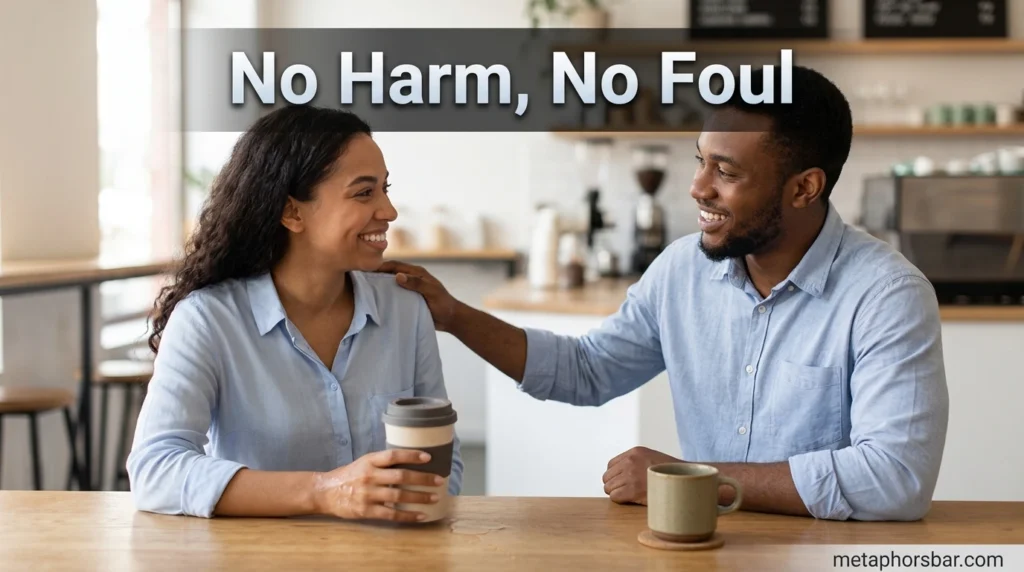
People often get confused by no harm, no foul because it sounds like a simple sentence, but it is actually an idiomatic expression with a special meaning. Many learners hear it in conversation, sports, movies, or casual writing and wonder whether it is literal, whether it needs a comma, or whether the phrase is used correctly in formal English. That matters in everyday speaking, writing, exams, and professional communication because idioms can sound natural and confident when used well, but awkward or unclear when used incorrectly.
The good news is that this phrase is easy to understand once you know the idea behind it. No harm, no foul means that if something did not cause real damage or serious trouble, then it is okay to let it go. In this article, you will learn the meaning, correct usage, punctuation, grammar rules, pronunciation, sentence examples, common mistakes, and memory tips so you can use no harm, no foul confidently.
What Does “No Harm, No Foul” Mean?
The phrase no harm, no foul means:
- no serious damage was done
- no one was really hurt
- the mistake is not serious enough to worry about
- the situation can be forgiven or ignored
It is often used when someone makes a small mistake, but the result is not important enough to argue about.
Simple meaning
Think of it like this:
- If there is no harm, then there is no foul
- If nobody was hurt and nothing bad happened, the matter is over
Examples
- “I bumped into your chair.”
“It’s okay, no harm, no foul.” - “Sorry I called you by the wrong name.”
“No harm, no foul.” - “I sent the message to the wrong person, but they didn’t mind.”
“Well, no harm, no foul.”
Tone
The phrase is usually:
- casual
- forgiving
- relaxed
- friendly
- often used to end a small disagreement
Comparison table: meaning of similar phrases
| Phrase | Meaning | Tone |
| no harm, no foul | no serious problem, so let it go | informal, forgiving |
| it’s okay | the mistake is acceptable | neutral |
| no big deal | not important | casual |
| don’t worry about it | no need to stress | friendly |
Key idea
The phrase is often used to stop a small issue from becoming a bigger one. It is a way of saying, “Nothing bad happened, so let’s move on.”
Where Did “No Harm, No Foul” Come From?
This phrase is strongly connected to sports, especially basketball in American English. In sports, a foul is a rule violation. The expression suggests that if no real harm was done, then the mistake should not be treated as a serious foul.
Why it became popular
The phrase moved from sports into everyday speech because it is:
- short
- memorable
- easy to understand
- useful for forgiving small mistakes
Origin summary table
| Element | Meaning |
| harm | injury, damage, trouble |
| foul | rule violation or wrongdoing |
| no harm, no foul | no damage, so no serious blame |
Why the phrase works well in English
It uses rhyme and rhythm:
- harm / foul
- short / strong / easy to remember
That makes it sound natural in conversation.
Practical note
The phrase is not meant to be read literally word by word. It is an idiom, so the whole phrase has a special meaning.
Correct Usage in Real Life
No harm, no foul is usually used in casual, conversational English when a mistake or misunderstanding turns out not to be serious.
Good situations for the phrase
- someone makes a small accident
- a mistake causes no real damage
- you want to forgive someone lightly
- you want to sound calm and friendly
Examples
- “I forgot to bring the book.”
“No harm, no foul. We can share mine.” - “I thought you said 3 o’clock, not 4.”
“No harm, no foul.” - “I deleted the wrong file, but it was only a backup.”
“No harm, no foul.”
Comparison table: best uses
| Situation | Suitable? | Example |
| small mistake | yes | No harm, no foul. |
| accidental confusion | yes | No harm, no foul, we fixed it. |
| serious injury or damage | no | no harm, no foul would be inappropriate |
| formal complaint | usually no | use more formal language |
Tone and style
The phrase often sounds:
- relaxed
- forgiving
- sometimes slightly playful
- not very formal
When not to use it
Avoid it when:
- the damage is serious
- someone has been hurt
- the situation is formal or legal
Examples of better alternatives:
- I’m sorry that happened.
- I hope everything is okay.
- I understand your concern.
- Let’s fix it.
Practical rule
Use no harm, no foul when the mistake is minor and the situation is truly not serious.
Grammar Rules and Punctuation
This phrase is an idiom and a short fixed expression. The grammar is simple, but the punctuation can confuse learners.
Basic structure
The standard form is:
No harm, no foul
The comma is commonly used to show the pause and rhythm of the expression.
Why the comma matters
The comma helps make the phrase easy to read:
- No harm, no foul.
Without the comma, it is still understandable in casual text, but the comma is the standard written form in polished English.
Grammar table: written forms
| Form | Status | Notes |
| no harm, no foul | standard | most common and recommended |
| no harm no foul | informal / less standard | often seen in casual writing |
| no-harm, no-foul | not standard | hyphens not normally used |
| no harm, nofoul | incorrect | wrong spacing |
Is it a full sentence?
It can function as a short sentence in conversation:
- “No harm, no foul.”
But it can also be part of a larger sentence:
- No harm, no foul, we fixed the problem quickly.
- There was a mistake, but no harm, no foul.
Comparison table: sentence use
| Use | Example | Function |
| stand-alone expression | No harm, no foul. | response |
| part of a sentence | It was an accident, but no harm, no foul. | explanation |
| with added detail | No harm, no foul, so we moved on. | transition |
Important note
Do not treat foul here as a normal adjective. It is part of the idiom and carries the meaning of a rule violation or offense in the figurative sense.
Sentence Examples: Correct and Incorrect Usage
Examples make the phrase much easier to understand.
Correct examples
- “I accidentally sent the text to the wrong group.”
“No harm, no foul.” - “I stepped on your shoe.”
“No harm, no foul.” - “I was a little late, but the meeting hadn’t started yet.”
“No harm, no foul.” - “I misheard your name.”
“No harm, no foul.”
More real-life examples
- A friend forgets to call back: “No harm, no foul.”
- Someone sends the wrong attachment, but fixes it quickly: “No harm, no foul.”
- A player accidentally bumps another player during a game: “No harm, no foul.”
Incorrect examples
- No harm, no fowl.
- No harm no foul.
- No harms, no foul.
- No harm, no fault.
Correct vs incorrect table
| Incorrect | Correct |
| no harm no foul | no harm, no foul |
| no harm, no fowl | no harm, no foul |
| no harms, no foul | no harm, no foul |
| no harm, no fault | no harm, no foul |
More examples of tone
- Friendly: “Oops, I forgot the keys.” “No harm, no foul.”
- Calm: “I sent the wrong file.” “No harm, no foul.”
- Casual: “I thought the train was at 8.” “No harm, no foul.”
A useful observation
This phrase is most natural when the speaker wants to reduce tension. It is less about the exact error and more about the result: if there was no real damage, the issue is closed.
Common Mistakes Learners Make
Learners often make the same errors with this phrase, especially because it is idiomatic.
Mistake 1: Misspelling “foul”
- Wrong: no harm, no fowl
- Right: no harm, no foul
2: Forgetting the comma
- Less preferred: no harm no foul
- Better: no harm, no foul
3: Using it in serious situations
If someone is injured or a real problem happened, this phrase can sound too casual or insensitive.
- Less suitable: “The car was badly damaged, but no harm, no foul.”
- Better: “I’m sorry that happened. Let’s work out the repair.”
4: Thinking it means “I did no harm”
It does not mean the action was harmless in every sense. It means that there was no serious negative result.
5: Overusing it
If used too often, the phrase can sound repetitive or dismissive.
Comparison table: mistakes and fixes
| Wrong | Correct |
| no harm, no fowl | no harm, no foul |
| no harm no foul | no harm, no foul |
| no harms, no foul | no harm, no foul |
| no harm, no foul in serious injury | use a more careful apology |
Easy memory tip
Remember:
- harm = damage
- foul = offense or violation
- together they mean: no damage, so no problem
That is the best way to avoid mistakes and use the phrase naturally.
Pronunciation, Style, and British vs American English
Pronunciation
The phrase is usually pronounced like:
- noh harm, noh fowl
The rhyme is part of what makes the idiom memorable.
Pronunciation table
| Word | Approximate pronunciation | Notes |
| harm | harm | clear and simple |
| foul | fowl | rhymes with “owl” |
| no harm, no foul | noh harm, noh fowl | natural rhythm |
Style
The phrase sounds:
- casual
- friendly
- forgiving
- somewhat American
- useful in everyday conversation
Comparison table: style choices
| Expression | Tone | Best use |
| no harm, no foul | informal, forgiving | casual conversation |
| it’s okay | neutral | everyday speech |
| don’t worry about it | friendly | reassurance |
| no problem | very common, neutral | most situations |
British vs American English
The phrase is especially common in American English, and many British speakers understand it, but they may use other expressions more often, such as:
- no problem
- it’s fine
- don’t worry about it
- no worries
Comparison table: regional use
| Variety | Commonness | Notes |
| American English | very common | especially in sports and casual speech |
| British English | understood, but less common | alternatives may be preferred |
| global English | recognized in many places | still informal |
Practical takeaway
There is no spelling difference between British and American English for this phrase, but its frequency and tone may feel more American and casual.
FAQs
Is “no harm, no foul” correct English?
Yes. It is a correct idiomatic expression.
Is the comma necessary?
It is strongly preferred in writing:
- No harm, no foul.
Can I use it in formal writing?
Usually not. It is better for casual conversation than for formal reports or serious messages.
What does it mean in simple words?
It means:
- no serious damage
- no real problem
- let it go
Is it rude?
Usually no, but it can sound too casual if the situation is serious.
Is “no harm, no foul” American English?
It is more strongly associated with American English, especially sports language.
Can I say “no harm, no foul” if someone is hurt?
No, not usually. If there is real harm, use a sincere apology and more serious language.
What are similar expressions?
- it’s okay
- no problem
- don’t worry about it
- no big deal
- all good
Can I write it without the comma?
You may see it that way, but no harm, no foul with a comma is the best written form.
Conclusion
The phrase no harm, no foul is a friendly, informal idiom that means if nothing serious happened, then let’s not worry about it. It is often used when a mistake or misunderstanding has no real negative result. The phrase is especially common in American English and in casual conversation.
Here is the easiest way to remember it:
- harm = damage or injury
- foul = offense or rule violation
- no harm, no foul = no damage, so no serious issue
- use it mainly in casual, forgiving, everyday English
So write:
- “I sent the wrong file.”
“No harm, no foul.” - “I forgot to bring the notes.”
“No harm, no foul.” - “I bumped your shoulder.”
“No harm, no foul.”
If you remember only one thing, remember this: the phrase means a small mistake did not cause real damage, so there is nothing serious to complain about. That simple rule will help you understand it, use it naturally, and recognize it whenever you hear or read it.