
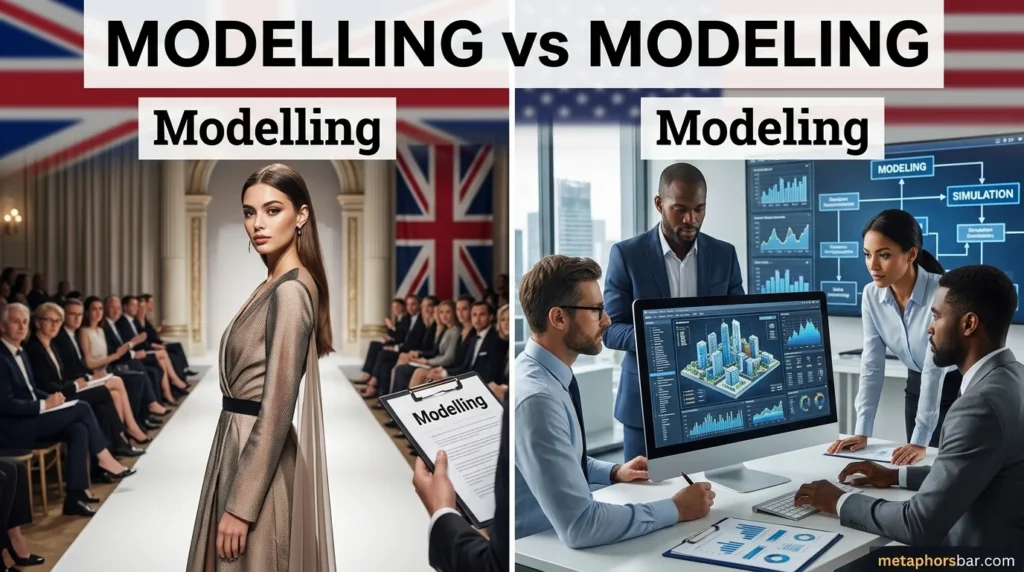
English learners often get confused by modelling vs modeling because the two words look almost the same and mean the same thing. The only visible difference is one extra l, but that small detail matters in writing, exams, school assignments, business communication, and professional documents. A spelling choice that is correct in one variety of English may look wrong in another, so writers often pause and wonder which form is best.
The good news is that this topic is very simple once you know the rule. Modelling is the preferred spelling in British English, while modeling is the preferred spelling in American English. Both words refer to the act of creating, shaping, or demonstrating a model, or to the profession of being a model. In this article, you will learn the meaning, correct usage, spelling differences, grammar rules, pronunciation, sentence examples, common mistakes, and easy memory tips so you can use both forms confidently.
What Do “Modelling” and “Modeling” Mean?
Both modelling and modeling mean the same thing. They are simply two spelling versions of the same word.
Main meanings
The word can mean:
- creating or making a model
- showing how something works
- being a fashion model
- representing something in a simplified form
- building a model for study, science, or design
Examples
- She is modelling a new dress for the show.
- He is modeling a new economic system.
- The company is modeling the product in 3D software.
- Scientists are modelling climate change.
What the word suggests
Depending on context, the word may refer to:
- fashion and appearance
- art and design
- science and mathematics
- data and simulation
- behavior or example-setting
Comparison table: meaning in different contexts
| Context | Meaning | Example |
| fashion | posing as a model | She is modelling clothes. |
| science | creating a simplified representation | They are modelling the weather. |
| design | building a model or prototype | The team is modeling the product. |
| behavior | showing an example | Parents are modelling good manners. |
Key idea
The meaning does not change between the two spellings. Only the spelling changes depending on the variety of English.
Which Spelling Is Correct: Modelling or Modeling?
Both are correct, but the correct form depends on where and how you are writing.
British English
- modelling
- modelled
- modeller
American English
- modeling
- modeled
- modeler
Spelling comparison table
| Variety | Present participle | Past tense | Person noun |
| British English | modelling | modelled | modeller |
| American English | modeling | modeled | modeler |
Simple rule
- Use modelling if you are writing in British English
- Use modeling if you are writing in American English
Why the spelling differs
The difference follows a common pattern in English:
- British English often doubles the final l
- American English usually does not double the final l in these cases
Related spelling pairs
| British English | American English |
| travelling | traveling |
| cancelled | canceled |
| jewellery | jewelry |
| modelling | modeling |
Practical tip
If your teacher, company, publisher, or country prefers one style, stay consistent with that style throughout your writing.
Grammar Rules Behind the Spelling
The word modelling/modeling is usually a verb form, but it can also function as a noun in some contexts.
As a verb
It often appears in progressive forms:
- am modelling / am modeling
- is modelling / is modeling
- are modelling / are modeling
- was modelling / was modeling
- were modelling / were modeling
Examples
- She is modelling for a fashion magazine.
- They are modeling the bridge in a computer program.
- He was modelling the clay into a shape.
- The team is modeling the data carefully.
As a noun
The word can also be used as a noun in some contexts:
- modelling = the activity or profession
- modeling = the activity or profession
Examples:
- Modelling is a competitive industry.
- Modeling is a competitive industry.
Grammar table: word forms
| Form | British English | American English |
| base verb | model | model |
| present participle | modelling | modeling |
| past tense | modelled | modeled |
| noun | modelling | modeling |
Important note
The grammar is the same in both varieties. The structure of the sentence does not change; only the spelling does.
Example structures
- She is modelling clothes.
- He is modeling behavior for students.
- The company has modelled the system.
- The researchers have modeled the system.
Practical rule
When you are forming the word, keep the spelling system of your chosen variety consistent from start to finish.
Sentence Examples: Correct and Incorrect Usage
Examples make the spelling difference much easier to remember.
Correct examples in British English
- She is modelling a red dress.
- The scientist is modelling the climate system.
- He has modelled the clay sculpture.
- The school offers a course in modelling.
Correct examples in American English
- She is modeling a red dress.
- The scientist is modeling the climate system.
- He has modeled the clay sculpture.
- The school offers a course in modeling.
More real-life examples
- British: “She is modelling for a fashion brand.”
- American: “She is modeling for a fashion brand.”
- British: “The architect is modelling the building in 3D.”
- American: “The architect is modeling the building in 3D.”
Incorrect examples
- She is modelling in American English.
This can be wrong if your document follows American spelling. - He is modeling in British English.
This can be wrong if your document follows British spelling. - They have modellled the system.
Too many l’s. - They have modeld the system.
Missing correct spelling.
Correct vs incorrect table
| Incorrect | Correct |
| modeling in British English | modelling |
| modellled | modelled / modeled |
| modeld | modeled / modelled |
| moddeling | modelling / modeling |
Another useful observation
In speech, most people will not notice the spelling difference because the pronunciation is very similar. But in writing, the difference matters a lot.
Common Mistakes Learners Make
Because the words sound the same, learners often make the same spelling mistakes again and again.
1: Mixing British and American forms in one text
- Wrong: She is modeling for a London brand, and she has modelled three outfits.
- Better: She is modelling for a London brand, and she has modelled three outfits.
- Or: She is modeling for a London brand, and she has modeled three outfits.
2: Doubling the wrong letters
- Wrong: modeling with one l in British English when the style guide wants modelling
- Wrong: modellling with too many l’s
3: Forgetting the spelling style of the audience
- Wrong in a British context: modeling
- Wrong in an American context: modelling
4: Assuming the meaning changes
The meaning does not change. Only the spelling does.
5: Overcorrecting
Some learners think one version is a mistake because they learned only one spelling. That is not true. Both are correct in the right context.
Common mistake table
| Wrong | Correct |
| modeling in British English text | modelling |
| modelling in American English text | modeling |
| modelleddd | modelled / modeled |
| moddeling | modeling / modelling |
Easy memory tip
Remember:
- British = double l
- American = single l
That simple pattern will solve most spelling problems.
Pronunciation, Style, and British vs American English
Pronunciation
The pronunciation is almost the same in both spellings.
- modelling → MOD-uh-ling
- modeling → MOD-uh-ling
The spelling difference does not usually affect how the word is spoken.
Pronunciation table
| Word | Approximate pronunciation | Notes |
| modelling | MOD-uh-ling | British spelling |
| modeling | MOD-uh-ling | American spelling |
| modelled | MOD-uhld | British past tense |
| modeled | MOD-uhld | American past tense |
Style
The British spelling often feels:
- slightly more formal in UK settings
- standard in British publications
- familiar in Commonwealth countries
The American spelling often feels:
- standard in US writing
- common in business, tech, and media in the United States
Style comparison table
| Feature | British English | American English |
| spelling | modelling | modeling |
| past tense | modelled | modeled |
| noun form | modelling | modeling |
| use in documents | UK style guides prefer it | US style guides prefer it |
British vs American English
The main difference is orthographic, not grammatical:
- modelling in British English
- modeling in American English
Practical takeaway
Choose the version that matches your audience, and keep it consistent. If you are writing for:
- a UK audience → use modelling
- a US audience → use modeling
FAQs
Is “modelling” correct?
Yes. It is correct in British English.
Is “modeling” correct?
Yes. It is correct in American English.
Which spelling should I use in school?
Use the spelling style your teacher or school prefers.
Which spelling is more common?
It depends on the country:
- modelling is more common in British English
- modeling is more common in American English
Do both words mean the same thing?
Yes. The meaning is the same. Only the spelling changes.
What is the past tense of modelling/modeling?
- British: modelled
- American: modeled
What is the noun form?
- British: modelling
- American: modeling
Is one spelling more correct than the other?
No. Both are correct in the right variety of English.
Can I mix them in one paragraph?
It is better not to. Use one style consistently.
Conclusion
The difference between modelling and modeling is simple once you know the rule. They mean the same thing, but they follow different spelling systems.
- modelling = British English
- modeling = American English
- modelled / modeled = past tense forms
- modelling / modeling = noun or verb form depending on context
So write:
- British: She is modelling clothes.
- American: She is modeling clothes.
- British: They have modelled the design.
- American: They have modeled the design.
If you remember only one thing, remember this: British English usually doubles the final “l,” while American English usually does not. That simple rule will help you spell the word correctly, keep your writing consistent, and sound more confident in school, work, and everyday English.