
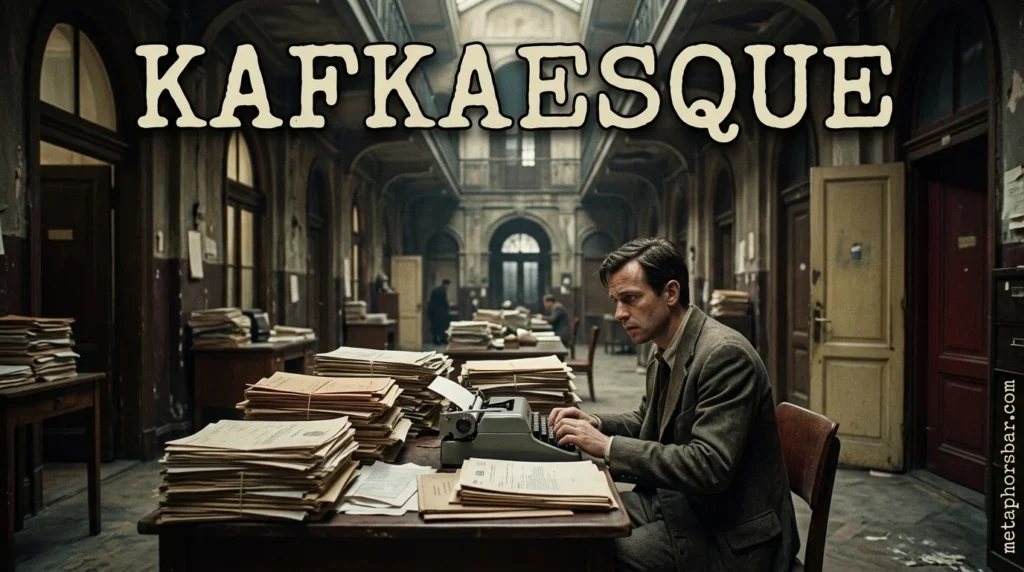
People often get confused by kafkaesque because it looks literary, sounds unusual, and carries a meaning that is bigger than the word itself. It is not a word people use for ordinary situations like “nice,” “busy,” or “expensive.” Instead, it describes something strange, frightening, confusing, and often controlled by an unfair system. That matters in everyday writing, speaking, exams, and professional communication because using kafkaesque correctly can make your English sound precise and intelligent, while using it loosely can make your meaning vague. Standard dictionaries define it as relating to Franz Kafka or his writings, especially something nightmarishly complex, bizarre, or illogical.
In simple English, kafkaesque means so confusing, oppressive, or absurd that it feels like a nightmare or like something from a Franz Kafka story. This article explains the meaning, correct usage, spelling, grammar, pronunciation, examples, and common mistakes in a clear, beginner-friendly way.
Meaning of Kafkaesque
The word Kafkaesque comes from the name of the Czech writer Franz Kafka, whose fiction is known for anxiety, alienation, absurdity, and characters trapped in strange systems they cannot understand or control. Britannica describes Kafka’s work as marked by anxiety and alienation, with characters facing absurd situations, and dictionaries connect the adjective directly to that literary atmosphere.
Simple definition
Kafkaesque = bizarre, frightening, confusing, and especially unfair or illogical in a way that feels like a Kafka story.
What the word suggests
A kafkaesque situation often includes one or more of these ideas:
- a complicated system that makes no sense
- a feeling of being trapped
- rules that seem absurd or impossible
- fear, stress, or helplessness
- a dark, surreal, dreamlike mood
Meaning comparison table
| Word | Core meaning | Tone |
| kafkaesque | bizarre, nightmarishly confusing, absurd, oppressive | literary, expressive |
| confusing | hard to understand | neutral |
| unfair | not just or not equal | neutral |
| surreal | dreamlike, strange | expressive |
| bureaucratic | connected to official systems and rules | neutral to formal |
A very simple way to think about it
If you can imagine a person stuck in endless paperwork, unclear rules, and a system that seems designed to frustrate them, kafkaesque may be the right word. Cambridge gives exactly this kind of example with a “Kafkaesque bureaucratic nightmare.”
Correct Usage: When to Use Kafkaesque
Use kafkaesque when you want to describe a situation, system, atmosphere, or experience that feels strangely oppressive, absurd, confusing, or nightmare-like. Cambridge defines it as extremely unpleasant, frightening, and confusing, especially when official rules and systems do not seem to make sense. Merriam-Webster similarly highlights something nightmarishly complex, bizarre, or illogical.
Correct uses
- The visa process became kafkaesque.
- He described the whole investigation as kafkaesque.
- The customer service system was so confusing that it felt kafkaesque.
- The office turned into a kafkaesque maze of forms and approvals
Best contexts for the word
- government paperwork
- legal systems
- complicated institutions
- strange workplaces
- stories or films with absurd, oppressive moods
- any setting that feels trapped in logic that is not logical
Correct usage table
| Context | Good example | Why it fits |
| bureaucracy | a kafkaesque passport delay | confusing official system |
| workplace | a kafkaesque HR process | unclear rules and helplessness |
| fiction | a kafkaesque nightmare | literary mood |
| daily life | a kafkaesque call-center experience | absurd and frustrating process |
When not to use it
Do not use kafkaesque for ordinary inconvenience. A long line, a delayed train, or a slow website is annoying, but not necessarily kafkaesque. The word is stronger and more specific than “bad” or “messy.”
Better alternatives when the meaning is weaker
If you only mean:
- annoying, use annoying
- confusing, use confusing
- slow, use slow
- inefficient, use inefficient
- unfair, use unfair
Use kafkaesque only when the situation has that surreal, oppressive, almost absurd quality.
Spelling Differences and Word Form
The standard spelling is Kafkaesque, with a capital K because it comes from the proper name Kafka. That spelling is how major dictionaries head the word.
Standard spelling
- Kafkaesque ✅
Common misspellings
| Incorrect | Correct |
| kafkesque | Kafkaesque |
| kafkaesq | Kafkaesque |
| kafka-esque | Kafkaesque |
| kafkaesque | Kafkaesque in dictionary-style writing |
| Kafkesque | Kafkaesque |
Why the spelling looks unusual
The word is built from the author’s surname Kafka plus the adjective ending -esque, which in English means “in the style of” or “resembling.” That ending helps explain why the word feels literary and descriptive.
Spelling comparison table
| Form | Status | Note |
| Kafkaesque | correct standard form | dictionary headword |
| kafkaesque | common in lowercased running text | often appears in casual writing |
| Kafka-esque | less standard | sometimes seen stylistically |
| kafkesque | incorrect | missing letters |
Capitalization note
Because the word is derived from Franz Kafka’s name, standard dictionary forms capitalize the K. That makes Kafkaesque the safest choice in essays, articles, and formal writing.
Grammar Rules: Part of Speech, Comparison, and Sentence Structure
Kafkaesque is an adjective. It describes a noun, just like strange, frightening, or oppressive. Cambridge and Merriam-Webster both label it as an adjective.
Grammar pattern
kafkaesque + noun
subject + be + kafkaesque
Examples:
- a kafkaesque nightmare
- a kafkaesque bureaucracy
- The situation was kafkaesque.
Can it be plural?
No. Adjectives are not pluralized in English. You do not say kafkaesques when describing more than one thing. Instead, the noun changes.
- one kafkaesque event
- two kafkaesque situations
- many kafkaesque scenes
Grammar table
| Grammar point | Correct form | Incorrect form |
| adjective before noun | kafkaesque system | kafkaesque systemses |
| adjective with be | the process was kafkaesque | the process were kafkaesque |
| plural noun | kafkaesque situations | kafkaesque situation |
| comparative use | more kafkaesque | kafkaesquest |
Can you compare it?
Yes, in everyday English people sometimes say more kafkaesque or very kafkaesque.
- The second interview became even more kafkaesque.
- The rules were very kafkaesque.
That does not mean the word has a regular everyday comparison pattern like “big, bigger, biggest.” It is still just an adjective, and comparative language is formed with more or less when needed.
Correct and incorrect examples
| Correct | Incorrect | Why |
| The appeal process was kafkaesque. | The appeal process was kafkaesquey. | wrong form |
| It felt like a kafkaesque nightmare. | It felt like an kafkaesque nightmare. | article error before consonant sound |
| The system became more kafkaesque. | The system became kafkaesquest. | wrong comparison |
| His explanation was kafkaesque. | His explanation kafkaesque. | missing verb |
British vs American English
There is no major meaning difference between British and American English for kafkaesque. Dictionaries in both traditions define it in essentially the same way: confusing, frightening, absurd, and often tied to oppressive official systems.
Regional comparison table
| Feature | British English | American English |
| meaning | same core meaning | same core meaning |
| spelling | Kafkaesque | Kafkaesque |
| use | literary, descriptive, critical | literary, descriptive, critical |
| common context | bureaucracy, frustration, absurdity | bureaucracy, frustration, absurdity |
Tone in both varieties
In both varieties, the word is:
- literary
- expressive
- slightly intellectual
- often used in criticism or analysis
Practical takeaway
You do not need a British version and an American version. The same spelling and meaning work in both. The only small difference you may notice is pronunciation detail. Cambridge gives a UK pronunciation of /ˌkæf.kəˈesk/ and a US pronunciation of /ˌkɑːf.kəˈesk/.
Pronunciation
The word is pronounced with the stress on the last syllable: -ESK. Cambridge gives UK /ˌkæf.kəˈesk/ and US /ˌkɑːf.kəˈesk/, while Merriam-Webster also shows pronunciation with stress at the end.
Pronunciation guide
| Variety | Pronunciation |
| UK | kaf-kuh-ESK |
| US | kahf-kuh-ESK |
Simple speaking guide
Say it like this:
KAF-kuh-ESK
or
KAHF-kuh-ESK
Pronunciation tips
- Stress the final syllable: ESK
- Keep the middle syllable light: kuh
- Do not say each part too heavily
- Try to connect the word smoothly in a sentence
Example in speech
- The paperwork turned into a kafkaesque mess.
- It felt almost kafkaesque to wait for approval for weeks.
Sentence Examples and Common Mistakes
Examples are the easiest way to learn this word well. The word usually appears with nouns like nightmare, bureaucracy, system, process, experience, or situation. That matches the dictionary sense of a strange, oppressive, or illogical atmosphere.
Correct examples
- The permit process was kafkaesque.
- She described the hospital bureaucracy as kafkaesque.
- The film creates a kafkaesque feeling of helplessness.
- His search for answers became a kafkaesque journey.
- The company’s approval system is so slow that it feels kafkaesque.
Incorrect examples
| Incorrect | Correct | Why |
| The situation was a kafkaesque. | The situation was kafkaesque. | adjective does not take “a” alone |
| The office was kafkaesques. | The office was kafkaesque. | adjective is not plural |
| She kafkaesque the process. | She described the process as kafkaesque. | wrong grammar |
| A kafkaesque coffee tasted bad. | A confusing coffee order tasted bad. | word used for the wrong kind of thing |
Side-by-side usage table
| Good use | Bad use |
| a kafkaesque legal battle | a kafkaesque sandwich |
| a kafkaesque waiting room | a kafkaesque birthday cake |
| a kafkaesque visa process | a kafkaesque pencil |
The word should describe a situation, system, atmosphere, or experience that feels absurd or oppressive, not just anything unpleasant. That is the core of the dictionary meaning.
Common mistakes learners make
- Using it for ordinary inconvenience
A delayed bus is annoying; it is not automatically kafkaesques. - Using it for any strange thing
Weird is too broad. Kafkaesques is darker, more oppressive, and more system-like. - Forgetting the literary flavor
The word comes from Kafka’s fiction, so it often works best in writing that wants a serious or reflective tone. Britannica’s description of Kafka’s work helps explain why. - Spelling it incorrectly
The safest form is Kafkaesque.
FAQs
What does kafkaesque mean in simple English?
It means very confusing, strange, frightening, and often unfair in a way that feels like a nightmare or a Kafka story.
Is kafkaesque a positive word?
Usually no. It is generally negative or at least unsettling. It suggests fear, absurdity, or oppressive confusion.
Is kafkaesque an adjective?
Yes. Dictionaries label it as an adjective.
Do you capitalize kafkaesque?
Standard dictionary headwords capitalize it as Kafkaesque because it comes from Kafka’s name.
What is an example of kafkaesque?
A classic example is a person trapped in an endless, confusing bureaucracy where the rules keep changing and nobody explains what is happening. Cambridge uses the example of a “Kafkaesques bureaucratic nightmare.”
Can I use kafkaesque in formal writing?
Yes, especially in essays, literary analysis, journalism, or analytical writing, but use it carefully. It is powerful, so it should match the situation accurately.
Is kafkaesque the same as surreal?
Not exactly. Surreal means dreamlike or strange, while kafkaesque usually adds the idea of oppressive, confusing systems and helplessness.
Conclusion
Kafkaesque is a vivid English adjective used for situations that feel bizarre, frightening, confusing, and often trapped in unfair or illogical systems. It comes from Franz Kafka’s writing, which is known for anxiety, alienation, and absurd situations, and dictionaries consistently connect the word to that literary background.
The easiest way to remember it is this: kafkaesque = nightmare-like confusion with a bureaucratic or absurd edge. Use it for a difficult visa process, a twisted legal system, a hopeless office maze, or any experience that feels strangely oppressive and impossible to explain. Keep the spelling Kafkaesque, stress the last syllable when you say it, and avoid using it for small everyday annoyances. Once you understand the tone, the word becomes a powerful tool for clear, expressive English.