
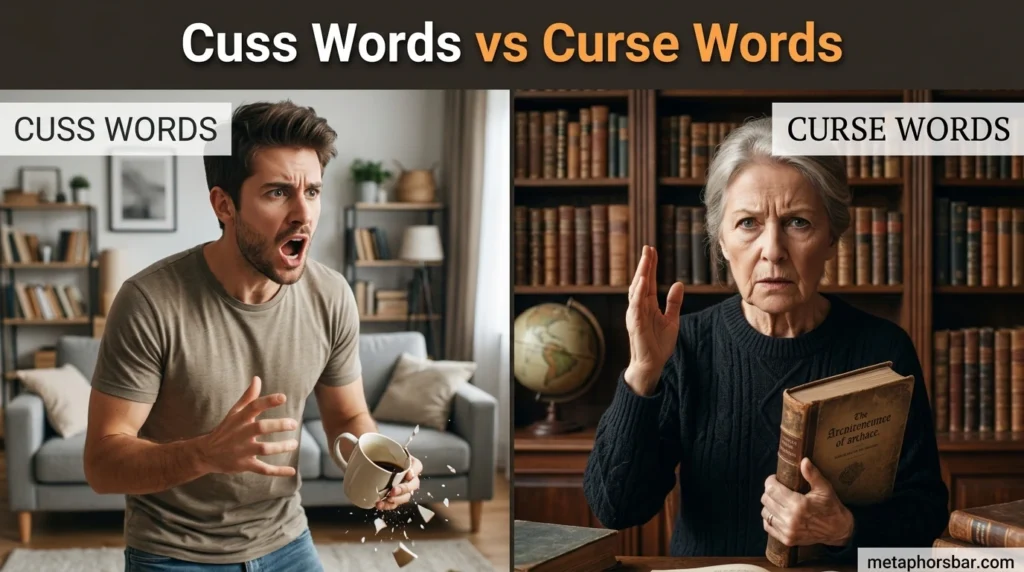
People often confuse cuss words and curse words because the two expressions point to the same general idea: rude, offensive, or taboo language. The confusion grows because cuss is strongly associated with American English and informal speech, while curse word and swear word are broader labels that dictionaries often use as synonyms. That matters in everyday writing, speaking, exams, and professional communication because choosing the wrong term can make your language sound too casual, too regional, or simply less precise. Cambridge, Merriam-Webster, and Oxford all show that these words overlap, but they do not behave exactly the same way in style and usage.
In simple terms, cuss words is an informal phrase, especially tied to American English, while curse words is a more general label for rude or offensive words. Swear words is also a very common equivalent, and many dictionaries list it as the main entry with curse word as a synonym, especially in American usage. This guide explains the meaning, correct usage, spelling, grammar, pronunciation, examples, and common mistakes in a clear, beginner-friendly way.
Meaning: What Do “Cuss Words” and “Curse Words” Mean?
A curse word is a rude, offensive, or obscene word used as an exclamation, insult, or expression of anger. Merriam-Webster defines curse word as “a profane or obscene oath or word,” and Oxford describes curse as a rude or offensive word or phrase used when angry. Cambridge’s swear word entry also points to curse word as a synonym, especially in American English.
Cuss words means the same general category of language in everyday speech, but the phrase is more informal and regionally marked. Cambridge defines cuss as a mainly US, old-fashioned, informal verb meaning to say words that are not polite because you are angry, and Oxford lists cuss and cussword as informal forms connected to rude or offensive language. That means cuss words is very natural in casual American speech, but it is less neutral than curse words or swear words.
Quick meaning table
| Term | Main meaning | Style | Regional feel |
| cuss words | rude or offensive words | informal | strongly American |
| curse words | rude or offensive words | neutral to informal | broader English |
| swear words | rude or offensive words | neutral | common in both UK and US |
| profanity | rude/offensive or blasphemous language | more formal | broad, especially in writing |
Simple memory tip
If you want a casual, very American-sounding phrase, cuss words fits. If you want a broader, more standard phrase, curse words or swear words is usually better.
Correct Usage: When to Use Each Expression
Use cuss words when you are writing or speaking casually, especially in American English, and when the tone is informal. Merriam-Webster and Cambridge both connect cuss with informal speech, and Oxford marks it as old-fashioned/informal. That makes cuss words acceptable in conversation, storytelling, or informal commentary, but less ideal for formal writing.
Use curse words when you want a general label that most English readers will understand. It works in casual speech, explanatory writing, and grammar discussions. It is also a safe choice if you want to avoid sounding too regional. Merriam-Webster and Oxford both treat curse word as a standard noun meaning a profane or obscene word.
Use swear words when you want the most common everyday term in many contexts. Cambridge defines swear word as “a rude or offensive word” and notes that curse word is especially the mainly US synonym. That makes swear word a strong all-purpose choice for learner-facing explanations.
Correct examples
- He got angry and started using curse words.
- The movie contains a few swear words.
- My grandfather says cuss words are rude.
- Please avoid profanity in the classroom.
Which one sounds most natural?
| Context | Best choice | Why |
| casual American speech | cuss words | informal and familiar |
| general English explanation | curse words / swear words | broader and clearer |
| formal writing | profanity / offensive language | more precise |
| classroom or exam writing | swear words / offensive words | standard and neutral |
Incorrect or awkward usage
- The teacher told us not to use cuss words in the essay. — possible, but too informal for many school contexts.
- The teacher told us not to use profane words in the essay. — understandable, but less natural than profanity or swear words.
- He shouted several curse words at the referee. — correct.
- He shouted several cuss words at the referee. — also understandable, but more informal and American-sounding.
Spelling Differences and Word Forms About cuss words vs curse words
The spelling difference is simple: cuss and curse are different words. Cuss is an altered form of curse, and Merriam-Webster explicitly gives cuss as an alteration of curse. That historical connection helps explain why the meanings overlap so much.
Spelling table
| Word | Standard spelling | Example |
| cuss | c-u-s-s | He started to cuss. |
| curse | c-u-r-s-e | He began to curse. |
| cuss word | two words or one in older forms | a rude word |
| curse word | two words | a rude word |
| swear word | two words | a rude word |
Word-form table
| Base word | Part of speech | Example |
| cuss | verb / noun | He cussed loudly; an awkward cuss |
| curse | verb / noun | He cursed under his breath; a curse word |
| swear | verb / noun | She swore; a swear word |
Common spelling mistakes
| Incorrect | Correct |
| curss word | curse word |
| cuse word | cuss word / curse word |
| cussworde | cussword / cuss word |
| curse wordses | curse words |
| sweare word | swear word |
Notes on “cussword”
Merriam-Webster lists cussword as a noun meaning swear word or a term of abuse. Oxford also lists cuss as an informal noun for a rude or offensive word. However, in modern everyday writing, cuss word and swear word are usually clearer and more natural than the closed compound cussword.
Grammar Rules: Singular, Plural, and Sentence Structure
Both expressions behave like ordinary noun phrases. You can use them with articles, adjectives, and plural forms, just like other countable nouns. The core phrase is usually cuss word or curse word, and the plural is cuss words or curse words.
Singular and plural
| Form | Correct example |
| singular | a curse word |
| plural | curse words |
| singular | a cuss word |
| plural | cuss words |
Grammar patterns
- a + curse word / cuss word
- He used a curse word.
- She muttered a cuss word.
- plural noun phrase
- The film has several curse words.
- The children repeated some cuss words.
- adjective + noun
- mild swear words
- offensive curse words
- rude cuss words
Grammar comparison table
| Structure | Correct | Incorrect |
| article + noun | a curse word | a curse words |
| plural noun | curse words | curse wordes |
| adjective + noun | rude swear words | rudely swear words |
| verb use | He cursed at them | He curse at them |
Correct and incorrect examples
- Correct: The actor apologized for using curse words during the interview.
- Incorrect: The actor apologized for using curse word during the interview.
- Correct: My uncle tends to cuss when he is frustrated.
- Incorrect: My uncle tends to cusses when he is frustrated.
- Correct: The teacher asked students not to swear in class.
- Incorrect: The teacher asked students not to swear words in class.
A useful distinction
- cuss is a verb when it means “to swear”
- curse is also a verb when it means “to use rude language”
- curse can also mean to wish harm on someone or something, which is a different sense entirely. Merriam-Webster and Cambridge both show this difference.
British vs American English About cuss words vs curse words
This is where the difference becomes more practical. Cuss words is especially associated with American English and informal speech. Cambridge labels cuss as mainly US, old-fashioned, and informal. That makes cuss words feel very American and conversational.
In British English, swear words is often the most natural everyday term. Cambridge defines swear word directly and notes curse word as “also mainly US,” which suggests curse word is especially familiar in American usage, while swear word functions as the broader term across English varieties. Oxford also uses swear word as the main learner entry.
Regional comparison table
| Phrase | British English | American English | Style |
| cuss words | uncommon | common | informal, regional |
| curse words | understood | common | neutral to informal |
| swear words | common | common | neutral |
| profanity | common in formal writing | common in formal writing | formal |
Practical takeaway
If you are writing for a broad audience, swear words or curse words is usually safer than cuss words. If you are writing dialogue for an American character or a casual American setting, cuss words may sound more natural.
Pronunciation About cuss words vs curse words
1Pronunciation is straightforward, but it helps to know the difference in rhythm and stress.
Pronunciation table
| Word | Pronunciation | Simple sound |
| cuss | /kʌs/ | “kuss” |
| curse | /kɜːrs/ in US, /kɜːs/ in UK-style notation | “kers” |
| swear | /swer/ | “sware” |
| profanity | /prəˈfæn.ə.ti/ | “pruh-FAN-uh-tee” |
Pronunciation tips
- cuss is short and sharp.
- curse has a stronger vowel and a final -se sound.
- swear rhymes with air.
- profanity is longer and more formal sounding.
Why pronunciation matters
Since cuss and curse sound different, speakers often choose them based on style, not just meaning. Cuss can sound more folksy or informal, while curse sounds more standard and widely understood in writing.
Sentence Examples, Side-by-Side Comparisons, and Common Mistakes
Examples make the difference very clear. Use cuss words when the tone is informal and especially American; use curse words or swear words when you want a more general or standard phrase. Oxford and Cambridge both show that these are rude/offensive words, but the label and style vary.
Side-by-side usage table
| Cuss words | Curse words |
| My dad hates cuss words. | My dad hates curse words. |
| The child picked up a few cuss words. | The child picked up a few curse words. |
| Try not to use cuss words in class. | Try not to use curse words in class. |
| He muttered some cuss words under his breath. | He muttered some curse words under his breath. |
More natural sentence examples
- The movie was edited to remove the swear words.
- She apologized for using curse words in front of the guests.
- He said a few cuss words after stubbing his toe.
- The article warns readers about strong profanity.
Correct and incorrect examples
| Correct | Incorrect | Why |
| He used curse words in anger. | He used curse word in anger. | plural needed |
| She swore at him. | She swear at him. | wrong verb form |
| The film has a lot of swear words. | The film has a lot of swore words. | wrong noun form |
| He cussed loudly. | He cuss loudly. | past tense needed |
Common mistakes learners make
- Using “curse” when you mean “curse someone”
This is a different sense. To curse can mean to speak offensively, but it can also mean to wish harm on someone or something. Context decides the meaning. - Thinking “cuss words” is the formal term
It is not. Dictionaries label cuss as informal and mainly US. - Using the wrong singular/plural form
Say a curse word, some curse words, a cuss word, or some cuss words. - Using a stronger term than necessary
In school or workplace writing, offensive language or profanity may sound more appropriate than either casual phrase. Oxford defines profanity as swear words or religious words used disrespectfully.
FAQs About cuss words vs curse words
Are cuss words and curse words the same?
They overlap in meaning, but they are not identical in tone. Cuss words is more informal and American; curse words is broader and more standard.
Which is more polite: cuss words or curse words?
Neither is truly polite, because both refer to rude language. If you want a more neutral term, use swear words or profanity, depending on the context.
Which term should I use in school writing?
Usually swear words, profanity, or offensive language works better than cuss words because it sounds more neutral and formal.
Is cuss an actual word?
Yes. Merriam-Webster and Cambridge both recognize cuss as a verb, and Oxford also lists cuss and cussword in related entries.
Is curse word used in British English?
Yes, it is understood, but swear word is often the more common everyday label in British English and in learner dictionaries.
Can I write “cuss words” in formal English?
You can, but it usually sounds too casual. In formal writing, profanity or offensive language is usually better.
Conclusion About cuss words vs curse words
Cuss words and curse words point to the same general idea: rude, offensive, or taboo language. The main difference is style. Cuss words is more informal and especially American, while curse words is a broader, more standard label. Swear words is also very common and often the safest all-purpose choice in neutral writing. Dictionaries from Cambridge, Merriam-Webster, and Oxford all show this overlap, while also revealing the regional and stylistic differences that matter in real usage.
A good way to remember the difference is this: cuss words sounds casual; curse words sounds general; swear words sounds neutral. If you are writing for school, work, or a broad audience, prefer swear words, curse words, or profanity. If you are writing informal American dialogue, cuss words can fit naturally. Once you know the tone you want, the correct choice becomes easy.