
The earth is always speaking, even when we are too busy to listen. It speaks through the weight of soil after rain, the smell of turned ground in spring, the firmness beneath our shoes, the patient strength of mountains, and the quiet pulse of roots moving unseen below the surface. Earth is not only a place we live on. It is a force that holds, feeds, shelters, and remembers.
That is why metaphors for earth matter so much. Earth is one of the richest symbols in language because it can stand for stability, home, fertility, growth, endurance, and the cycle of life itself. A good metaphor can turn the earth into a body, a mother, a foundation, a book, a cradle, or a quiet giant. It can make the abstract feel physical and the familiar feel newly alive.
Whether you are writing poetry, fiction, a speech, a social media caption, or a reflective essay, metaphors for earth can make your words feel grounded, deep, and memorable.
Why Metaphors for Earth Matter in Writing and Reflection
They help make a vast idea feel human
Earth is enormous, ancient, and impossible to fully hold in one sentence. A metaphor gives it shape the mind can touch.
They connect us to life and belonging
The earth is where things grow, rest, and return. Metaphors can capture that emotional sense of origin and connection.
They make writing more memorable
A sentence like “the land was beautiful” is clear. A sentence like “the land was a patient hand holding the sky” lingers much longer.
Three Powerful Metaphors for Earth
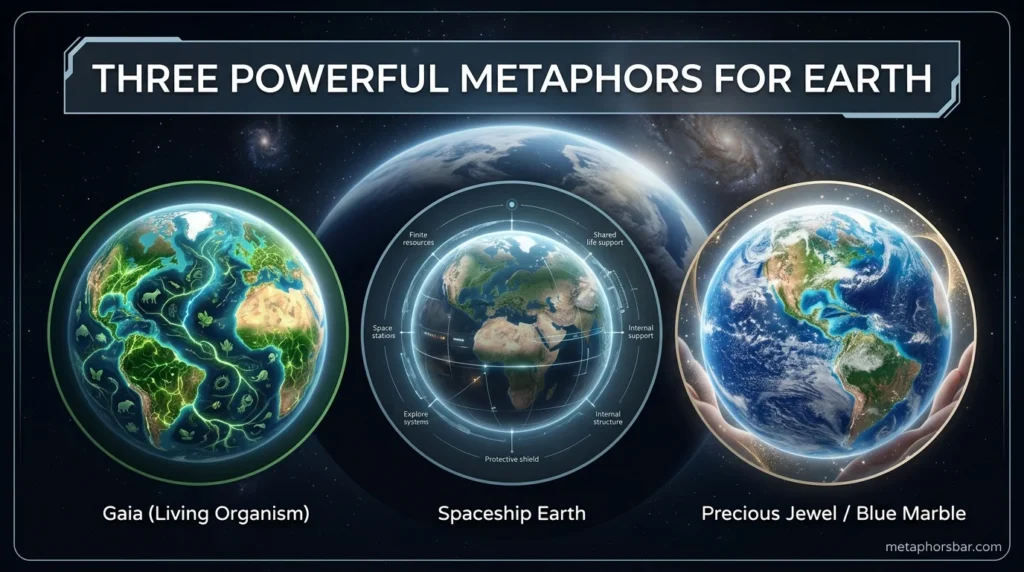
1. Earth as a Mother
One of the oldest and most powerful metaphors for earth is the image of a mother. Earth gives, nourishes, protects, and sustains life. Like a mother, it receives seeds, supports growth, and welcomes what returns to it. This metaphor is especially useful when you want the earth to feel loving, life-giving, and deeply connected to human existence.
Meaning and explanation
When earth is compared to a mother, the image emphasizes care, nourishment, and creation. A mother carries, feeds, and shelters; the earth does the same in its own great and ancient way. It holds the roots of trees, the homes of animals, the water that passes through it, and the bodies that one day return to it. This metaphor is especially powerful because it brings warmth and tenderness to something immense.
The mother image also suggests patience. Earth does not rush growth. It waits. It supports, It allows life to unfold in its own time. That makes it a beautiful metaphor when you want to describe earth as a source of quiet and constant generosity.
Example sentence or scenario
The garden rested in the earth like a child in a mother’s arms, safe, fed, and full of promise.
This metaphor works especially well in poetry, environmental writing, and reflective essays about nature, home, or origin.
Alternative ways to express it
- a nurturing parent
- a mother of roots and rivers
- a cradle of life
- a womb of seasons
- a guardian of growing things
Sensory and emotional details
You can imagine warm soil, the smell of rain-dark ground, and the soft pressure of roots pressing downward. Emotionally, this metaphor feels tender, generous, and protective. It suggests that earth is not just a surface—it is a living source of care.
Mini storytelling touch
A farmer once said that after every storm, he thanked the earth the way he thanked his mother: not with grand speeches, but with attention. That small story captures the power of this metaphor. Earth, like a mother, is often most powerful in the way it quietly keeps giving.
Literary or cultural reference
Across many cultures, the earth is personified as a mother figure. In mythology and spiritual traditions, she is often the one who births, feeds, and receives all things. As a metaphor, this image feels timeless because it reflects the deep human instinct to see the land as a source of life.
2. Earth as a Foundation
Earth is also one of the strongest metaphors for foundation. Beneath every building, tree, and path lies the ground that holds it all in place. As a metaphor, earth suggests stability, support, and the unseen strength that makes everything else possible. It is especially useful when you want to emphasize reliability, roots, and the sense of standing on solid ground.
Meaning and explanation
When earth is compared to a foundation, the image highlights support and structure. A foundation is what everything rests on. It may not be visible, but it is essential. In the same way, earth becomes a symbol of the deep and steady force beneath life’s motion. This metaphor works especially well when describing a person’s values, a community’s strength, or the basic conditions that allow growth.
It is a powerful image because it reminds us that what is most important is often what is hidden. A house is only as stable as its foundation. A life, too, depends on what lies beneath its surface.
Example sentence or scenario
Her family was the earth beneath her steps, the foundation that held her steady when everything else felt uncertain.
This metaphor works beautifully in essays, speeches, personal reflections, and writing about resilience or support.
Alternative ways to express it
- the ground beneath us
- a bedrock of strength
- a base that holds everything up
- solid ground
- a deep support under the surface
Sensory and emotional details
You can imagine the firmness of soil beneath your feet, the cool stillness of stone, and the reassuring pressure of standing on something stable. Emotionally, this metaphor feels grounded, calm, and secure. It suggests that earth is the place where balance begins.
Mini storytelling touch
A woman once returned to her childhood home after years away and stood in the backyard with her shoes off, feeling the earth beneath her feet. “This,” she said, “is what support feels like.” That is the essence of the foundation metaphor: earth is the unseen strength that lets us stand tall.
Literary or cultural reference
The idea of earth as foundation appears often in literature, architecture, and philosophy. It symbolizes steadiness, truth, and the essential ground from which all things rise.
3. Earth as a Living Book
Earth can also be imagined as a book full of layers, stories, and records of time. Mountains, fossils, riverbeds, tree rings, and rocks all seem to hold history in their surfaces. As a metaphor, earth becomes a living book that can be read by those who know how to look closely.
Meaning and explanation
When earth is compared to a book, it suggests memory, wisdom, and the marks left by time. Books hold stories; earth holds evidence of change, life, erosion, and creation. This metaphor is especially powerful when you want to show earth as something alive with information, not just scenery. It invites readers to see the land as a record of what has happened and what continues to happen.
This metaphor works especially well in writing about geology, ancestry, history, or the way landscapes seem to remember. It is a lovely choice when you want to suggest that the earth has a voice, and that its voice is written in layers.
Example sentence or scenario
The canyon was a living book, each stratum a page written by wind, water, and time.
This metaphor is ideal for essays, nature writing, and poetic reflections on the age and memory of land.
Alternative ways to express it
- a page of time
- a manuscript of stone
- an archive of seasons
- a history written in soil
- a storybook of layers
Sensory and emotional details
You can imagine the rough texture of rock, the colors of exposed layers, and the silence that seems to hang around ancient places. Emotionally, this metaphor feels thoughtful, reverent, and expansive. It suggests that earth is not passive; it is a record of everything it has carried.
Mini storytelling touch
An old geologist once pointed to a cliff face and said, “This is not a wall. It is a memory.” That is the heart of the living book metaphor. Earth tells stories in sediments, scars, and growth rings, if only we learn how to read them.
Literary or cultural reference
Many traditions treat the earth as something that stores memory and wisdom. From sacred landscapes to ancient texts written in the language of nature, earth as a book is a metaphor that links knowledge to place.
How to Choose the Right Metaphor for Earth
Use mother when the earth feels nurturing and alive
Choose this metaphor when you want the emphasis on care, life, and tenderness.
Use foundation when the earth feels stable and supportive
This is the best choice when you want the sense of ground, strength, and reliability.
Use living book when the earth feels historic and wise
Choose this image when the land seems to carry memory, layers, and stories across time.
The best metaphor depends on what you want to say about earth. It can nurture, hold, and remember—and each image gives it a different emotional shape.
Interactive Exercises for Practicing Metaphors for Earth
Exercise 1: Complete the sentence
Finish this prompt in three different ways:
“Earth is like ______ because ______.”
Try one answer that feels nurturing, one that feels sturdy, and one that feels wise.
Example: Earth is like a mother because it feeds every root, seed, and living thing without asking for thanks.
Exercise 2: Sensory mapping
Think of a place on earth that means something to you—a garden, field, mountain, beach, or patch of soil. Write down:
- one smell
- one sound
- one texture
- one color
- one feeling
Then turn those details into a metaphor.
For example: The earth smelled like rain and stone, sounded like wind through grass, felt like steady ground under bare feet, looked like an open book of brown and green, and carried the feeling of home.
Exercise 3: Story starter
Begin a paragraph with:
“The earth felt like…”
Let the image guide the tone. You can make it poetic, grounding, solemn, or peaceful.
Exercise 4: Journal or caption prompt
Try writing a one-line reflection:
- “Earth is the mother of every root.”
- “The ground beneath me felt like a promise.”
- “The canyon was a book written in stone.”
Bonus Tips for Using Metaphors for Earth in Writing, Social Media, and Daily Life
In writing
Use earth metaphors in poetry, essays, fiction, and nature writing to create depth and emotional resonance. They work especially well when you want to describe grounding, growth, and memory.
On social media
A short metaphor can make a post feel thoughtful and vivid. “The earth felt like home today” or “The land is a living book” can add personality to nature captions and reflections.
In everyday conversation
Metaphors can help you express how grounding or comforting a place feels. Instead of saying “That place was peaceful,” you might say, “It felt like the earth was holding me.”
In journaling
If you are reflecting on identity, support, or belonging, earth metaphors can help you think about what grounds you and what grows from that ground.
Keep the image true to the moment
The strongest metaphor is the one that really fits the earth you are describing. Some places feel maternal, some feel sturdy, and some feel ancient and full of memory. Let the image match the truth.
FAQs
1. What is a metaphor for earth?
A metaphor for earth is a figurative comparison that describes earth using another image, such as a mother, a foundation, or a living book.
2. Why are metaphors for earth useful?
They help make earth feel more vivid, emotional, and meaningful in writing or speech.
3. What is a simple metaphor for earth?
A simple example is: Earth is a mother. It suggests nourishment, care, and life-giving strength.
4. Can earth metaphors be used in poetry?
Yes. Earth is one of the richest poetic subjects because it naturally carries symbolism, texture, and emotional depth.
5. How do I create my own metaphor for earth?
Think about what earth feels like—nurturing, stable, ancient, or layered—and compare it to something with similar qualities.
6. Are these metaphors only for nature writing?
No. They can also be used to describe identity, home, support, growth, memory, and resilience.
7. What makes a strong metaphor for earth?
A strong metaphor is sensory, emotionally fitting, and easy to imagine. It should help the reader feel the earth, not just recognize it.
Conclusion
Earth is one of the oldest and most powerful symbols we have because it holds life, memory, and stability all at once. That is why metaphors matter—they help us describe not only what earth is, but what it means to us.
A mother gives earth nourishment and care. A foundation gives it strength and support. A living book gives it memory and wisdom. Together, these images remind us that earth is not merely ground beneath our feet—it is the living context of our existence.
So when you write about earth, do not settle for the obvious. Let it nurture, hold, and remember through your words. A good metaphor can make the earth feel unforgettable.