
A dream can begin as something almost too small to notice: a flicker behind the eyes, a half-remembered wish, a picture that arrives in the dark and stays long after morning. Some dreams are the kind we carry while sleeping—strange, symbolic, and luminous. Others are the kind we carry awake—the things we long for, build toward, and protect quietly in our hearts. In both cases, dreams often feel bigger than language. They shimmer, drift, and transform, refusing to sit still long enough to be defined.
That is why metaphors for dreams matter so much. A strong metaphor can make a dream feel visible. It can turn hope into something we can plant, follow, cross, or hold. Whether you are writing poetry, fiction, a speech, a journal entry, or a social media caption, metaphors for dreams give your words depth, beauty, and motion.
Why Metaphors for Dreams Matter in Writing and Communication
They make something invisible feel real
Dreams are often abstract. Metaphors give them shape, texture, and atmosphere so readers can picture what you mean.
They help capture both hope and uncertainty
Dreams are exciting, but they can also feel fragile, distant, or difficult to reach. A good metaphor can hold both the brightness and the difficulty.
They make writing more memorable
A sentence like “I have big dreams” is clear, but “my dreams are stars I keep trying to follow” lingers in the mind much longer.
They deepen emotional expression
Dream metaphors can reflect longing, imagination, purpose, or even the mysterious quality of sleep and nighttime thought.
Three Powerful Metaphors for Dreams
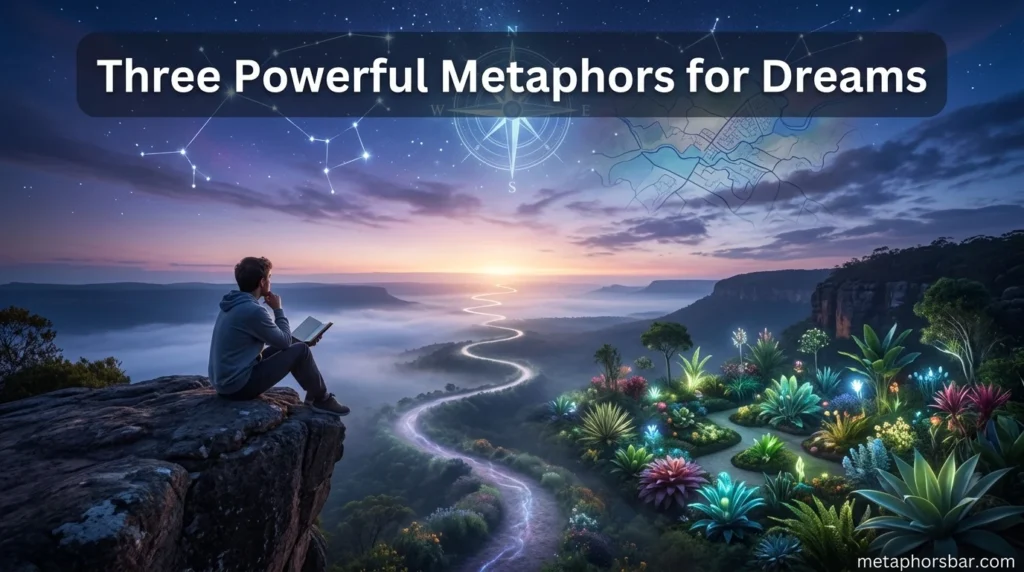
1. Dreams as Seeds
One of the most beautiful metaphors for dreams is the seed. A seed is small, quiet, and full of hidden possibility. It does not look like a tree, a flower, or a harvest—but it carries all of them within it. That makes it a perfect image for dreams that are still growing, still waiting, or just beginning to take root.
Meaning and explanation
When dreams are compared to seeds, the emphasis is on potential, patience, and growth over time. A dream may begin as something tiny: an idea, a hope, a decision, a spark. Like a seed, it needs care, sunlight, water, and time. This metaphor is especially useful when you want to describe dreams that are not yet visible to the world but are alive beneath the surface.
It also suggests that dreams need nurturing rather than force. You cannot rush a seed into becoming a tree, just as you cannot always rush a dream into reality. The process matters.
Example sentence or scenario
Her dream of becoming a writer was a seed she kept watering with late-night pages and quiet determination.
This metaphor works beautifully in motivational writing, personal essays, and stories about growth or ambition.
Alternative ways to express it
- a seed of possibility
- a buried sprout of hope
- a growing idea
- a promise in the soil
- a tiny beginning with roots
Sensory and emotional details
You can imagine dark soil, the soft press of earth, the first unfurling of a green shoot, and the warmth that helps things grow. Emotionally, this metaphor feels hopeful, patient, and tender. It suggests that dreams may begin small, but they are alive with future shape.
Mini storytelling touch
A young girl once kept a notebook full of sketches, poems, and business ideas in a drawer for years. She never called it anything grand. She simply said, “I’m planting something.” Years later, one of those sketches became her first product, and one of those poems became her first book. That is the power of the seed metaphor: it honors beginnings that are still underground.
Literary or cultural reference
Seeds appear often in literature, religion, and folklore as symbols of promise, hidden life, and future harvest. As a metaphor for dreams, the seed reminds us that great things often begin in quiet, unseen places.
2. Dreams as Stars or Constellations
Stars are distant, brilliant, and full of meaning. They guide travelers, decorate the night, and inspire wonder. As a metaphor for dreams, stars suggest aspiration, direction, and the beauty of something that may be far away but still worth following. When many dreams connect, they can become a constellation—a pattern visible only when you step back and see how the pieces fit together.
Meaning and explanation
When dreams are compared to stars, the image emphasizes brightness, distance, and guidance. A dream may not be easy to reach, but it can still light the way. This metaphor is especially effective when the dream feels inspirational, beautiful, or larger than the present moment. A constellation adds another layer: it shows that dreams are not always isolated; they can form a pattern, a path, a larger picture.
This metaphor works well when you want to describe dreams as something that orients a person through darkness or uncertainty.
Example sentence or scenario
His dreams were stars scattered across the dark, each one small alone but brilliant when he learned to follow them together.
This metaphor works especially well in poetry, speeches, and reflective writing about purpose or ambition.
Alternative ways to express it
- a sky of possibilities
- a constellation of goals
- a star to guide by
- a light in the distance
- a night map of hope
Sensory and emotional details
You can imagine a dark sky, cold air, and the feeling of looking up toward something beautiful and far beyond your reach. Emotionally, this metaphor feels expansive, inspiring, and slightly mysterious. It suggests that dreams can guide us even when they remain just beyond our fingertips.
Mini storytelling touch
An old sailor once told a child that the stars “don’t move for us, but they still tell us where to go.” That is exactly what makes this metaphor so powerful. Dreams, like stars, may not come closer just because we want them to—but they can still show us direction.
Literary or cultural reference
Stars have long symbolized fate, guidance, and aspiration in literature and mythology. As a metaphor for dreams, they capture the feeling of reaching toward something bright and meaningful even in darkness.
3. Dreams as a Bridge
A bridge connects two places that might otherwise remain apart. As a metaphor for dreams, it suggests movement, transition, and the possibility of crossing from where we are now to where we hope to be. This image is especially useful when dreams feel like a link between present reality and future possibility.
Meaning and explanation
When dreams are compared to a bridge, the emphasis is on connection and passage. A dream can connect the known to the unknown, the present self to the future self, and the ordinary day to a larger destination. This metaphor is especially effective when the dream is about transformation, progress, or crossing a difficult gap.
A bridge also suggests structure. Dreams may feel airy and imaginative, but they often require support—plans, choices, and courage. This makes the bridge a strong metaphor for dreams that are hopeful but grounded.
Example sentence or scenario
Her dream of opening a bakery was a bridge between the small apartment she lived in now and the warm shop she imagined for the future.
This metaphor is ideal for practical ambition, life transitions, and stories about moving from one stage of life to another.
Alternative ways to express it
- a passage to the future
- a crossing of hope
- a span between now and next
- a path over uncertainty
- a link from wish to action
Sensory and emotional details
You can imagine the boards or stone beneath your feet, the stretch of water or distance below, and the relief of reaching the other side. Emotionally, this metaphor feels purposeful, courageous, and steady. It suggests that dreams are not just things we imagine—they are ways we move.
Mini storytelling touch
A man who had worked in the same factory for twenty years once said that going back to school at night felt like “building a bridge to a life I had almost stopped believing in.” That is the beauty of this metaphor: it turns dreaming into crossing, and crossing into change.
Literary or cultural reference
Bridges often symbolize transition, risk, and hope in stories and history. As a metaphor for dreams, they remind us that moving toward a new life requires both imagination and structure.
How to Choose the Right Metaphor for Dreams
Use seed when your dream is still growing
Choose this metaphor when the dream is small, tender, and full of hidden potential.
Use stars or constellations when your dream feels distant but guiding
This is the best choice when the dream gives direction, inspiration, or a sense of wonder.
Use bridge when your dream is about crossing into a new future
Choose this image when you want to emphasize change, movement, and connection between now and later.
The best metaphor depends on what your dream feels like. Some dreams grow, some shine, and some carry you across.
Interactive Exercises for Practicing Metaphors for Dreams
Exercise 1: Complete the sentence
Finish this prompt in three different ways:
“My dream is like ______ because ______.”
Try one answer that feels hopeful, one that feels distant, and one that feels active.
Example: My dream is like a seed because it needs time and care before anyone can see how much it will grow.
Exercise 2: Sensory mapping
Think of a dream you have—sleeping or waking. Write down:
- one color
- one sound
- one object
- one movement
- one feeling
Then turn those details into a metaphor.
For example: My dream sounded like wind in tall grass, looked like a sky full of stars, moved like a bridge being built one plank at a time, and carried the feeling of quiet hope.
Exercise 3: Story starter
Begin a short paragraph with:
“My dream felt like…”
Let the image guide the tone. You can make it poetic, practical, mysterious, or warm.
Exercise 4: Journal or caption prompt
Try writing a one-line reflection:
- “My dream is a seed I keep watering.”
- “I follow my dreams like stars.”
- “This dream is the bridge to who I’m becoming.”
Bonus Tips for Using Metaphors for Dreams in Writing, Social Media, and Daily Life
In writing
Use these metaphors in poems, stories, essays, and reflections to make dreams feel alive and layered. They are especially powerful when describing hope, ambition, or the imagination.
On social media
A short metaphor can make a caption or post feel thoughtful and memorable. “Planting seeds for my dreams” or “Following the stars I chose” adds poetic energy without sounding forced.
In everyday conversation
Metaphors can help you talk about your goals in a more vivid way. Instead of saying “I want to do something big,” you might say, “I’m building a bridge to it.”
In journaling
If you are reflecting on your hopes, metaphor can help you see where your dreams are growing, guiding, or connecting you to change.
Keep the image honest
The strongest dream metaphor is the one that truly fits the dream. Some dreams are quiet seeds. Some are bright stars, Some are sturdy bridges. Let the image reflect the truth of the feeling.
FAQs
1. What is a metaphor for dreams?
A metaphor for dreams is a figurative comparison that describes dreams using another image, such as a seed, a star, or a bridge.
2. Why are metaphors for dreams useful?
They help make dreams feel more vivid, emotional, and memorable in writing or speech.
3. What is a simple metaphor for dreams?
A simple example is: Dreams are seeds. It suggests growth, potential, and patience.
4. Can dream metaphors be used in poetry?
Yes. They are especially effective in poetry because they can carry emotion, symbolism, and imagery in a small space.
5. How do I create my own metaphor for dreams?
Think about what your dream feels like—growing, guiding, or crossing—and compare it to something with similar qualities.
6. Are these metaphors only for goals and ambitions?
No. They can also describe sleeping dreams, imagination, longing, and the inner world of possibility.
7. What makes a strong metaphor for dreams?
A strong metaphor is vivid, emotionally fitting, and easy to imagine. It should help the reader feel the dream, not just label it.
Conclusion
Dreams can feel as small as a seed, as far as a star, or as purposeful as a bridge. That is why metaphors matter—they help us describe not only the shape of a dream, but the feeling of carrying it.
A seed gives dreams growth and patience. A star or constellation gives them light and direction. A bridge gives them movement and connection. Together, these images remind us that dreams are never just wishes—they are living possibilities asking for space, attention, and courage.
So when you write about dreams, do not settle for the obvious. Let them grow, shine, and cross through your language. A good metaphor can make dreams feel unforgettable.