
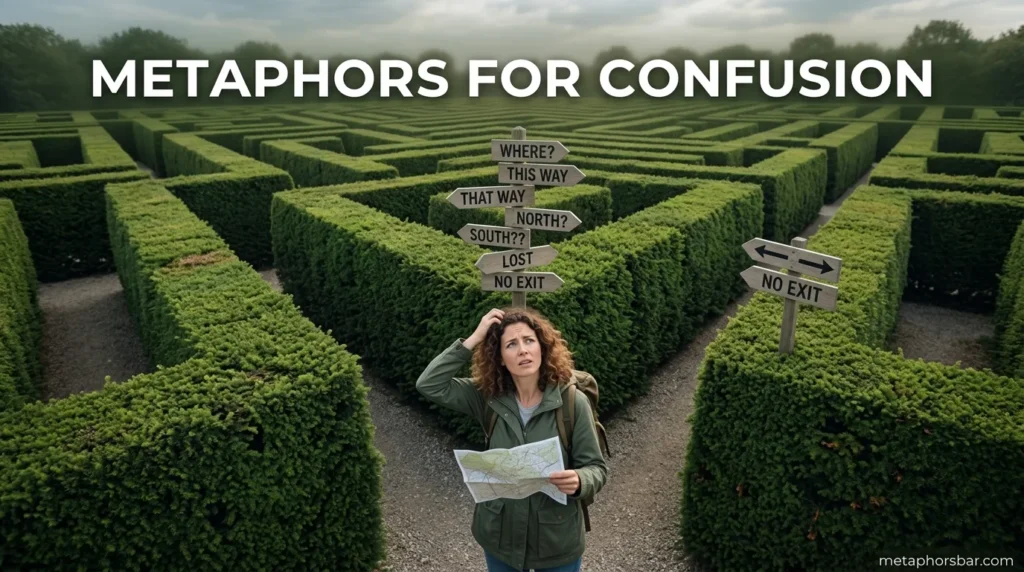
The first thing confusion does is steal the edges from the world. A room that was simple a moment ago now feels oddly unfamiliar. A conversation that seemed clear suddenly twists into a tangle of half-meaning, second-guessing, and missed signals. You read the same line twice. Then again. The words are still there, but their shape seems to slip away just as you reach for them.
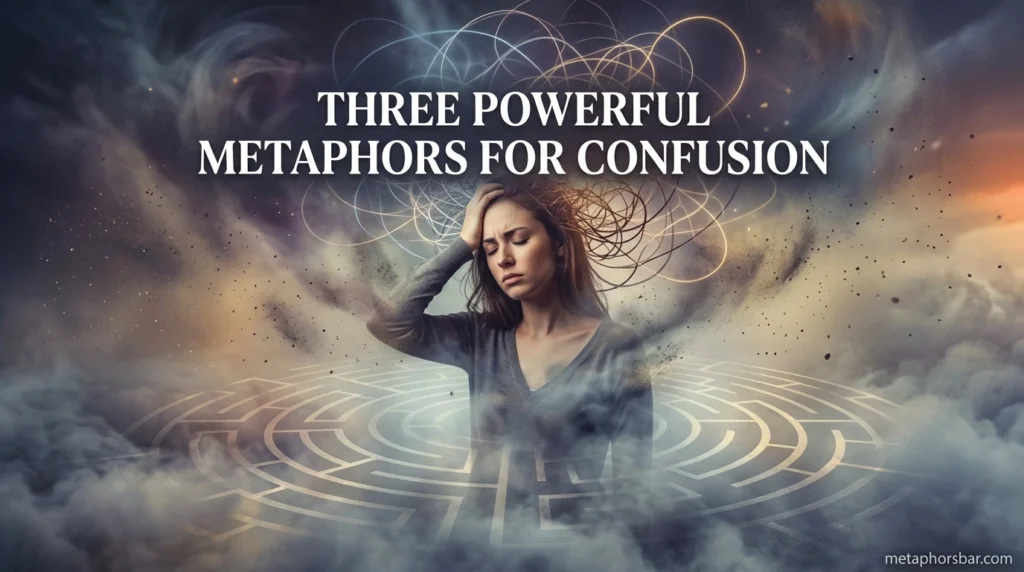
That is why metaphors for confusion matter so much. Confusion is one of those states that can be deeply personal and surprisingly hard to describe. It may feel like fog in the mind, a maze with no map, or a radio tuned between stations. A strong metaphor gives confusion form. It turns something slippery into something readers can picture, feel, and remember.
Whether you are writing a poem, a story, a journal entry, a speech, or a social media caption, metaphors for confusion can make your language richer, more sensory, and more human.
Why Metaphors for Confusion Matter in Writing and Communication
They make an invisible experience visible
Confusion often lives inside the mind, which means it can be difficult to explain plainly. A metaphor gives it a body, a texture, and a shape.
They help you show the kind of confusion you mean
Not all confusion feels the same. Sometimes it is gentle uncertainty. Sometimes it is total disorientation Sometimes it is the frustration of too many choices. The metaphor you choose can show that difference clearly.
They make your writing more memorable
A sentence like “I was confused” tells the reader what happened. A sentence like “my thoughts were walking through fog with no map” leaves an image behind.
Three Powerful Metaphors for Confusion
1. Confusion as Fog
Fog is one of the most natural metaphors for confusion because it blurs the path ahead. You can still move, but you cannot see very far. That is exactly what confusion often feels like: not complete stoppage, but uncertain motion. The future is there, the answer may be there, but everything is softened and hard to trust.
Meaning and explanation
When confusion is compared to fog, it suggests obscurity, lack of clarity, and a sense of being unable to see the full picture. It works especially well when a person knows something is happening, but cannot quite identify what it means. Fog is quiet, cool, and disorienting without being loud or aggressive.
This metaphor is especially useful for describing emotional confusion, decision-making, uncertainty in relationships, or mental states where the truth is not absent but hidden.
Example sentence or scenario
Her confusion settled over the morning like fog, softening every thought until even simple choices felt far away.
This metaphor works beautifully in reflective writing, literary fiction, and scenes where the confusion is more subtle than chaotic.
Alternative ways to express it
- a haze of uncertainty
- a mist across the mind
- a blurred horizon
- a clouded path
- a white curtain over thought
Sensory and emotional details
You can imagine cool damp air, muffled sounds, and the dim shape of the road disappearing into white. Emotionally, this metaphor feels quiet, uncertain, and slightly isolating. It suggests confusion that does not shout; it simply hides things.
Mini storytelling touch
A student once stood outside her exam room and said it felt like “thinking from inside a cloud.” That image is memorable because it captures how confusion can make everything seem close and distant at the same time. Fog does not destroy the road—it just makes it hard to trust your next step.
Literary or cultural reference
Fog appears often in literature and film as a symbol of uncertainty, transition, and hidden truth. As a metaphor for confusion, it feels timeless because it mirrors the way the mind can lose its sharp outline.
2. Confusion as a Maze
A maze is a powerful metaphor for confusion because it suggests multiple paths, dead ends, false turns, and the frustrating feeling of not knowing which direction is right. Unlike fog, which hides the path, a maze gives you too many paths. That makes it especially useful when confusion comes from choices, complexity, or too many competing signals.
Meaning and explanation
When confusion is described as a maze, it suggests a place where the answer exists, but getting to it is difficult. You may think you are heading in the right direction, only to hit a wall or loop back around. This metaphor works especially well for confusing systems, complicated relationships, tangled problems, or any situation where the mind keeps circling without finding the center.
It is a useful image because it captures both frustration and effort. A person in a maze is not passive—they are trying. They are just not sure which path matters.
Example sentence or scenario
Trying to understand the instructions felt like walking through a maze, every sentence leading to another turn and no exit in sight.
This metaphor works well in essays, personal reflection, and storytelling when confusion comes from complexity or overload.
Alternative ways to express it
- a tangle of paths
- a puzzle with no border
- a loop of wrong turns
- a corridor of false choices
- a winding trap of thought
Sensory and emotional details
You can picture stone walls, echoing footsteps, and the uneasy feeling of turning corners without knowing what waits there. Emotionally, this metaphor feels frustrating, exhausting, and a little claustrophobic. It suggests that confusion can trap attention and make progress feel far away.
Mini storytelling touch
A man once described learning a new software system as “being dropped into a hedge maze with no tea and no map.” That image is funny, but it is also precise. Confusion often feels like effort without orientation—you keep moving, but the center remains hidden.
Literary or cultural reference
Mazes appear in myth, fairy tales, and fantasy as symbols of trial, problem-solving, and discovery. As a metaphor for confusion, the maze works because it reflects the mind’s repeated attempt to find its way through complexity.
3. Confusion as a Radio Between Stations
A radio between stations makes static, broken sounds, and half-heard fragments. As a metaphor for confusion, it is especially strong when thought feels scattered, interrupted, or mixed with too many incomplete signals. It suggests that the mind is trying to tune in, but nothing stays clear long enough to hold onto.
Meaning and explanation
When confusion is compared to a radio between stations, it emphasizes interference, fragmentation, and the difficulty of catching a whole message. This metaphor works well when someone is receiving conflicting information, experiencing emotional noise, or struggling to make sense of a situation that keeps cutting in and out.
It is a very modern, sensory metaphor. Unlike the fog and maze, which are about environment and direction, the radio is about signal. Confusion becomes a matter of too much static and not enough clarity.
Example sentence or scenario
His thoughts were like a radio between stations, full of static, half-finished ideas, and voices he could not quite make out.
This metaphor is especially effective in writing about mental overload, anxiety, difficult conversations, or the experience of trying to understand someone who is being unclear.
Alternative ways to express it
- a channel of static
- a broken signal
- voices in the interference
- a station that keeps fading
- a signal with too much noise
Sensory and emotional details
You can imagine the crackle of static, the flicker of a dial, and the frustration of trying to catch a sentence before it disappears. Emotionally, this metaphor feels restless, noisy, and unfinished. It suggests confusion that is not silent, but crowded with incomplete meaning.
Mini storytelling touch
A woman once said that after a fight with her brother, every thought felt like “a radio that kept switching to the wrong song.” That image is striking because it captures the emotional static of confusion—when you know something is there, but you cannot hear it clearly enough to understand.
Literary or cultural reference
Static and signal interference often appear in modern storytelling as symbols of communication breakdown. As a metaphor for confusion, the radio is vivid because it makes misunderstanding feel audible.
How to Choose the Right Metaphor for Confusion
Use fog when confusion feels quiet and obscuring
Choose this metaphor when the problem is lack of clarity, not lack of options.
Use maze when confusion feels complicated and demanding
This is the best choice when you are lost among too many turns, choices, or pieces of information.
Use radio between stations when confusion feels noisy and fragmented
Choose this image when the mind is overwhelmed by mixed signals, static, or incomplete thoughts.
The best metaphor depends on the kind of confusion you want to describe. Confusion can blur, tangle, and interrupt—and each image gives it a different emotional shape.
Interactive Exercises for Practicing Metaphors for Confusion
Exercise 1: Complete the sentence
Finish this prompt in three different ways:
“My confusion felt like ______ because ______.”
Try one answer that feels visual, one that feels structural, and one that feels sensory.
Example: My confusion felt like fog because every answer seemed close and far away at the same time.
Exercise 2: Sensory mapping
Think of a moment when you felt confused. Write down:
- one sound
- one texture
- one color
- one shape
- one emotion
Then turn those details into a metaphor.
For example: It sounded like static, felt like wandering walls, looked like gray mist, had the shape of a maze, and carried the emotion of uncertainty.
Exercise 3: Story starter
Begin a short paragraph with:
“Confusion was like…”
Let the image guide the tone. You can make it poetic, honest, frustrating, or even a little humorous.
Exercise 4: Social media or journal prompt
Try writing a one-line reflection:
- “Today my confusion felt like fog at dawn.”
- “The problem was a maze with too many turns.”
- “My mind was a radio between stations.”
Bonus Tips for Using Metaphors for Confusion in Writing, Social Media, and Daily Life
In writing
Use these metaphors in fiction, poetry, memoirs, and essays to make confusion feel vivid instead of generic. They help readers feel the experience from the inside.
On social media
A short metaphor can make a post about a confusing day or situation more relatable. “My brain is fog today” says more than “I’m confused.”
In everyday conversation
Metaphors can help you explain confusion without overexplaining it. Saying “It feels like a maze in there” can communicate the experience quickly and clearly.
In journaling
If you are trying to process a messy situation, metaphor can help you identify whether the confusion feels like obscurity, complexity, or interference. That clarity can be useful all by itself.
Keep the image honest
The strongest confusion metaphor is the one that truly fits the feeling. Some confusion is foggy, some is tangled, and some is noisy. Let the image match the truth.
FAQs
1. What is a metaphor for confusion?
A metaphor for confusion is a figurative comparison that describes confusion using another image, such as fog, a maze, or a radio between stations.
2. Why are metaphors for confusion useful?
They help make a hard-to-describe feeling easier to understand, picture, and express in writing or speech.
3. What is a simple metaphor for confusion?
A simple example is: Confusion is like fog. It suggests obscurity, uncertainty, and hidden direction.
4. Can these metaphors be used in fiction or essays?
Yes. They are especially effective in fiction, essays, memoirs, and poetry because they help create mood and emotional depth.
5. How do I create my own metaphor for confusion?
Think about what confusion feels like—blurred, tangled, noisy, or uncertain—and compare it to something with similar qualities.
6. Are these metaphors only for serious writing?
No. They can also be used in journaling, captions, and even humorous observations if the tone fits.
7. What makes a strong metaphor for confusion?
A strong metaphor is vivid, emotionally accurate, and easy to picture. It should help the reader feel the confusion, not just label it.
Conclusion
Confusion can be hard to describe because it changes the shape of the world. Sometimes it hides the path. Sometimes it creates too many paths, Sometimes it fills the air with static. That is why metaphors matter—they help us turn uncertainty into language that can be seen, felt, and understood.
A fog gives confusion its blur. A maze gives it its complication. A radio between stations gives it its noise and interruption. Together, these images remind us that confusion is not one thing—it can obscure, tangle, and interfere all at once.
So when you write about confusion, do not settle for the plain word alone. Let it blur, twist, or crackle through your language. A good metaphor can make uncertainty feel much more understandable.