
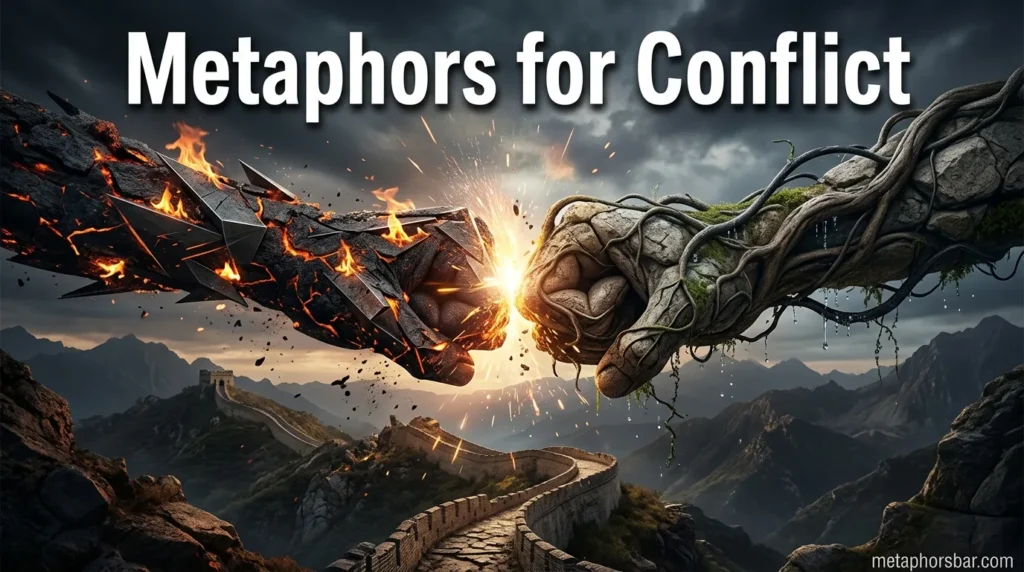
A conflict rarely enters the room politely. It arrives with a shift in temperature, a sharpened edge in someone’s voice, a silence that feels heavier than speech. One second, the space is ordinary; the next, it is charged, as if the air itself has learned how to hold its breath. Conflict can be loud or quiet, explosive or slow-burning, private or public—but it always changes the shape of a moment.
That is why metaphors for conflict are so useful. Conflict is one of the most common, complicated experiences in human life, yet it can be difficult to describe clearly without flattening it. A strong metaphor can show whether conflict feels like a storm, a tug-of-war, a fire, a battlefield, or a crack running through something once whole. It gives the tension a body, a color, and a sound.
Whether you are writing fiction, a speech, a poem, a personal essay, or even a thoughtful social media caption, metaphors for conflict can make your language more vivid, more emotional, and more memorable.
Why Metaphors for Conflict Matter in Writing and Communication
They make tension easier to see
Conflict often lives in tone, silence, and subtle shifts. A metaphor turns that invisible pressure into something readers can picture.
They help show the kind of conflict you mean
Not every conflict feels the same. Some are sudden and explosive. Some are slow and corrosive, Some are back-and-forth struggles. The metaphor you choose can show the exact shape of the tension.
They make writing more memorable
A sentence like “they were arguing” gives information. A sentence like “their conversation was a thunderstorm with no shelter” leaves an impression.
They can add emotional depth
Conflict is not just about disagreement. It can involve fear, pride, hurt, power, uncertainty, or longing. Metaphor helps those layers come through.
Three Powerful Metaphors for Conflict
1. Conflict as a Storm
A storm is one of the most natural metaphors for conflict because it captures force, noise, unpredictability, and emotional upheaval. It is especially useful when conflict comes suddenly, spreads quickly, and affects everything around it. A storm can be brief and fierce, or it can roll in and darken the whole day.
Meaning and explanation
When conflict is compared to a storm, it suggests weather that cannot be easily controlled. Thunder can stand for raised voices. Lightning can stand for sharp words or sudden realizations. Wind can suggest pressure, motion, and the way tensions spread. This metaphor works especially well when conflict feels overwhelming, public, or dramatic.
The storm image also carries movement. Storms gather, break, and pass. That makes it useful when you want conflict to feel powerful but not permanent.
Example sentence or scenario
The argument hit the dinner table like a storm, rattling every calm thing in the room and leaving everyone silent afterward.
This metaphor works beautifully in fiction, memoirs, and scenes where tension turns suddenly intense.
Alternative ways to express it
- a thundercloud of tension
- a tempest of disagreement
- a weather front of anger
- a squall of hurt feelings
- a rolling storm of words
Sensory and emotional details
You can imagine dark clouds, the crack of thunder, the smell of rain on dry pavement, and the uneasy stillness before the first drop falls. Emotionally, this metaphor feels powerful, disruptive, and heavy with pressure. It suggests that conflict can change the atmosphere in an instant.
Mini storytelling touch
A teacher once described a classroom debate as “the kind of storm you can hear before you can see.” That line works because conflict often begins with a tone shift before the real words arrive. The storm metaphor captures that approach, that buildup, and that release.
Literary or cultural reference
Storms appear constantly in literature and film as symbols of turmoil, change, and emotional upheaval. In stories, storms often arrive when a relationship, a decision, or a kingdom is about to be tested. As a metaphor for conflict, the storm carries that same sense of force and transformation.
2. Conflict as a Tug-of-War
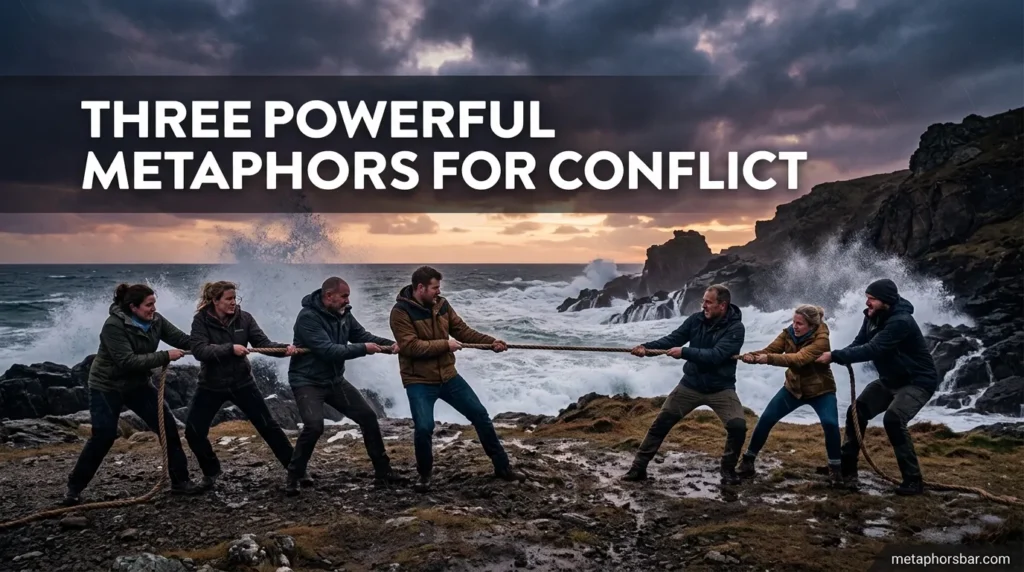
A tug-of-war is a powerful metaphor for conflict because it shows two or more sides pulling in opposite directions. It suggests resistance, balance, struggle, and the feeling that neither side is willing to let go. This metaphor is especially useful when conflict is about competing desires, values, or power.
Meaning and explanation
When conflict is compared to a tug-of-war, the focus is on opposition and effort. Each side pulls, resists, and braces. No one moves easily, and the rope becomes the place where the struggle is visible. This image works very well for relationships, negotiations, internal conflict, or situations where two forces are trying to win the same space.
Unlike the storm, which feels chaotic and atmospheric, tug-of-war feels grounded and physical. You can feel the strain in the arms, the tension in the rope, and the effort of not yielding.
Example sentence or scenario
Their relationship felt like a tug-of-war, each decision pulling them farther from the middle they once shared.
This metaphor is especially effective in writing about disagreements, emotional push-and-pull, or political and social struggles.
Alternative ways to express it
- a rope pulled from both ends
- a struggle for ground
- a contest of wills
- a back-and-forth pull
- a battle of resistance
Sensory and emotional details
You can imagine feet digging into dirt, muscles tightening, the rope burning against your hands, and the breathless strain of not slipping. Emotionally, this metaphor feels exhausting, tense, and unresolved. It suggests conflict as something that drains energy while offering no easy release.
Mini storytelling touch
A couple once described their attempt to decide where to live after marriage as “a rope stretched so tight it started to hum.” That image is striking because it shows how conflict can become a constant pull, even when no one is shouting. The tug-of-war metaphor captures the strain of wanting different things at once.
Literary or cultural reference
Tug-of-war appears in sports, games, and folklore as a symbol of struggle, competition, and opposing forces. As a metaphor for conflict, it reflects the human experience of being pulled between loyalties, desires, or responsibilities.
3. Conflict as a Cracking Wall
A cracking wall is a strong metaphor for conflict because it suggests strain, hidden damage, and the possibility that something once solid is beginning to break. This metaphor is especially useful when conflict is not loud but corrosive—something that slowly weakens trust, stability, or connection over time.
Meaning and explanation
When conflict is compared to a cracking wall, it suggests pressure building inside a structure that once seemed secure. At first, the damage may be small: a hairline fracture, a faint sound, a weakness barely visible. But the cracks spread if the pressure continues. This metaphor is particularly useful for long-term conflict in families, communities, teams, or relationships.
It works because it shows that conflict can be silent and structural. Not every disagreement is a storm. Some are cracks that appear slowly and deepen over time.
Example sentence or scenario
Years of unspoken resentment had made their friendship feel like a cracking wall—still standing, but no longer safe to lean on.
This metaphor is ideal for essays, fiction, and reflective writing about trust, decay, or hidden strain.
Alternative ways to express it
- a fracture in the foundation
- a wall under pressure
- a split in the structure
- a fault line in trust
- a breaking point in stone
Sensory and emotional details
You can imagine the faint sound of plaster splitting, dust falling, and the uneasy sight of a line spreading across a once-smooth surface. Emotionally, this metaphor feels fragile, worrying, and deeply human. It suggests that conflict can weaken things from the inside before anyone admits the danger.
Mini storytelling touch
An older brother once said that the silence in his family after an argument “felt like a crack in the living room wall nobody wanted to talk about.” That image is memorable because it captures what unresolved conflict often does—it stays visible, even when everyone pretends not to see it.
Literary or cultural reference
Cracks and fault lines appear often in literature and architecture as symbols of hidden weakness, fracture, and collapse. As a metaphor for conflict, the cracking wall makes emotional strain feel structural and real.
How to Choose the Right Metaphor for Conflict
Use storm when conflict is sudden and overwhelming
Choose this metaphor when the tension arrives fast, grows loud, and changes the atmosphere quickly.
Use tug-of-war when conflict is about opposition and control
This is the best choice when the issue is a struggle between two sides that are both unwilling to yield.
Use cracking wall when conflict is slow and corrosive
Choose this image when the tension builds over time and weakens trust or structure from within.
The best metaphor depends on what kind of conflict you want to describe. Conflict can rage, pull, and crack—and sometimes it does all three.
Interactive Exercises for Practicing Metaphors for Conflict
Exercise 1: Complete the sentence
Finish this prompt in three different ways:
“The conflict felt like ______ because ______.”
Try one answer that feels loud, one that feels physical, and one that feels slow or hidden.
Example: The conflict felt like a storm because one sharp sentence changed the entire mood of the room.
Exercise 2: Sensory mapping
Think of a conflict you have observed or experienced. Write down:
- one sound
- one texture
- one color
- one movement
- one emotion
Then turn those details into a metaphor.
For example: It sounded like thunder behind a door, felt like rope burning in the hands, looked like a crack spreading through plaster, moved like wind over a field, and carried the emotion of frustration mixed with fear.
Exercise 3: Story starter
Begin a short paragraph with:
“The conflict was like…”
Let the image guide the tone. It can be dramatic, restrained, reflective, or poetic.
Exercise 4: Social media or journal prompt
Try writing a one-line reflection:
- “Their argument came like a storm over the house.”
- “The disagreement became a tug-of-war we both refused to release.”
- “The silence after that talk felt like a cracking wall.”
Bonus Tips for Using Metaphors for Conflict in Writing, Social Media, and Daily Life
In writing
Use these metaphors in fiction, essays, memoirs, and poetry to make conflict feel concrete and emotionally layered. They help readers understand the shape of tension instead of only the fact of disagreement.
On social media
A short metaphor can make a post about a hard week or difficult conversation feel more expressive. “Today felt like a storm” or “That conversation was a tug-of-war” can communicate tension more vividly than plain labels.
In everyday conversation
Metaphors can help you describe conflict without sounding vague or repetitive. Instead of saying “We had issues,” you might say, “It felt like a wall starting to crack.”
In character writing
If you are writing a character or describing a real person, the metaphor can show whether the conflict is explosive, competitive, or quietly damaging. That adds emotional realism.
Keep the image honest
The strongest conflict metaphor is the one that truly fits the tension. Some conflict is stormy. Some is a struggle of wills, Some is slow and structural. Let the image reflect the truth.
FAQs
1. What is a metaphor for conflict?
A metaphor for conflict is a figurative comparison that describes tension or disagreement using another image, such as a storm, tug-of-war, or cracking wall.
2. Why are metaphors for conflict useful?
They help make tension easier to visualize, understand, and express in writing or speech.
3. What is a simple metaphor for conflict?
A simple example is: Conflict is like a storm. It suggests force, noise, and disruption.
4. Can these metaphors be used in fiction or essays?
Yes. They are especially effective in fiction, essays, memoirs, and poetry because they make emotional and social tension feel vivid.
5. How do I create my own metaphor for conflict?
Think about what the conflict feels like—sudden, pulling, cracking, or stormy—and compare it to something with similar qualities.
6. Are these metaphors only for serious writing?
No. They can also be used in reflective captions, speeches, and everyday conversation when the tone fits.
7. What makes a strong metaphor for conflict?
A strong metaphor is vivid, emotionally accurate, and easy to picture. It should help the reader feel the conflict, not just identify it.
Conclusion
Conflict is one of the most powerful forces in human life because it changes tone, structure, and relationship all at once. That is why metaphors matter—they help us describe not only that conflict exists, but what it feels like to live inside it.
A storm captures sudden upheaval. A tug-of-war captures resistance and pull. A cracking wall captures the slow damage beneath the surface. Together, these images remind us that conflict is not one thing—it can rage, strain, and fracture in many different ways.
So when you write about conflict, do not settle for plain language alone. Let it storm, pull, or crack through your words. A good metaphor can make tension unmistakable.