
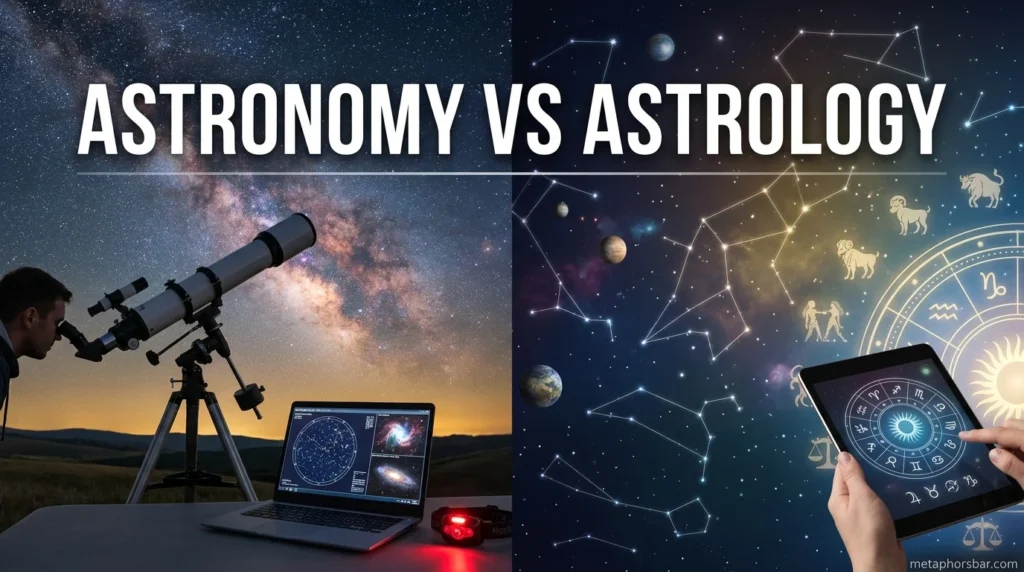
People often mix up astronomy and astrology because the words look similar, sound close, and both seem connected to stars, planets, and the sky. In everyday writing, speaking, exams, and professional communication, though, they mean very different things. Using the wrong word can confuse readers, weaken your sentence, or make your writing look careless. This guide explains the difference in a simple, practical way so you can use both words correctly and confidently.
Meaning: What Each Word Really Means
The easiest way to understand astronomy vs astrology is to remember this:
- Astronomy is a science.
- Astrology is a belief system.
Astronomy studies space, stars, planets, galaxies, and the physical universe using observation, mathematics, and scientific methods. Astrology is the idea that the positions of celestial bodies can influence human personality, relationships, and life events.
Quick comparison table
| Word | Meaning | Field | Main focus | Example |
| Astronomy | Study of space and celestial objects | Science | Stars, planets, galaxies, the universe | “She wants to study astronomy at university.” |
| Astrology | Belief that stars and planets affect human life | Belief / pseudoscience | Horoscopes, zodiac signs, predictions | “He reads astrology columns for fun.” |
Simple memory trick
- Astronomy = A for academic and analysis
- Astrology = A for augury and assumptions
That is not a formal rule, but it helps many learners remember the difference.
Correct Usage: When to Use “Astronomy” and When to Use “Astrology”
Using the right word depends on what you are talking about.
Use astronomy when you mean:
- studying the moon, stars, planets, and space
- telescope research
- black holes, comets, and galaxies
- scientific facts about the universe
Use astrology when you mean:
- horoscopes
- zodiac signs
- birth charts
- personality predictions based on star positions
Correct and incorrect examples
| Correct | Incorrect | Why |
| “Astronomy helps scientists understand the universe.” | “Astrology helps scientists understand the universe.” | Astronomy is the science, not astrology. |
| “She studied astronomy in college.” | “She studied astrology in college.” | A college science course is astronomy. |
| “My friend enjoys reading astrology forecasts.” | “My friend enjoys reading astronomy forecasts.” | Forecasts and horoscopes belong to astrology, not astronomy. |
| “The telescope is used in astronomy.” | “The telescope is used in astrology.” | Telescopes are tools for scientific observation. |
Real-life usage tip
If your sentence includes words like scientist, universe, telescope, galaxy, or research, you probably need astronomy.
If your sentence includes words like zodiac, horoscope, chart, prediction, or birth sign, you probably need astrology.
Spelling Differences: Why These Words Look So Similar
Many learners confuse these terms because they share the beginning astro-, which comes from a Greek root meaning “star.”
Even though the words are similar, their spellings are different and must be memorized carefully.
Spelling comparison table
| Feature | Astronomy | Astrology |
| Number of letters | 10 | 9 |
| Middle letters | -nom- | -log- |
| Ending | -y | -y |
| Common mistake | spelling it as astrolomy or astronimy | spelling it as astronogy or astrologey |
Word breakdown
- astronomy = astro + nomy
- astrology = astro + logy
This is useful because:
- -nomy is often associated with naming, arrangement, or systems in academic contexts
- -logy often means “study of,” but in this case astrology is the established word for star-based prediction systems
A spelling reminder
Many writers accidentally type one word when they mean the other because auto-correct does not always help. A quick proofreading habit is to check the middle letters:
- astro + nomy = astronomy
- astro + logy = astrology
Grammar Rules and Word Forms
From a grammar point of view, both astronomy and astrology are uncountable nouns in most standard uses. That means we usually do not make them plural.
Correct form table
| Word | Grammar type | Common use | Example |
| astronomy | uncountable noun | field of study | “Astronomy is fascinating.” |
| astrology | uncountable noun | belief system | “Astrology is popular in some magazines.” |
Grammar points to remember
1. Use singular verbs with both words
Because they are usually uncountable, they take singular verbs.
- Correct: Astronomy is a science.
- Correct: Astrology is controversial.
- Incorrect: Astronomy are a science.
- Incorrect: Astrology are popular.
2. Use articles carefully
You can say:
- an astronomy course
- a course in astronomy
- an astrology reading
- a book on astrology
But you would not usually say:
- “two astrologies”
- “three astronomies”
Those plural forms are generally not used in standard English.
3. Adjectives and modifiers
You can add adjectives normally:
- modern astronomy
- observational astronomy
- traditional astrology
- Vedic astrology
- Western astrology
Grammar comparison table
| Structure | Astronomy | Astrology |
| Adjective + noun | modern astronomy | Western astrology |
| Noun + noun | astronomy research | astrology charts |
| Preposition phrase | a degree in astronomy | a belief in astrology |
| Verb agreement | astronomy is | astrology is |
British vs American English: Is There Any Difference?
There is no major spelling difference between British English and American English for astronomy or astrology. Both varieties use the same spelling.
However, there can be slight differences in usage and tone.
In both British and American English
- astronomy is used in scientific and academic contexts
- astrology is used for horoscopes, zodiac signs, and similar beliefs
Minor usage differences
In American English, people may more casually mention astrology in pop culture, social media, or magazine-style content. In British English, the same is true, though the tone may be slightly more reserved in formal contexts.
Still, the core meaning does not change.
Example in both varieties
- “She is studying astronomy at university.”
- “He believes astrology can explain personality traits.”
There is no need to change spelling based on region.
Pronunciation: How to Say Them Clearly
These words are close in spelling but not identical in pronunciation. Saying them clearly helps avoid misunderstanding.
Pronunciation guide
| Word | Pronunciation | Stress |
| astronomy | uh-STRON-uh-mee | stress on the second syllable |
| astrology | uh-STROL-uh-jee | stress on the second syllable |
Easy sound tips
- astronomy has a stronger “nom” sound in the middle.
- astrology has a clearer “log” sound in the middle.
Practice sentence examples
- “I enjoy astronomy because I love learning about planets.”
- “She reads astrology columns every morning.”
Common pronunciation mistake
Some learners blur the middle sounds and make both words sound almost identical. Slow down and focus on the middle syllable:
- astronomy
- astrology
That small difference is often enough for listeners to understand you clearly.
Sentence Examples in Real Context
Examples are one of the best ways to remember correct usage. Below are simple, natural sentences that show how each word works in everyday English.
Astronomy in sentences
- Astronomy is one of the oldest sciences.
- He took an astronomy class last semester.
- The observatory offers free astronomy lectures.
- Scientists use astronomy to study distant galaxies.
- My brother wants to become an astronomy teacher.
Astrology in sentences
- She reads astrology every morning with her coffee.
- Many people check astrology apps for fun.
- Astrology is not considered a science.
- The magazine includes a weekly astrology column.
- He does not believe in astrology, but he enjoys discussing it.
Side-by-side usage table
| Context | Use astronomy | Use astrology |
| School / university | astronomy course, astronomy lab | rarely used as a formal subject |
| Science / research | astronomy findings, astronomy department | not appropriate |
| Horoscopes / zodiac | not appropriate | astrology reading, astrology chart |
| News / magazines | astronomy article, astronomy discovery | astrology column |
| Conversation | “I love astronomy.” | “She follows astrology.” |
Correct vs incorrect in context
Correct:
- “The university has a strong astronomy program.”
- “She does not believe in astrology.”
Incorrect:
- “The university has a strong astrology program.”
- “She does not believe in astronomy horoscopes.”
Common Mistakes Learners Make
Because the words are similar, mistakes are common. Here are the biggest ones to avoid.
Mistake 1: Using the words interchangeably
Some learners think astronomy and astrology are just two words for the same thing. They are not.
- Wrong: Astronomy tells you your personality from your birthday.
- Right: Astrology claims to relate personality to star positions.
Mistake 2: Mixing scientific and horoscope vocabulary
If you are talking about science, use astronomy. If you are talking about horoscopes, use astrology.
- Wrong: Astronomy says my sign is Leo.
- Right: Astrology says my sign is Leo.
Mistake 3: Spelling errors
Because the words are close, people often misspell them.
- Wrong: astromony
- Right: astronomy
- Wrong: astrologly
- Right: astrology
Mistake 4: Wrong verb agreement
Since both are usually uncountable nouns, use singular verbs.
- Wrong: Astrology are popular.
- Right: Astrology is popular.
- Wrong: Astronomy are interesting.
- Right: Astronomy is interesting.
Mistake 5: Using “astrology” in formal science writing
In academic writing, reports, and exams about space, do not use astrology when you mean astronomy.
- Wrong: The astrology of Mars explains its orbit.
- Right: The astronomy of Mars explains its orbit.
Common mistakes table
| Mistake type | Incorrect example | Correct example |
| Meaning confusion | “Astronomy predicts your future.” | “Astrology predicts your future.” |
| Science vs belief | “Astrology studies black holes.” | “Astronomy studies black holes.” |
| Spelling | “astronamy” | “astronomy” |
| Grammar | “Astrology are popular.” | “Astrology is popular.” |
| Formal writing | “I wrote an astrology essay on galaxies.” | “I wrote an astronomy essay on galaxies.” |
FAQs About Astronomy vs Astrology
1. Are astronomy and astrology the same?
No. Astronomy is the scientific study of space, while astrology is a belief system that connects celestial movements with human life.
2. Which one is a science?
Astronomy is a science. Astrology is not considered a science by the scientific community.
3. Which word should I use for horoscopes?
Use astrology. Horoscopes, zodiac signs, and birth charts belong to astrology.
4. Which word should I use for planets and stars?
Use astronomy. It is the correct word for the scientific study of space.
5. Are the spellings different in British and American English?
No. The spellings are the same in both varieties.
6. Can I say “astronomies” or “astrologies”?
Usually no. In standard English, both are generally used as uncountable nouns.
7. How can I remember the difference quickly?
Remember this simple rule:
- Astronomy = science of space
- Astrology = star-based beliefs and horoscopes
Conclusion
The difference between astronomy and astrology is simple once you know the meaning. Astronomy is the scientific study of space, planets, stars, and the universe. Astrology is the belief that celestial bodies affect human personality and future events. In grammar, both words are usually uncountable nouns, both take singular verbs, and both are spelled the same in British and American English.
For everyday writing, the safest way to remember it is this: use astronomy for science and astrology for horoscopes. If you are writing an exam, preparing a school assignment, or communicating professionally, choosing the correct word shows accuracy, confidence, and strong language skills. Keep that distinction in mind, and you will use both words correctly every time.