
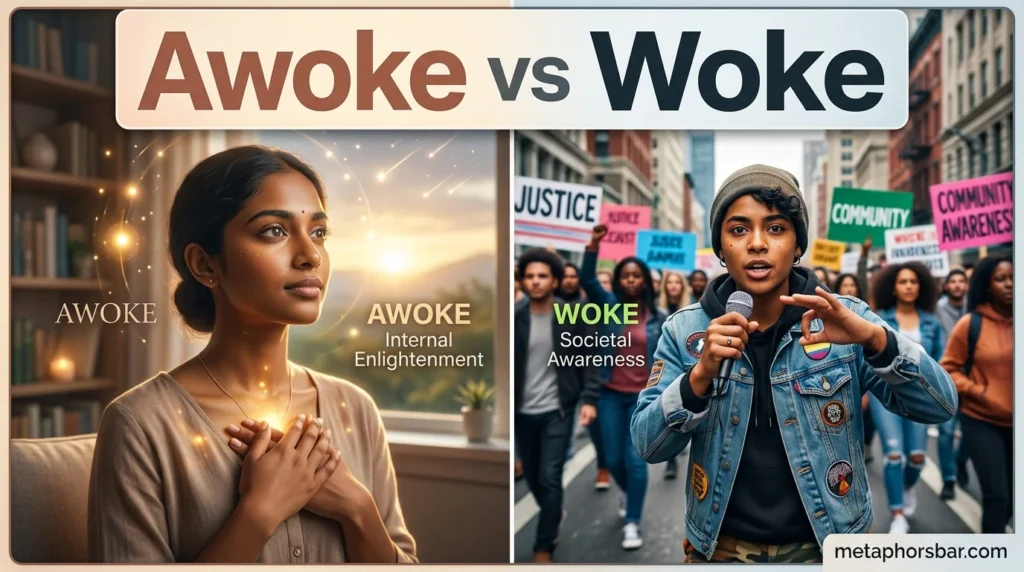
English learners often get confused by awoke vs woke because both words look similar, both relate to the verb awake, and both can refer to the past. That can make it hard to know which one is correct in writing, speaking, exams, and professional communication. If you choose the wrong form, your sentence may still be understandable, but it can sound less natural or less polished.
The good news is that this topic is simple once you know the pattern. Awoke and woke are both past-tense forms of awake. In standard English, woke is much more common in everyday speech, while awoke is often a little more formal, literary, or old-fashioned. In this article, you will learn the meaning, correct usage, spelling differences, grammar rules, pronunciation, sentence examples, common mistakes, and easy memory tips so you can use both forms confidently.
What Do “Awoke” and “Woke” Mean?
Both words are past-tense forms of the verb awake, which means to stop sleeping or to become conscious.
Simple meaning
- to stop sleeping
- to wake up
- to become aware
- to become conscious
Examples
- I awoke early.
- I woke early.
- She awoke to the sound of rain.
- She woke to the sound of rain.
Meaning table
| Word | Meaning | Part of speech |
| awake | not sleeping / become conscious | verb/adjective |
| awoke | past tense of awake | verb |
| woke | past tense of wake/awake | verb |
Key idea
In most cases, awoke and woke mean the same thing when they refer to sleeping or waking up. The difference is mainly in style, frequency, and grammar form.
Important note
Do not confuse woke as a past-tense verb with woke as a modern adjective meaning socially aware or politically conscious. In this article, we are focused mainly on the verb forms awoke and woke.
Which One Is Correct in Which Situation?
Both forms are correct, but they are used differently in tone and frequency.
Use woke when:
- you want the most common everyday past tense
- you are speaking naturally
- you want a simple, modern, familiar verb form
Examples:
- I woke at 6 a.m.
- She woke suddenly.
- They woke up late.
Use awoke when:
- you want a slightly more formal or literary tone
- you are writing a story, poem, or narrative
- you want to sound more elevated or old-fashioned
Examples:
- He awoke before dawn.
- She awoke in a dark room.
- The village awoke to the sound of bells.
Comparison table: usage choice
| Situation | Better choice | Example |
| everyday speech | woke | I woke early. |
| casual writing | woke | She woke up late. |
| storytelling or literature | awoke | He awoke at sunrise. |
| formal or poetic tone | awoke | The city awoke to morning light. |
Practical rule
If you are unsure, woke is usually the safer and more natural choice in modern English. Awoke is perfectly correct, but it sounds a little more formal or literary.
Spelling Differences and Word Forms
There is no spelling difference in the sense of British vs American English here. The main difference is that the two words are different past-tense forms of awake.
Word forms
- awake = base form
- awoke = past tense
- woke = past tense
- awoken = past participle
Table of word forms
| Base form | Past tense | Past participle | Example |
| awake | awoke | awoken | I have awoken early lately. |
| wake | woke | woken | She has woken up. |
Important note
Many learners think woke is the only past form, but awoke is also standard English. The issue is not correctness, but which one sounds more natural in a given context.
Spelling-related comparison table
| Form | Correct? | Notes |
| awoke | yes | standard, more formal/literary |
| woke | yes | standard, common in everyday English |
| awaked | usually no | not standard for this meaning |
| woken | yes | past participle |
| awoken | yes | past participle |
Correct vs incorrect examples
| Incorrect | Correct |
| I awaked at 7. | I awoke at 7. / I woke at 7. |
| She has woke early. | She has woken early. / She awoke early. |
| He had waked up late. | He had woken up late. |
Easy memory tip
- awoke = past tense, more formal
- woke = past tense, more common
- woken = past participle
Grammar Rules Behind Awoke and Woke
Both awoke and woke are irregular verb forms. English irregular verbs do not always follow the usual -ed ending pattern.
Basic grammar
The base verb is awake or wake, depending on the structure.
Examples:
- I awake early every day.
- I woke early yesterday.
- I have woken early several times this month.
Common structures
- simple past: woke / awoke
- past participle: woken / awoken
- present tense: awake / wakes
- progressive: am waking / is waking / was waking
Grammar table: forms in sentences
| Tense/form | Example with awake | Example with wake |
| present | I awake early. | She wakes early. |
| past | I awoke early. | I woke early. |
| past participle | I have awoken early. | I have woken early. |
Using “awoke” and “woke” with objects and phrases
You will often see them with:
- up
- early
- suddenly
- to the sound of something
- to a realization
Examples:
- He woke up at dawn.
- She awoke to a loud noise.
- I woke up feeling tired.
- They awoke to the reality of the situation.
Important note
In modern English, wake up is more common than awake in everyday conversation. So many people say:
- I woke up
instead of: - I awoke
Both can be correct, but woke up is the most natural in speech.
Sentence Examples: Correct and Incorrect Usage
Examples are the easiest way to understand when each form sounds best.
Correct examples with woke
- I woke before sunrise.
- She woke up late.
- They woke to the sound of birds.
- We woke early for the flight.
- He woke suddenly from a dream.
Correct examples with awoke
- I awoke before sunrise.
- She awoke in the middle of the night.
- They awoke to the sound of birds.
- We awoke early for the flight.
- He awoke suddenly from a dream.
More real-life examples
- Woke: “I woke up at 5 this morning.”
- Awoke: “He awoke with a start after hearing the noise.”
- Woke: “My brother woke early to go jogging.”
- Awoke: “The child awoke during the thunderstorm.”
Sentence-style comparison table
| Meaning | Woke example | Awoke example |
| simple past | I woke at 6. | I awoke at 6. |
| waking suddenly | She woke suddenly. | She awoke suddenly. |
| poetic tone | — | The town awoke at dawn. |
| everyday tone | I woke up late. | — |
Incorrect examples
- I waked at 6.
- She has woke at noon.
- They were awoken early yesterday.
This may appear in some contexts, but for simple past you usually want woke or awoke.
Correct vs incorrect table
| Incorrect | Correct |
| I waked early. | I woke early. / I awoke early. |
| She has woke up. | She has woken up. |
| They awoke up late. | They woke up late. / They awoke late. |
| He awake yesterday. | He awoke yesterday. / He woke yesterday. |
A useful observation
In casual English, woke up is very common:
- I woke up early.
- She woke up late.
- They woke up hungry.
But in more formal or literary writing, awoke can sound elegant:
- The city awoke to sunlight.
- She awoke to the truth.
Common Mistakes Learners Make
Because the words are close, learners often make predictable errors.
1: Using “awaked”
- Wrong: I awaked early.
- Right: I awoke early. / I woke early.
2: Using “woke” as a past participle
- Wrong: She has woke.
- Right: She has woken.
3: Adding “up” twice
- Wrong: I awoke up early.
- Right: I woke up early.
- Right: I awoke early.
4: Thinking “woke” is informal only
It is common, yes, but it is also standard English and perfectly correct.
5: Mixing tenses
- Wrong: Yesterday I wake early.
- Right: Yesterday I woke early.
Common mistake table
| Wrong | Correct |
| I awaked early. | I awoke early. / I woke early. |
| She has woke. | She has woken. |
| I awoke up early. | I woke up early. / I awoke early. |
| Yesterday I wake early. | Yesterday I woke early. |
Easy memory tip
Remember:
- woke = simple past, everyday English
- awoke = simple past, slightly formal
- woken / awoken = past participles
If you remember that, most mistakes disappear.
Pronunciation, Style, and British vs American English
Pronunciation
The two past-tense forms are pronounced similarly, which is part of why learners confuse them.
- awoke → uh-WOHK
- woke → wohk
Pronunciation table
| Word | Approximate pronunciation | Notes |
| awake | uh-WAYK | base form |
| awoke | uh-WOHK | past tense, more formal |
| woke | wohk | past tense, very common |
| woken | WOH-kuhn | past participle |
| awoken | uh-WOH-kuhn | past participle |
Style
- woke sounds natural and common in daily English.
- awoke sounds a little more literary or formal.
Style comparison table
| Word | Tone | Best use |
| woke | natural, everyday | speech, simple writing |
| awoke | formal, literary | stories, essays, descriptions |
| woken | standard past participle | perfect tenses |
| awoken | literary or formal | perfect tenses in writing |
British vs American English
There is no major British vs American English difference in the correctness of awoke or woke. Both forms are used in both varieties.
However:
- woke is generally more common in everyday speech in both British and American English
- awoke is more likely to appear in literature, older texts, or more elevated writing
Practical takeaway
This is not a regional spelling issue. It is mainly a matter of style, frequency, and verb form.
FAQs
Is “awoke” correct?
Yes. It is a correct past tense of awake.
Is “woke” correct?
Yes. It is also a correct past tense of awake and is the more common everyday form.
Which one should I use in writing?
Use woke for natural, everyday English. Use awoke if you want a slightly more formal or literary tone.
Can I say “woke up”?
Yes. Woke up is very common and natural.
Can I say “awoke up”?
Usually no. You normally say:
- I awoke early
or - I woke up early
What is the past participle?
- awake → awoken
- wake → woken
Is “woke” only a modern slang word?
No. In this context, woke is a standard past-tense verb form. It should not be confused with the modern social/political adjective woke.
Which one is more formal?
Awoke is slightly more formal or literary.
Conclusion
The difference between awoke and woke is simple once you know the pattern. Both are correct past-tense forms of awake, but woke is the more common and natural choice in everyday English, while awoke sounds a little more formal, literary, or old-fashioned.
Here is the easiest way to remember it:
- awake = base form
- awoke / woke = past tense
- awoken / woken = past participle
- woke = common, natural, everyday
- awoke = formal, literary, less common
So write:
- I woke early this morning.
- She awoke before sunrise.
- They have woken already.
- He has awoken to the truth.
If you remember only one thing, remember this: use “woke” for modern everyday English, and “awoke” when you want a slightly more formal or literary tone. That simple rule will help you choose the right form and sound more confident in writing and speaking.