
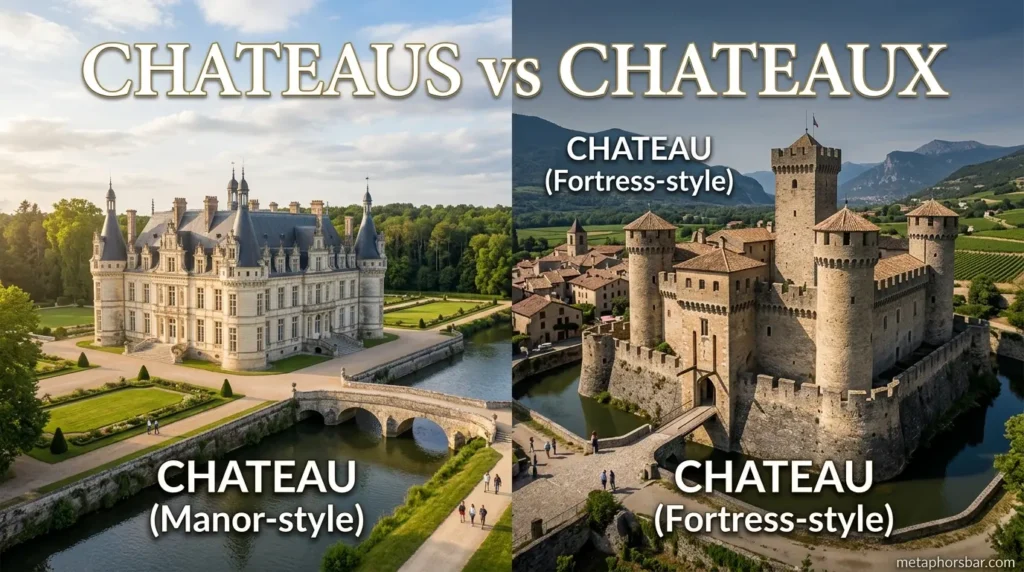
English learners and even fluent writers often get confused by chateaus vs chateaux because both words look elegant, foreign, and a little formal. They are easy to mix up in writing, especially when you see them in books, travel writing, history articles, or descriptions of luxury homes. The confusion matters because spelling mistakes in borrowed words can make your writing look less polished in exams, business communication, and professional publishing.
The good news is that the rule is simple once you understand the origin of the word. Both forms are connected to the French word château, which means a castle or grand house. In English, the singular is usually chateau or château, and the plural can be chateaux or chateaus depending on style and context. In this article, you will learn the meaning, correct usage, spelling differences, grammar rules, pronunciation, examples, common mistakes, and easy memory tips so you can use these words confidently.
Meaning of “Chateau,” “Chateaux,” and “Chateaus”
The first step is to understand what the word means.
Chateau
A chateau is a large stately house, a country estate, or sometimes a castle, especially in French or French-style contexts.
Examples:
- They stayed in a beautiful chateau in the countryside.
- The chateau was built in the 18th century.
- The family bought an old chateau and restored it.
Chateaux
Chateaux is the traditional plural form, borrowed from French spelling rules.
Examples:
- The region is famous for its many chateaux.
- Tourists visited several chateaux along the river.
- The guidebook listed the best chateaux in the area.
Chateaus
Chateaus is the English-style plural form. It follows the common English pattern of adding -s.
Examples:
- Some travel writers use chateaus instead of chateaux.
- The article described several chateaus in southern France.
- Luxury chateaus attract many visitors.
Simple meaning table
| Word | Meaning | Number | Style |
| chateau | a castle or grand house | singular | English/French loanword |
| chateaux | castles or grand houses | plural | traditional French plural |
| chateaus | castles or grand houses | plural | anglicized plural |
Important note
The confusion is not about meaning. All three forms refer to the same general idea. The difference is mainly about spelling, plural formation, and style.
Which Spelling Is Correct: Chateaus or Chateaux?
This is the big question. The answer depends on whether you want the traditional French plural or the regular English plural.
The traditional form: chateaux
If you want to preserve the French spelling, use chateaux.
This is the form most people expect in careful or formal writing.
Examples:
- The valley is dotted with old chateaux.
- We toured three chateaux during the holiday.
The anglicized form: chateaus
If you want to use a regular English plural, you may see chateaus.
Examples:
- The magazine mentioned several chateaus in the region.
- Some English speakers prefer chateaus because it looks more familiar.
Which one is more common?
In many formal contexts, chateaux is the more traditional and often preferred spelling. Chateaus is also understood and used in English, especially when writers want a simpler plural form.
Comparison table: spelling differences
| Form | Language influence | Use | Example |
| chateau | French loanword | singular | one chateau |
| chateaux | French plural | traditional plural | two chateaux |
| chateaus | English plural | anglicized plural | two chateaus |
Practical takeaway
If you are writing something formal, elegant, or travel-related, chateaux is usually the safer and more refined choice. If you are writing in a more ordinary English style, chateaus can still be acceptable.
Grammar Rules for Pluralizing Foreign Words
This topic becomes easier when you understand how English treats borrowed words.
English usually has two options
When English borrows a foreign noun, it may:
- keep the original plural form, or
- use a normal English plural ending.
Examples:
- cactus → cacti / cactuses
- stadium → stadiums
- index → indices / indexes
- bureau → bureaux / bureaus
- chateau → chateaux / chateaus
Why does this happen?
English often borrows words from French, Latin, Greek, Italian, and other languages. Over time, some of these words keep their original plural, while others become fully English.
Grammar comparison table
| Singular | Traditional plural | English-style plural |
| chateau | chateaux | chateaus |
| bureau | bureaux | bureaus |
| index | indices | indexes |
| cactus | cacti | cactuses |
Which plural should you use?
That depends on:
- your audience
- your style guide
- how formal your writing is
- whether you want a French look or an English look
Rule of thumb
If the word still feels strongly French and you want a polished, traditional style, use chateaux.
If you want a simpler English plural, chateaus may be acceptable.
Important caution
Do not use both forms randomly in the same piece. Choose one style and stay consistent.
Real-Life Sentence Examples
Seeing the words in context is the fastest way to learn them.
Correct examples with
chateau
- We visited a chateau near the Loire Valley.
- The chateau had a long and fascinating history.
- Her wedding was held at a beautiful chateau.
chateaux
- France is famous for its many chateaux.
- The river route includes several historic chateaux.
- Tourists often photograph the chateaux at sunset.
chateaus
- The travel brochure listed several chateaus in the countryside.
- Some writers use chateaus as the plural in English.
- Luxury chateaus are popular with visitors.
Comparison table: correct usage in context
| Sentence | Best form | Why |
| We toured one old estate. | chateau | singular form |
| We toured many old estates. | chateaux / chateaus | plural form |
| The guide mentioned French castles. | chateaux | traditional French plural |
| The writer preferred an English-style plural. | chateaus | anglicized plural |
Correct vs incorrect examples
| Incorrect | Correct |
| one chateaux | one chateau |
| many chateau | many chateaux / chateaus |
| a chateaus | a chateau |
| several chateau | several chateaux / chateaus |
A natural way to think about it
- chateau = one
- chateaux/chateaus = more than one
That part is simple. The tricky part is choosing the plural spelling.
Pronunciation and Spelling Tips
Because these words come from French, pronunciation can look intimidating, but it is not difficult.
Pronunciation
In English, chateau is usually pronounced roughly like:
- shat-oh or sha-toh
Chateaux and chateaus are usually pronounced the same way in English:
- shat-ohs
Pronunciation comparison table
| Word | Approximate pronunciation | Notes |
| chateau | shat-oh | singular |
| chateaux | shat-ohz | plural |
| chateaus | shat-ohz | plural |
Spelling tips
Here are a few easy tricks to remember:
- chateau ends in -eau, which is common in French words.
- chateaux ends in -eaux, the French plural pattern.
- chateaus ends in -eaus, the English-style plural.
Memory trick
Think of it this way:
- -eau = one
- -eaux = French plural
- -eaus = English plural
Why spelling matters
If you are writing about travel, architecture, history, or luxury real estate, correct spelling makes your writing look more professional and trustworthy.
Common spelling confusion
Some writers accidentally write:
- chateu
- chateaux
- chateux
These are not standard English spellings. Stick with:
- chateau
- chateaux
- chateaus
British vs American English: Is There a Difference?
There is no strict rule that says British English must use one spelling and American English must use another. However, style and preference can vary.
British English
British writers may be more likely to preserve the French look, especially in formal or literary writing.
Examples:
- The chateau was restored beautifully.
- The region has many chateaux.
American English
American writers may be slightly more open to anglicized plural forms, especially in general writing.
Examples:
- The chateau was restored beautifully.
- The brochure mentioned several chateaus.
Comparison table
| Feature | British English | American English |
| singular | chateau | chateau |
| traditional plural | chateaux | chateaux |
| English-style plural | possible but less traditional | possible and understandable |
| main difference | style preference | style preference |
Practical note
This is less about national rules and more about writing style. In both varieties, chateaux looks more traditional and French, while chateaus looks more English and simplified.
Best advice
If you are unsure, use chateaux in formal writing, travel writing, or academic discussion. It is the form most readers will recognize as elegant and correct in a French context.
Common Mistakes Learners Make
Because the word is unfamiliar, mistakes are common. Here are the main ones to avoid.
1: Using the singular form for plural meaning
- Wrong: There are many chateau in the area.
- Right: There are many chateaux in the area.
- Also acceptable: There are many chateaus in the area.
2: Using the wrong French-style ending
- Wrong: chateaux
- Wrong: chateux
- Right: chateaux
3: Mixing plural styles in one piece
- Weak style: The article mentioned chateaux in one paragraph and chateaus in another.
- Better: Choose one plural style and stay consistent.
4: Confusing spelling with pronunciation
Both plurals are usually pronounced similarly in English, but the spelling is different. Do not spell them the same way just because they sound alike.
Mistake 5: Using the wrong article
- Wrong: an chateau
- Right: a chateau
Common mistakes table
| Wrong sentence | Correct sentence |
| I visited a beautiful chateaux. | I visited a beautiful chateau. |
| The guide showed us three chateau. | The guide showed us three chateaux. |
| The brochure listed many chateaux. | The brochure listed many chateaux. |
| She stayed in an chateau. | She stayed in a chateau. |
Helpful proofreading tip
When you see the word in your writing, ask:
- Is it one building or many?
- Do I want the French plural or the English plural?
- Does my spelling match my style?
That quick check prevents most errors.
FAQs About Chateaus vs Chateaux
Is “chateaux” the correct plural?
Yes. Chateaux is the traditional French plural and is widely accepted in English, especially in formal writing.
Is “chateaus” wrong?
Not necessarily. Chateaus is an anglicized plural that appears in English. It is less traditional, but it can be acceptable depending on style and context.
Which form should I use in formal writing?
Usually chateaux is the safer and more elegant choice.
What is the singular form?
The singular is chateau. In some French-influenced writing, you may also see château with the circumflex accent, but in English it is often written without the accent.
How do I pronounce the plural?
Both chateaux and chateaus are usually pronounced the same way in English, roughly like shat-ohz.
Can I use “chateau” for any big house?
Not exactly. It usually refers to a large country house, estate, or castle-like building, often in a French setting.
Should I use accents in English?
Often English writers leave out accents. So chateau and chateaux are common in English text, while château and châteaux are more French-looking.
Which spelling is better for SEO?
That depends on your audience. If readers are likely searching the traditional French form, chateaux may be more natural. If they are searching an English-style plural, chateaus may also be useful. For general writing, it is best to choose one standard and stay consistent.
Conclusion
The difference between chateaus and chateaux is not about meaning. Both refer to the plural of chateau, which means a castle or grand house. The real difference is spelling style. Chateaux is the traditional French plural and is often preferred in formal, elegant, or travel-related writing. Chateaus is the anglicized plural and may appear in English writing when a simpler plural form is wanted.
Here is the easiest way to remember it:
- chateau = one
- chateaux = traditional French plural
- chateaus = English-style plural
If you want the safest and most polished choice, use chateaux. If your audience prefers simpler English spelling, chateaus can be understandable, but it is less traditional. Most importantly, be consistent and match your choice to your audience and style.
So when you write:
- a chateau in France
- several chateaux along the river
- a few chateaus in an English-style travel article
you will know exactly what you are doing.
If you remember only one thing from this article, remember this: one chateau, many chateaux or chateaus — but chateaux is the classic French plural.