
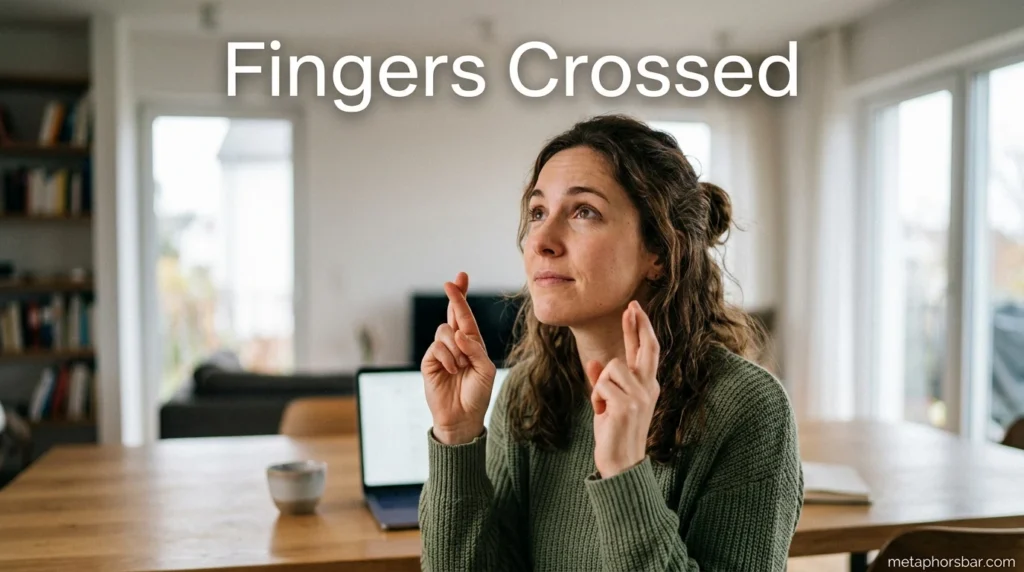
People often get confused by fingers crossed because it looks like a simple phrase, but it is actually an idiom with a specific social meaning. In everyday writing and speaking, it can show hope, luck, or quiet support. That matters in exams, casual conversation, emails, messages, and professional communication because a phrase like this can change the tone of what you say. Used correctly, it sounds natural and friendly. Used incorrectly, it can seem awkward or unclear.
The good news is that fingers crossed is easy to understand once you know what it means and how it is used. In this article, you will learn the meaning, correct usage, grammar patterns, pronunciation, sentence examples, common mistakes, and simple memory tips so you can use it confidently and naturally.
What Does “Fingers Crossed” Mean?
The phrase fingers crossed is used to express hope that something will happen well or hope for a lucky result. It is often said when the outcome is uncertain.
Simple meaning
- I hope things go well.
- Let’s hope for the best.
- I am wishing for good luck.
- I am hoping something works out.
Examples
- Fingers crossed that the interview goes well.
- We’re waiting for the results, so fingers crossed.
- Fingers crossed the weather stays nice.
What the phrase suggests
This phrase usually carries:
- hope
- optimism
- anxiety
- a wish for good luck
Comparison table: basic meaning
| Phrase | Meaning | Tone |
| fingers crossed | hope for a good outcome | hopeful, informal |
| good luck | wishing success | neutral |
| I hope so | expressing hope | common, neutral |
| let’s hope for the best | positive expectation | conversational |
A simple way to think about it
If something important is uncertain, fingers crossed is a friendly way to say:
- “I hope this turns out well.”
Where Does the Phrase Come From?
The phrase comes from a traditional gesture: crossing the fingers, usually the index finger over the middle finger, to symbolize hope or luck.
Why the gesture matters
People have long used physical gestures to show wishes and beliefs. Crossing the fingers became connected with:
- hope for protection
- a wish for luck
- quietly expressing support
Why it is still popular
Even today, the phrase is common because it is:
- short
- easy to understand
- emotionally warm
- useful in both speech and writing
Origin summary table
| Element | Explanation |
| literal image | crossing fingers |
| figurative meaning | hoping for a good outcome |
| common use | messages, speech, casual writing |
| tone | friendly and informal |
Important note
The phrase is usually used figuratively, not literally. If someone says “finger cross,” they may or may not actually cross their fingers. The phrase itself already carries the meaning.
Read More: https://metaphorsbar.com/abstract-nouns/
Correct Usage in Real Life
This phrase is most often used when the result is not yet known. It is a way to show hope without sounding too serious.
Common situations
- waiting for exam results
- hoping for good weather
- wishing for success in an interview
- waiting for a reply
- hoping a plan works
Examples
- Fingers cross that I pass the test.
- The meeting is tomorrow, so fingers cross.
- Fingers cross we get the job.
- Fingers cross the package arrives today.
Comparison table: where the phrase fits best
| Situation | Example | Meaning |
| exam result | Fingers crossed I pass. | hope for success |
| travel | Fingers crossed the flight is on time. | hope for smooth travel |
| job interview | Fingers crossed I get the position. | hope for a positive result |
| daily life | Fingers crossed it doesn’t rain. | hope for a good outcome |
Tone and style
The phrase is:
- casual
- friendly
- supportive
- slightly emotional
It is very common in:
- texts
- chats
- informal emails
- spoken English
- social media posts
More examples in context
- “I sent in my application yesterday.”
“Great. Finger crossed!” - “The doctor will call us this afternoon.”
“Finger crossed everything is okay.”
This makes the phrase useful for comforting or encouraging others as well as yourself.
Grammar Rules Behind “Fingers Crossed”
Even though fingers crossed is an idiom, it still follows grammar patterns.
Basic structure
The phrase usually appears in one of these forms:
- Fingers crossed!
- Fingers crossed that + clause
- Keep your fingers crossed
- I’ve got my fingers crossed
Grammar comparison table
| Form | Example | Function |
| fingers crossed | Fingers crossed! | short expression of hope |
| fingers crossed that + clause | Fingers crossed that we win. | full sentence with hope |
| keep your fingers crossed | Keep your fingers crossed for me. | request for support |
| have my fingers crossed | I have my fingers crossed. | describe current hope |
Common sentence patterns
- Finger crossed that she arrives on time.
- Keep your finger crossed for me.
- I have my finger crossed about the results.
- We’re all keeping our finger crossed.
Verb agreement note
When you turn the phrase into a full sentence, you must still use normal grammar:
- I have my finger crossed.
- She has her finger crossed.
- They are keeping their finger crossed.
Correct examples
- I have my fingers cross for you.
- She has her fingers cross.
- They are keeping their fingers cross.
Incorrect examples
- I has my finger crossed.
- She have her finger crossed.
- Finger crossed that he wins.
This is not wrong in casual speech, but it is more of a fragment unless context makes it clear.
A useful tip
The phrase often works as a standalone comment in conversation or as a short phrase before a clause. That is why it feels so natural in spoken English.
Sentence Examples: Correct and Incorrect Usage
Examples make idioms much easier to understand.
Correct examples
- Finger crossed the weather stays clear.
- I’m keeping my finger crossed for good news.
- Finger crossed that the surgery goes well.
- She said, “Finger crossed!” when the results were announced.
- We’ve done all we can, so finger crossed.
More real-life examples
- Fingers cross that the train is not delayed.
- I’ve got my finger crossed for your interview.
- Fingers cross the boss approves the plan.
- Fingers cross the new software works properly.
Correct ways to expand the phrase
- I’ve got my fingers cross.
- We’re keeping our fingers cross.
- Let’s keep our fingers cross.
- I’m crossing my fingers that everything goes well.
Incorrect examples
- Fingers cross the weather stays clear.
- I’m keeping my finger crossed.
- Fingers cross that the test goes well.
- We have finger crossed.
- Crossing finger for you.
Correct vs incorrect table
| Incorrect | Correct |
| I’m keeping my finger crossed. | I’m keeping my fingers crossed. |
| Fingers cross that we win. | Fingers crossed that we win. |
| Crossed fingers for you. | I’ve got my fingers crossed for you. |
| Fingers crossing for the results. | I’m keeping my fingers crossed for the results. |
Why these corrections matter
The idiom is fixed. The most common standard forms use:
- fingers (plural)
- crossed (past participle/adjective-like form)
So the phrase should usually stay as:
- finger crossed
- keep your finger crossed
- I’ve got my finger crossed
Common Mistakes Learners Make
Because the phrase is so familiar, learners often make small but noticeable mistakes.
1: Using the wrong number
- Wrong: finger crossed
- Right: fingers cross
The phrase is usually plural because it refers to the gesture with two fingers.
2: Confusing the noun and verb forms
- Wrong: Fingers cross that he passes.
- Right: Finger crossed that he passes.
3: Forgetting the article or possessive in full sentences
- Wrong: I have fingers cross.
- Right: I have my fingers cross.
4: Using it in a completely literal way when the idiom is intended
If you want to express hope, just use the phrase naturally. Do not over-explain it.
- Better: Fingers cross we get there on time.
- Less natural: I am crossing my fingers in order to show that I hope we get there on time.
5: Overusing it in formal writing
This phrase is friendly, but it may sound too casual in serious reports or formal letters.
Common mistake table
| Wrong | Correct |
| finger crossed | fingers crossed |
| I have fingers crossed. | I have my fingers crossed. |
| Fingers cross for you. | Fingers crossed for you. |
| Crossing finger that it works. | Fingers crossed that it works. |
Easy memory tip
Remember:
- fingers = plural
- crossed = fixed idiomatic form
- my/your/our = needed in full sentences
Pronunciation, Style, and British vs American English
Pronunciation
The phrase is usually pronounced like:
- FING-gerz krawst or FING-gerz krosd
The exact sound depends on accent, but the rhythm stays simple.
Spoken rhythm
- FINGER CROSSED
The phrase is short and easy to say, which makes it very common in conversation.
Style
This phrase sounds:
- casual
- supportive
- hopeful
- friendly
It is common in:
- text messages
- speaking
- social media
- informal emails
- everyday conversation
Style comparison table
| Phrase | Tone | Best use |
| fingers crossed | casual, hopeful | conversation, texting |
| I hope so | neutral | everyday speech |
| let’s hope for the best | warm, positive | conversation |
| best wishes | polite, more formal | cards, emails |
British vs American English
There is no major difference in meaning or spelling between British and American English for this phrase. Both use it in the same way.
Comparison table
| Feature | British English | American English |
| phrase | fingers crossed | fingers crossed |
| meaning | hope for a good outcome | hope for a good outcome |
| spelling | same | same |
| usage | common and natural | common and natural |
Practical note
You do not need separate rules for British and American English here. It is a universal idiom in modern English.
FAQs
Is “fingers crossed” correct English?
Yes. It is a very common and correct idiom.
Does it mean “good luck”?
Yes, in many situations it is used to mean “I hope things go well” or “good luck.”
Can I use it in writing?
Yes, especially in informal writing, chats, messages, and casual emails.
Is it formal?
No. It is informal and friendly.
Can I say “keep your fingers crossed”?
Yes. That is one of the most common full forms of the phrase.
Is “fingers crossed” the same as “I hope”?
They are similar, but not identical. Fingers crossed is more casual and emotional.
Can I use it for myself and for other people?
Yes.
- For myself: Finger crossed I pass.
- For someone else: Finger crossed for your interview.
Can I say “I’m keeping my fingers crossed for you”?
Yes. That is a very natural and supportive sentence.
Is it rude?
No. It is usually warm and encouraging.
What is the easiest way to remember it?
Think of the phrase as a short way to say:
- “I hope everything goes well.”
Conclusion
The phrase fingers crossed is a friendly and natural idiom used to show hope for a good result. It is often said when the outcome is uncertain, and it can be used in conversation, texting, informal writing, and supportive comments. The phrase usually appears in fixed forms such as fingers crossed, keep your fingers crossed, or I’ve got my fingers crossed.
Here is the easiest way to remember it:
- fingers = the plural gesture
- crossed = the traditional hope/luck idea
- meaning = “I hope this turns out well”
So write:
- Finger crossed the weather stays nice.
- I’m keeping my finger crossed for you.
- Finger crossed that the interview goes well.
If you remember only one thing, remember this: fingers crossed is a simple, natural way to express hope for a positive outcome. That small phrase will help you sound warm, fluent, and confident in everyday English.