
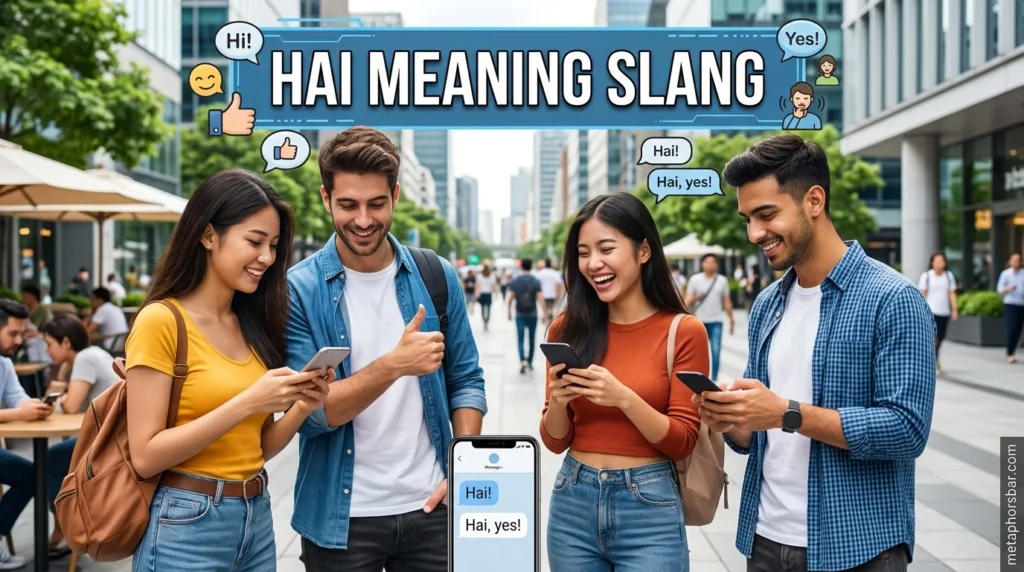
If you have seen hai in a text, comment, caption, or DM and wondered what it means, you are not alone. People search for hai meaning slang because the word looks like a small typo, but in online conversation it can be a real greeting with its own style. Internet slang matters because a tiny word can change the tone of a message, and knowing what it means helps you reply naturally instead of feeling confused.
In many chats, hai works like a casual “hi” or “hey,” and in some online meme-style writing it can feel a little playful, cute, or exaggerated. That is why it shows up on WhatsApp, Instagram, TikTok, and Snapchat. Understanding it can help you read messages faster, avoid overthinking, and recognize when someone is just saying hello in a fun way. Current slang sources and dictionaries treat it as a greeting rather than a secret code.
What does “hai” mean in text?
In texting and online chat, hai usually means hi or hey. Urban Dictionary defines it as “actually the word ‘Hey’” used as a greeting, and in internet-style writing it is often used as a playful or stylized way to call attention or start a conversation. In other words, if someone messages you “hai,” they are usually just saying hello in a cute, casual, or slightly meme-like way.
In simple English, hai can mean:
- hi
- hey
- hello
- a casual greeting
- a playful internet-style opening line
Does hai have a full form?
No. Hai is not a standard acronym, so it does not have a true “full form” like BRB or IDK. The closest plain-English meaning is hi or hey. Urban Dictionary describes it as the word “hey” in a stylized spelling, and other language references show that “hai” can also exist as a separate word in other languages, which is why context matters.
Short meaning of hai
The short meaning of hai is:
- hello
- hi
- hey
- a friendly greeting
- a cute or casual internet-style opener
Why people search for hai meaning slang
People search for hai because it can look like a typo of “hi,” a foreign-language word, or a meme spelling. Since the same letters show up in different languages and contexts, readers often want to know whether it is just a greeting or something else. Urban Dictionary and other current references show that the internet slang meaning is basically a greeting, which is why it appears in chats, memes, and casual social posts.
It is also searched because online language keeps changing. Some people write “hai” to sound cute, playful, or ironic, while others use it as a simple hello. That mix makes it useful to understand before replying.
Origin and rise in popularity
The slang spelling hai is often linked to internet meme style and playful online writing. Urban Dictionary says it is used as a greeting and notes that it was spread in part by the Irish TV show Hardy Bucks in some circles. Another common internet use is “hai guise,” which Urban Dictionary describes as a memey way of saying “hi guys.” These examples show how “hai” became popular through internet humor and stylized spelling rather than through formal grammar.
At the same time, “hai” is also a real word in several languages, so its popularity online is partly because it is short, simple, and visually distinctive. That makes it easy to use as a greeting in chat, captions, and memes.
How “hai” is used in real conversations
In real conversation, hai is usually just a casual greeting. It can sound friendly, a little cute, or a little goofy depending on the person using it. Urban Dictionary’s examples show it being used as a call for attention or as a greeting at the end of a question.
Here are natural examples:
- “Hai, how are you?”
- “Hai there!”
- “Hai bestie”
- “Hai, you free later?”
- “Oh hai, didn’t see you there”
In each example, the meaning is basically hello. The spelling just gives it a more playful or stylized feel.
Hai meaning on WhatsApp, Instagram, TikTok, and Snapchat
Since hai usually means hi or hey, its meaning stays mostly the same across major platforms. The platform changes the vibe, not the core meaning. That is an inference based on the greeting definitions from current sources and the way those platforms are used for casual messaging.
On WhatsApp, “hai” usually reads as a simple hello in a private chat or group chat. Because WhatsApp is a direct-messaging app, a short greeting like this feels natural. You might see it as the first word in a message or as a cute opener.
Example:
- “hai, are you coming?”
On Instagram, “hai” often appears in DMs, comments, or story replies. It can sound playful or flirty, but most of the time it still just means “hey.” The stylized spelling can make a message feel softer or more casual.
Example:
- “hai, nice photo!”
TikTok
On TikTok, “hai” can show up in comments, captions, or meme-style posts. TikTok often rewards short, cute, or ironic writing, so the spelling fits the platform’s style very well. It still means a greeting, not a separate hidden code.
Example:
- “hai, this video is so funny”
Snapchat
On Snapchat, “hai” often appears in quick chats or snap replies. Since Snapchat is built around fast casual conversation, a short greeting like this feels very normal there. It may sound a little more playful than a plain “hi.”
Example:
- “hai, send another snap”
What “hai” does not mean
Hai does not usually mean something formal, technical, or secret. It is not a code word in normal texting. It is also not a standard acronym with a fixed full form. The main internet meaning is simply a greeting.
“Hai” also does not mean WYLL. WYLL is a different slang term that means “what do you look like?” according to Merriam-Webster. So if someone says “hai,” they are not asking about your appearance.
And because “hai” is also a real word in some languages, it does not always belong to slang. For example, Wiktionary lists “hai” in several languages, including as a verb in Spanish and as a word in some other language contexts, so the surrounding message matters.
Common confusions and wrong interpretations
A common mistake is thinking “hai” is always just a typo of “hi.” Sometimes it is, but often it is a deliberate stylized spelling used for tone. Urban Dictionary shows that it is used as a greeting and can spread through memes and internet culture.
Another confusion is assuming it is a foreign-language word in every message. Sometimes it is, but in chat slang it is often just a cute way to say hello. Because the same spelling can appear in other languages, you should always look at context.
A third mistake is reading too much into it. In most messages, “hai” is just a friendly opener, not a serious statement.
Similar slang terms and alternatives
If you understand “hai,” you will also recognize these similar greetings:
- hi
- hey
- hello
- hey there
- yo
- what’s up
Hai vs hi
“Hi” is the standard spelling. “Hai” is the playful, stylized version often seen online.
Hai vs hey
“Hey” can feel a little more direct or attention-getting. “Hai” often feels softer, cuter, or more meme-like. That difference is based on the stylized nature of the spelling in internet use.
How to reply when someone says “hai”
Your reply can be simple because “hai” is already a greeting. The best answer usually depends on the tone you want to give back. Since it is casual, you do not need a long reply unless you want to keep the conversation going.
Polite replies
- “Hi!”
- “Hey!”
- “Hello!”
- “Hi, how are you?”
These are the safest and most natural answers.
Flirty replies
If the conversation already feels playful or romantic, you can reply lightly:
- “Hai, stranger 😉”
- “Hai, you made my day.”
- “Oh, hai there.”
These are tone-based examples, not a special meaning of the word.
Boundary-respecting replies
- “Hi, I’m busy right now.”
- “Hello, what’s up?”
- “Hey, I’ll reply later.”
- “Hi, please keep it short.”
These are useful if you want to stay polite without opening a long chat.
Is “hai” still popular?
Yes, “hai” is still recognizable online, especially in meme-style writing and casual chat. Urban Dictionary still defines it as a greeting, and “hai guise” continues to appear as an internet-style playful spelling of “hi guys.” That means it is still alive as a stylized online greeting rather than a formal abbreviation.
Its place in Gen Z slang culture is mostly playful. It is not a huge viral term like some newer internet words, but it stays useful because it sounds cute, light, and familiar in chat.
FAQs
What does “hai” mean in text?
It usually means hi or hey in a casual, playful way.
Is “hai” slang?
Yes. In internet use, it is often a stylized slang spelling of “hi” or “hey.”
What does “hai” mean on TikTok?
On TikTok, it usually works as a cute or playful greeting.
Does “hai” have a full form?
No. It is not a standard acronym. The closest meaning is simply hi or hey.
Is “hai” the same as WYLL?
No. WYLL means “what do you look like?” while hai is just a greeting.
Can “hai” mean something in another language?
Yes. It can appear in other language contexts too, so meaning depends on context.
Conclusion
Hai in slang usually means hi or hey. It is a playful, stylized greeting often used in chats, comments, captions, and memes. On WhatsApp, Instagram, TikTok, and Snapchat, it still works like a friendly hello, just with a softer or cuter tone. It is not a formal acronym, and it is not the same as WYLL. Once you know the context, “hai” is easy to understand and easy to reply to naturally.