
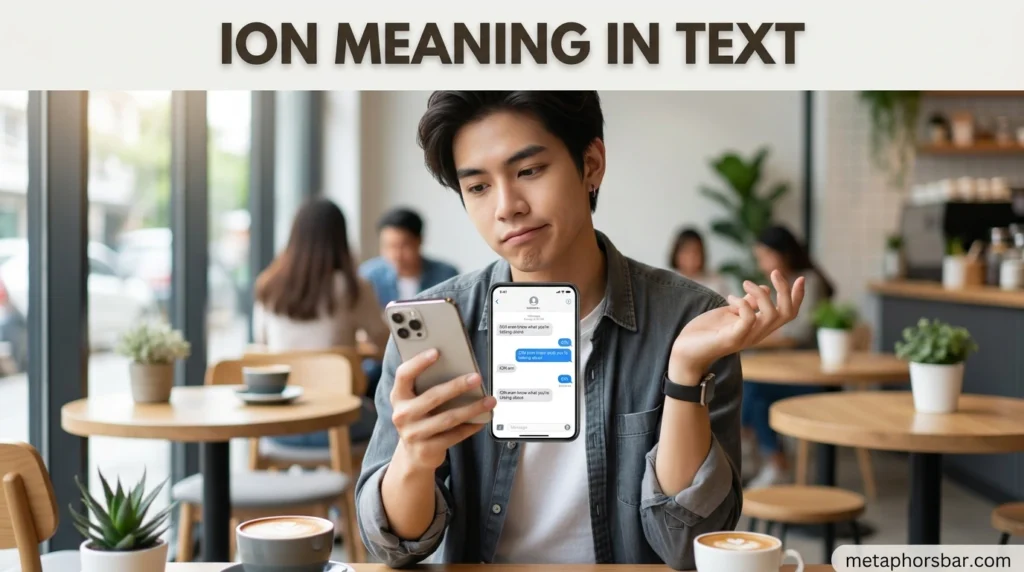
If you have seen ION in a text and paused for a second, you are not alone. People search for ion meaning in text because this tiny word can look like a chemistry term, a typo, or slang all at once. In modern digital conversations, short forms spread quickly, and a small abbreviation can carry a whole tone: casual, blunt, tired, or dismissive. That is why understanding internet slang matters.
It helps you read messages correctly, catch the speaker’s mood, and reply naturally without guessing. The most common texting meaning of ion today is “I don’t”, usually in phrases like “ion know” or “ion care.” Depending on context, it can sometimes function like “I don’t know,” but the core idea is the same: a fast, informal way of saying “I don’t…” in casual chat.
What does ION mean in text?
In texting and online chat, ION usually means “I don’t.” explains that the slang ion is used in Black English as a shorthand for “I don’,” and modern slang explainers describe it as an informal spelling people use in casual conversation. In real messages, it often appears inside longer phrases such as “ion know” or “ion care.”
In simple English, ION can mean:
- I don’t know.
- I don’t care.
- I didn’t mean to.
- I don’t want to.
That is why ION often feels less like a formal acronym and more like a fast, spoken-style shortcut. It reflects how people actually say the words in casual conversation.
ION full form
ION does not have one single official full form the way some acronyms do. In texting slang, it is usually just a phonetic spelling of “I don’t.” Slang guides also show it being used in forms like ion know and ion care, which makes the “full form” more about sound than spelling.
ION short meaning
The short meaning of ION is basically:
- I don’t
- I don’t know
- I don’t care
- I didn’t mean to
Why people search for ION meaning in text
People search for this because ION is easy to confuse with the science word ion, which is a charged atom or molecule. Merriam-Webster and both define the standard science word that way, so the same letters can mean something completely different depending on context.
It is also common in casual chat, social media, and music lyrics, so beginners often want to know whether they are seeing slang or a real scientific term. notes that the slang ion shows up in social media and text messaging, and current slang explainers continue to treat it as an active texting form in 2026.
Origin and rise in popularity
The texting version of ION comes from spoken casual English, especially the way “I don’t” can sound like “ion” in fast speech. Dictionary.com describes it as part of Black English, and Slang.org says ION is an alternative slang spelling of “I don’t,” popularized on Twitter. Later, it spread through texting, TikTok, DMs, and group chats because it is fast and expressive.
Its rise in popularity fits the larger trend of internet language becoming more speech-like. People often type the way they talk, especially when they want to sound relaxed, blunt, or authentic. That is why ION works so well in modern chat.
How ION is used in real conversations
ION is usually used when someone wants to sound casual and avoid spelling out the full phrase. It often appears in answers that show uncertainty, refusal, or lack of interest. MeaningLoop and Urban Dictionary examples show ION in phrases like “ion know,” “ion care,” and “ion mean to…”
Here are some natural examples:
- “ion know.”
- “ion care.”
- “ion even know.”
- “ion mean to do that.”
- “ion wanna go.”
In each example, the word is not standing alone as a normal dictionary item. It is part of a casual sentence that sounds like spoken English.
ION in short chat style
ION is useful because it makes messages shorter and more conversational. Instead of writing a complete sentence, people can quickly type the slang form and keep the tone informal. That is one reason it remains visible in social media, DMs, and group chats.
ION meaning on WhatsApp, Instagram, TikTok, and Snapchat
The core texting meaning of ION stays the same across platforms: I don’t. What changes is the kind of conversation around it. On WhatsApp, it often appears in quick personal chats. On Instagram, it may show up in comments or replies. On TikTok, it is common in captions or comment threads where people are reacting fast. On Snapchat, it fits short, casual exchanges especially well.
WhatsApp example
“ion know yet.”
This is a natural WhatsApp-style reply when someone is unsure or does not have an answer. WhatsApp is built for quick, private messaging, so slang like ION fits easily there.
Instagram example
“ion care what they say.”
On Instagram, ION often shows up in comments or DMs where the speaker wants to sound blunt or unbothered.
TikTok example
“ion even know how this happened.”
TikTok comments often use short, expressive slang, and ION works well there because it feels fast and conversational.
Snapchat example
“ion wanna argue.”
Snapchat is one of the most natural places for this slang because users tend to keep messages short and casual.
What ION does not mean
ION does not usually mean the science word when someone is texting casually. The chemistry definition of ion is a charged atom or molecule, and that is the meaning you should use in science, math, or physics contexts. In casual chat, though, the slang meaning is the one people usually intend.
ION also does not mean WYLL. WYLL is a different slang term entirely. Merriam-Webster defines WYLL as “what do you look like?” so it is about appearance, not refusal, uncertainty, or “I don’t.”
ION is not a formal acronym with one universal definition either. Its meaning changes a little by context, but the main texting sense is still “I don’t.”
Common confusions and wrong interpretations
A common mistake is assuming ION must always be a science term. That is only true when the conversation is about chemistry or physics. If the message sounds casual, the slang meaning is probably the correct one.
Another mistake is thinking ION is the same as IDK. They are related in feeling, but not identical. Ion know means “I don’t know,” while IDK is a more standard internet abbreviation for the same idea. The style is different, even if the message is similar.
A third confusion is reading ION as rude every time. It can sound blunt, but it is usually just casual shorthand. The tone depends on the full sentence and the relationship between the speakers.
Similar slang terms and related abbreviations
ION belongs to a larger family of fast chat forms that people use to sound informal or expressive. Similar terms include:
- IDK = I don’t know
- IDC = I don’t care
- Iono / iono = I don’t know
- I ain’t = informal spoken form often used similarly
- NAH = no / no thanks
ION vs IDK
ION is a spoken-style spelling, while IDK is a more standard abbreviation. Both can express uncertainty, but ION sounds more like the way people naturally speak.
ION vs IDC
ION is about I don’t in a broader sense, while IDC is explicitly I don’t care. If someone says “ion care,” they are essentially saying IDC in a more stylized form.
ION vs the science word ion
This is the easiest comparison to remember:
- ION in text = I don’t
- ion in science = a charged atom or molecule
How to reply when someone says ION
How you reply depends on what the person is trying to say. If they mean they do not know something, you can keep the conversation moving. If they are refusing something or showing disinterest, your response should match the tone. Since ION often sounds blunt, a calm reply usually works best.
Polite replies
- “No worries.”
- “That’s okay.”
- “Got it.”
- “Fair enough.”
These work when the person is simply saying they do not know or do not want something.
Flirty replies
ION itself is not a flirty term, but in a playful conversation you can answer lightly:
- “ion know? maybe you do 😉”
- “ion believe you’re this mysterious.”
- “ion? tell me more.”
These replies only fit when the conversation already feels playful.
Boundary-respecting replies
- “That’s fine, but please be direct.”
- “I understand, but I need a clear answer.”
- “No problem, we can talk later.”
- “I hear you, but I’m not pushing it.”
These are useful if the message feels vague or dismissive.
Is ION still popular?
Yes, ION is still popular in casual texting and social media. Recent 2026 explainers still describe it as a current slang shortcut used in messages, comments, and DMs, especially among younger users. also notes that the slang ion continues to appear in social media and text messaging.
Its place in Gen Z slang culture is strong because it sounds like speech, not formal writing. That makes it feel natural in fast, real-time conversation. It is not the flashiest slang word, but it remains useful because it is short and authentic.
FAQs
What does ION mean in text?
ION usually means I don’t in texting and online chat.
Is ION slang?
Yes. ION is a slang spelling used in casual online conversation.
What does ION mean on TikTok?
On TikTok, ION usually means I don’t and is commonly used in captions or comments.
Does ION mean I don’t know?
Often, yes. In phrases like ion know, it means I don’t know.
Is ION the same as the science word ion?
No. In science, ion means a charged atom or molecule. In texting, ion usually means I don’t.
Is ION the same as WYLL?
No. ION means I don’t, while WYLL means what do you look like?
Conclusion
ION in text most commonly means “I don’t.” You will usually see it in phrases like “ion know,” “ion care,” or “ion wanna.” It is a casual, speech-like spelling that fits modern chats on WhatsApp, Instagram, TikTok, and Snapchat. It is not the same as the chemistry word ion, and it is not the same as WYLL. Once you know the context, ION becomes easy to read and easy to reply to. In most conversations, it simply helps people sound quick, informal, and real.