
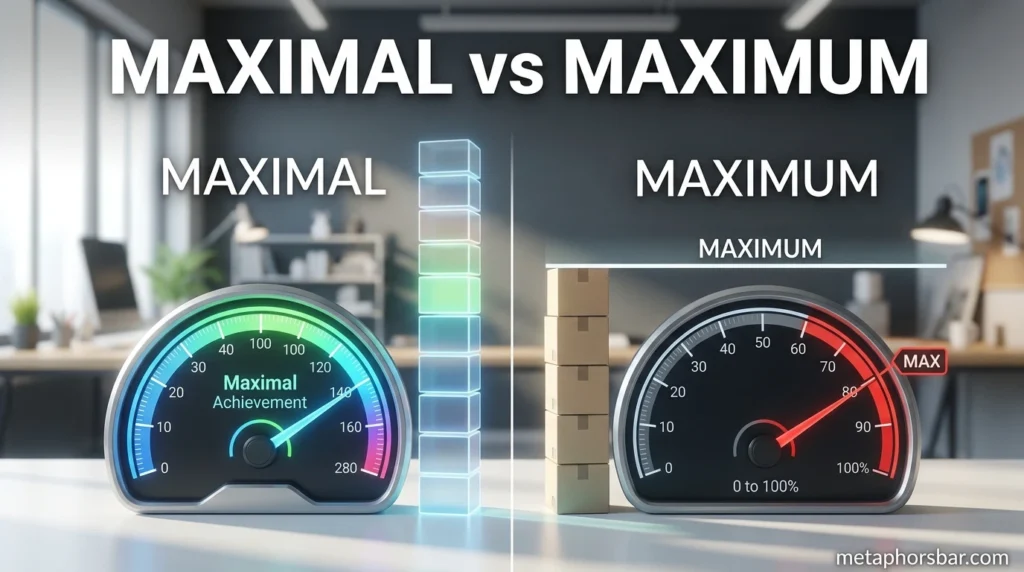
English learners often get confused by maximal vs maximum because the two words look closely related and both seem to mean “as much as possible.” That confusion matters in everyday writing, speaking, exams, and professional communication because using the wrong form can make your English sound less precise. In math, business, science, or formal writing, the difference is especially important because one word usually describes a noun and the other usually describes an adjective.
The good news is that the difference is simple once you see the pattern. Maximum usually refers to the greatest amount, number, or level, while maximal usually means as great as possible or the highest possible degree. In many everyday situations, especially in standard English, maximum is much more common. In this article, you will learn the meaning, correct usage, spelling differences, grammar rules, pronunciation, sentence examples, common mistakes, and easy memory tips so you can use both confidently.
What Do “Maximal” and “Maximum” Mean?
At the basic level, both words are connected to the idea of something being at the highest point. But they are not used in exactly the same way.
Maximum
Maximum means:
- the greatest amount
- the highest number
- the highest level allowed
- the most possible
Examples:
- The maximum speed is 60 km/h.
- He reached the maximum score.
- We can stay for a maximum of two hours.
Maximal
Maximal means:
- as great as possible
- of the highest degree
- reaching the greatest possible extent
Examples:
- The patient showed maximal improvement.
- The machine works at maximal efficiency.
- The plan aims for maximal benefit.
Simple meaning table
| Word | Main meaning | Common idea |
| maximum | greatest amount or level | the most |
| maximal | as great as possible | highest possible degree |
Key idea
- maximum = the top limit or greatest amount
- maximal = the greatest possible degree or extent
That difference may seem small, but it changes how the word is used in a sentence.
Which One Is Correct in Which Situation?
The correct choice depends on grammar and meaning.
Use maximum when:
- you are talking about a limit
- you need a noun
- you want to say the highest amount or number
- you want a common, everyday word
Examples:
- The maximum temperature today is 35°C.
- You may stay for a maximum of ten minutes.
- This is the maximum capacity of the room.
Use maximal when:
- you need an adjective
- you want to describe something as as great as possible
- you are writing in a more formal, technical, or academic style
Examples:
- The treatment gives maximal relief.
- We want maximal efficiency.
- She showed maximal effort during the experiment.
Side-by-side usage table
| Situation | Better choice | Example |
| limit or cap | maximum | maximum speed |
| greatest amount | maximum | maximum number of students |
| highest possible degree | maximal | maximal benefit |
| technical or academic description | maximal | maximal response |
Practical rule
If you can replace the word with the most or the greatest amount, use maximum.
If you can replace it with as great as possible, use maximal.
A simple example
- maximum: “The maximum number of tickets is 4.”
- maximal: “The program aims for maximal growth.”
The first one gives a limit. The second one describes the highest possible degree.
Grammar Rules Behind the Two Words
The biggest grammar difference is that maximum and maximal do not behave the same way in a sentence.
Maximum as a noun
Maximum is often a noun. It can be the subject or object of a sentence.
Examples:
- The maximum is 100.
- We reached the maximum.
- There is a maximum of five people.
Maximum as an adjective
Maximum can also be used like an adjective before a noun.
Examples:
- maximum speed
- maximum value
- maximum capacity
Maximal as an adjective
Maximal is mainly an adjective.
Examples:
- maximal effort
- maximal efficiency
- maximal benefit
Grammar comparison table
| Word | Part of speech | Example | Function |
| maximum | noun | The maximum is 100. | a limit or highest amount |
| maximum | adjective | maximum speed | describes a noun |
| maximal | adjective | maximal effort | describes a noun |
Important note
In everyday English, maximum is far more common than maximal. You will see maximum in:
- signs
- rules
- instructions
- school work
- business documents
- newspapers
You will see maximal more often in:
- academic writing
- technical writing
- medicine
- biology
- psychology
- formal analysis
Why learners get confused
Because both words can describe something “at the top,” learners may think they are interchangeable. But one usually talks about a limit and the other usually talks about the greatest possible degree.
Correct vs incorrect examples
| Incorrect | Correct |
| maximal speed limit | maximum speed limit |
| maximum effort in the study | maximal effort in the study |
| the maximal is 50 | the maximum is 50 |
| maximum benefit possible | maximal benefit possible |
Sentence Examples: Correct and Incorrect Usage
Examples make the difference much easier to understand.
Correct examples with maximum
- The maximum number of students is 30.
- Please drive at the maximum speed allowed.
- You can keep the car for a maximum of three days.
- The room has a maximum capacity of 50 people.
- The calculator shows the maximum value.
Correct examples with maximal
- The patient showed maximal improvement after treatment.
- The software is designed for maximal performance.
- The system aims for maximal efficiency.
- We need maximal cooperation from all members.
- The goal is maximal productivity with minimal waste.
More real-life examples
- Maximum: “The maximum weight allowed is 10 kg.”
- Maximal: “The therapy produced maximal results.”
- Maximum: “There is a maximum of six people per table.”
- Maximal: “The lab studied maximal enzyme activity.”
Incorrect examples
- The maximum benefit is reached by the patient.
This may be acceptable in some contexts, but maximal benefit is often more natural if you mean “greatest possible benefit.” - He worked with maximum effort in the technical report.
This can be understandable, but maximal effort may be better in a technical or scientific context. - The maximal speed is 100.
Usually wrong if you mean a limit. Use maximum speed.
Correct vs incorrect table
| Incorrect | Correct |
| maximal speed limit | maximum speed limit |
| the maximal is 10 | the maximum is 10 |
| maximum performance possible | maximal performance possible |
| maximum benefit in biology | maximal benefit in biology |
A useful observation
In many cases, maximum is the safer and more natural choice. Use maximal mainly when you want a precise, technical, or formal adjective meaning “as great as possible.”
Common Mistakes Learners Make
Because the words are related, learners often make predictable mistakes.
Mistake 1: Using maximal for a limit
- Wrong: The maximal speed is 60.
- Right: The maximum speed is 60.
Why? A speed limit is a maximum, not a maximal condition.
Mistake 2: Using maximum when maximal is more precise
- Less precise: The treatment gives maximum relief.
- Better: The treatment gives maximal relief.
Why? In this case, the meaning is not a simple limit but the greatest possible extent of relief.
Mistake 3: Thinking both words are always interchangeable
They are not. One is often about a limit, and the other is often about a degree.
Mistake 4: Using maximal in everyday speech where maximum is simpler
- Less natural: We can stay for a maximal of ten minutes.
- Better: We can stay for a maximum of ten minutes.
Mistake 5: Forgetting that maximum can be a noun
- Wrong: The maximum speed is the maximal.
- Right: The maximum speed is 60.
Common mistakes table
| Wrong sentence | Correct sentence |
| maximal speed limit | maximum speed limit |
| maximal of five people | maximum of five people |
| maximum benefit in a technical study | maximal benefit in a technical study |
| the maximal is 100 | the maximum is 100 |
Easy memory tips
Think:
- maximum = limit, cap, greatest amount
- maximal = highest possible degree, especially in technical or formal writing
That simple idea will help you avoid most mistakes.
Pronunciation, Style, and British vs American English
Pronunciation
The words sound similar, but the stress patterns are slightly different.
- maximum is usually pronounced MAK-si-mum
- maximal is usually pronounced MAK-si-muhl or MAK-si-mal
Pronunciation table
| Word | Approximate pronunciation | Notes |
| maximum | MAK-si-mum | common word, three syllables |
| maximal | MAK-si-muhl | more formal-sounding |
| maximize | MAK-si-myze | related verb |
Style
- Maximum is more common in everyday English and formal instructions.
- Maximal is more technical and academic.
Style comparison table
| Word | Tone | Best use |
| maximum | common, practical | rules, limits, general writing |
| maximal | technical, academic | research, science, formal analysis |
British vs American English
There is no major British vs American English difference in the meaning of the words. Both varieties use:
- maximum
- maximal
The real difference is frequency:
- maximum is much more common in both British and American English
- maximal is less common and more specialized
Practical note
If you are unsure, maximum is usually the safer choice unless the sentence clearly needs the more technical adjective maximal.
FAQs
Is “maximal” the same as “maximum”?
Not exactly. They are related, but maximum usually means the greatest amount or limit, while maximal means as great as possible.
Which word is more common?
Maximum is much more common in everyday English.
Which word means “limit”?
Maximum.
Which word means “as great as possible”?
Maximal.
Can I say “maximum effort”?
Yes, people say that, but in technical or formal writing maximal effort may be more precise depending on the context.
Can I say “maximal speed”?
Usually no if you mean a speed limit. Use maximum speed.
Is “maximum” a noun or adjective?
It can be both.
Is “maximal” a noun?
No, it is mainly an adjective.
What is the safest word to use?
In most everyday situations, maximum is the safer and more natural word.
Is there a British spelling difference?
No. The spelling is the same in British and American English.
Conclusion
The difference between maximal and maximum is easy once you remember their jobs.
- Maximum = the greatest amount, number, or limit
- Maximal = as great as possible, especially in formal or technical writing
So write:
- maximum speed
- maximum number of people
- maximum capacity
- maximal benefit
- maximal efficiency
- maximal improvement
If you remember only one thing, remember this: use “maximum” for limits and greatest amounts, and use “maximal” for the highest possible degree or extent. That simple rule will help you choose the right word in writing, speaking, exams, and professional communication with confidence.