

The stadium lights glow like small moons in the dark sky. The air smells of grass and sweat. A runner bends low at the starting line. Her breath comes fast. Her heart pounds like a drum in a parade. The crowd goes quiet. Then the gun fires—and she shoots forward like an arrow released from a bow.
In that moment, she is not just a person running. She is a storm. A spark. A rocket.
This is the magic of metaphors for athletes. A metaphor helps us see something in a new way. It says one thing is another thing. It paints a picture in our mind. Instead of saying, “He runs fast,” we say, “He is lightning on the track.” The second line feels alive. It moves.
Metaphors are important in sports writing, speeches, social media posts, and even daily talk. They add power. They help us feel the struggle, the hope, and the joy of athletes. In this article, you will explore strong, easy metaphors for athletes. You will learn what they mean, how to use them, and how to create your own.
Let’s step onto the field.
What Are Metaphors for Athletes? Simple Meaning and Power
A metaphor says one thing is another thing to show a deeper truth.
When we say, “An athlete is a warrior,” we do not mean they wear armor or carry a sword. We mean they are brave. They fight hard. They never give up.
Metaphors for athletes help us:
- Show strength
- Show speed
- Show focus
- Show teamwork
- Show heart
Writers, coaches, and fans use metaphors to inspire others. Great sports moments often feel bigger than life. Metaphors help match that big feeling.
Think of famous athletes like Muhammad Ali. People called him “The Greatest.” That phrase became a metaphor. It meant more than winning. It meant boldness and belief.
Now let’s explore powerful examples.
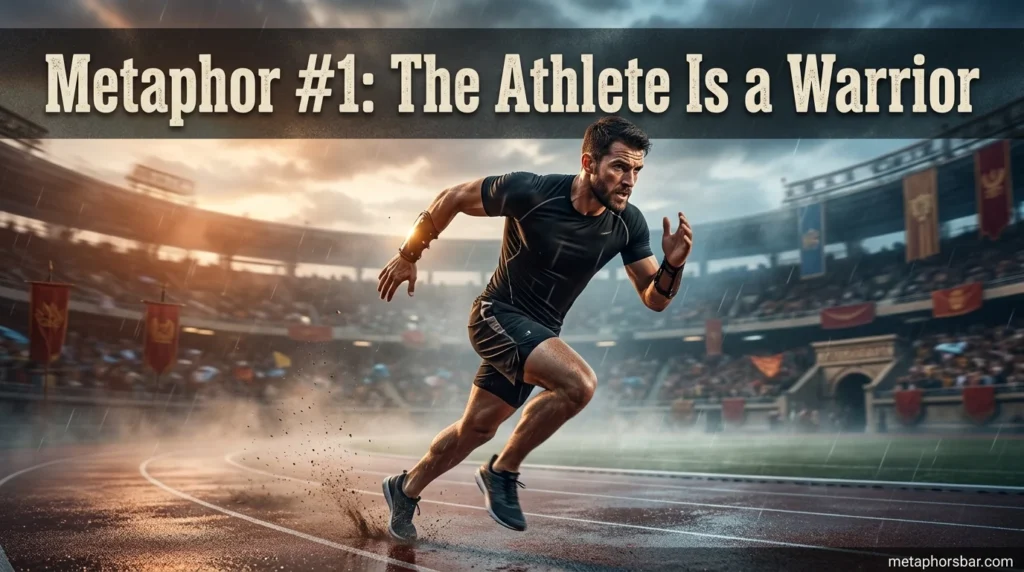
Metaphor #1: The Athlete Is a Warrior
Meaning and Explanation
Calling an athlete a warrior means they are brave and strong. They fight through pain. They do not quit when things get hard.
This metaphor works well in tough sports like boxing, football, or wrestling.
Example Sentence or Scenario
“After twisting his ankle, he stayed on the field. He was a warrior in the final minutes.”
You can imagine sweat on his face. Mud on his knees. The crowd roaring. He keeps going.
Another Way to Say It
- She is a soldier on the court.
- He is a fighter in every match.
- They are battle-tested champions.
Mini Story
When Serena Williams came back after injuries, many called her a warrior. She faced young players. She faced doubt. Yet she stood tall. The court was her battlefield.
The word “warrior” shows courage, not violence. It shows heart.
Metaphor #2: The Athlete Is Lightning
Meaning and Explanation
Lightning is fast. It is bright. It strikes in a flash. When you call an athlete lightning, you highlight speed and surprise.
This metaphor fits runners, soccer players, and wide receivers.
Example Sentence or Scenario
“She was lightning on the track, gone before anyone could blink.”
You can see her shoes hit the ground. You hear the quick slap of steps. Then she crosses the line.
Another Way to Say It
- He is a bolt of speed.
- She is a flash across the field.
- They move like a sudden spark.
Cultural Touch
Think of Usain Bolt. His last name is Bolt. Fans often said he was lightning. The metaphor felt perfect.
Lightning shows power and beauty. It feels wild and alive.
Metaphor #3: The Athlete Is a Machine
Meaning and Explanation
A machine works without stopping. It does not slow down. It keeps going with steady force.
Calling someone a machine shows strength, control, and endurance.
Example Sentence or Scenario
“He lifted weight after weight. He was a machine in the gym.”
You picture metal plates clanging. Muscles tight. Sweat dripping. No break. Just rhythm.
Another Way to Say It
- She is built like steel.
- He runs like clockwork.
- They are engines on the field.
Real-Life Example
Fans once called Cristiano Ronaldo a machine. He trains hard. He keeps his body strong, He scores again and again. The metaphor shows his steady power.
This metaphor fits athletes who train with focus and discipline.
How to Create Your Own Metaphors for Athletes

Here is one simple tip:
Tip: Match the Quality, Not the Object
Do not just pick a random thing. Ask yourself:
- Is the athlete fast? Think of lightning, a cheetah, or a rocket.
- Is the athlete strong? Think of a mountain or a bull.
- Is the athlete calm? Think of still water.
Focus on the quality first.
For example:
If a goalkeeper stays calm under pressure, you could say, “He is an anchor in a storm.”
The anchor is not the player. But it shows steadiness.
Try to feel the mood. Then choose the image.
Metaphors for Teamwork in Sports
Athletes do not always shine alone. Teams matter.
Example: The Team Is a Symphony
Meaning
A symphony is music played by many instruments. Each part matters. When they work together, the sound is beautiful.
Example Sentence
“The team moved like a symphony, each pass smooth and timed.”
You can almost hear the rhythm of feet and ball.
Another Way to Say It
- They are a well-oiled machine.
- They are threads in one strong rope.
- They move as one body.
Mini Story
In basketball, players like Stephen Curry shine. But even he needs teammates. When the team passes well and defends together, they become more than five players. They become music.
Team metaphors show unity and trust.
Metaphors for Mental Strength in Athletes
Sports are not just about muscles. The mind matters.
Example: The Athlete Is a Rock**
Meaning
A rock stands firm. Wind hits it. Rain falls. It does not move.
This metaphor shows calm and strength under pressure.
Example Sentence
“During the penalty kick, she was a rock. She did not shake.”
The stadium is loud. Fans shout. But she breathes slow. She kicks. Goal.
Another Way to Say It
- He is unbreakable.
- She is steel under stress.
- They are calm seas in chaos.
Mental strength often decides big games.
Metaphors for Comebacks and Growth
Athletes fall. They lose. They get hurt. Then they rise.
Example: The Athlete Is a Phoenix
Meaning
A phoenix is a bird from stories that rises from ashes. It is reborn after fire.
This metaphor shows comeback and new life.
Example Sentence
“After her injury, she returned like a phoenix, stronger than before.”
You see flames. You see ashes. Then bright wings rise.
Another Way to Say It
- He rose from the dust.
- She came back stronger.
- They rebuilt from ruins.
This metaphor fits comeback stories in any sport.
Interactive Exercise
Let’s practice.
Exercise 1: Fill in the Blank
- The swimmer was a ______ in the water.
- The boxer stood like a ______ in the ring.
- The young player is a ______ ready to explode.
Choose images that match speed, strength, or potential.
Exercise 2: Rewrite a Simple Sentence
Simple: “She plays very well.”
Now add a metaphor.
Example: “She is a shining star on the court.”
Try your own version.
Exercise 3: Use a Real Athlete
Pick an athlete you admire. It could be Lionel Messi or someone from your local team.
Write one line:
“_____ is a _____ because _____.”
This helps you connect the image to the reason.
Bonus Tips
Metaphors are not only for books.
In Writing
- Use one strong metaphor, not too many at once.
- Keep it simple.
- Make sure it matches the mood.
Instead of: “He is a rocket, storm, lion, and tank.” Pick one. Let it shine.
On Social Media
Sports captions love strong images.
Example: “Game day. Ready to be a storm on the field.”
Short. Bold. Easy to feel.
In Daily Life
You can inspire friends.
Tell a child after practice: “You were a star out there.”
That line can build confidence.
Famous Cultural and Literary References in Sports Metaphors
Writers often compare athletes to heroes from stories.
Some call great players “giants.” This reminds us of legends in old tales.
Others call them “kings” or “queens” of the sport.
When people called Michael Jordan “Air Jordan,” it was more than a nickname. It was a metaphor. It showed flight, grace, and power in the air.
These images stick in our minds. They turn moments into myths.
FAQs
What are metaphors for athletes?
Metaphors for athletes are creative comparisons that describe athletes in vivid and imaginative ways. Instead of describing someone directly, a metaphor compares them to something else, such as a machine, warrior, or cheetah, to highlight qualities like speed, strength, endurance, or determination.
Why are metaphors important in sports writing?
Metaphors make sports writing more engaging and emotional. They help readers picture the action, understand an athlete’s abilities, and feel the excitement of competition. A strong metaphor can turn an ordinary description into something memorable and powerful.
What are some common metaphors for athletes?
Some popular metaphors include:
- “A warrior in the arena” for a fearless competitor
- “A machine” for someone consistent and unstoppable
- “A cheetah on the field” for an extremely fast athlete
- “A rock” for a dependable teammate
- “A storm” for a player who overwhelms opponents
Can metaphors inspire athletes?
Yes, metaphors can be highly motivational. Comparing athletes to powerful or determined images can boost confidence, encourage persistence, and create a strong mindset before competitions or training sessions.
Are metaphors only used in professional sports?
No. Metaphors are used in school sports, coaching, motivational speeches, fitness communities, and everyday conversations. Anyone can use metaphors to describe athletic performance or determination.
How can I create my own metaphor for athletes?
Think about the athlete’s strongest quality, such as speed, power, focus, or resilience. Then compare that quality to something widely recognized for the same trait. For example:
- Speed → lightning, rocket, cheetah
- Strength → bulldozer, mountain, iron wall
- Endurance → marathon engine, endless river
What is the difference between a metaphor and a simile?
A metaphor directly states that one thing is another, such as “The athlete was a lion.” A simile uses words like “as” or “like,” such as “The athlete was as fierce as a lion.”
Can metaphors make sports speeches better?
Absolutely. Coaches, commentators, and motivational speakers often use metaphors to inspire teams and energize audiences. They make messages more emotional, memorable, and impactful.
Conclusion
Metaphors for athletes bring energy, emotion, and imagination into the world of sports. They transform ordinary descriptions into vivid images that capture the strength, speed, discipline, and passion of athletic performance. Whether an athlete is described as a warrior, a machine, or a lightning bolt, these comparisons help readers and listeners better understand the intensity and determination behind every game and competition.
Using metaphors can also inspire athletes themselves by reinforcing confidence and motivation. From sports journalism to motivational speeches and casual conversations, athlete metaphors add color and excitement that make stories unforgettable. By learning and creating your own metaphors, you can describe athletic talent in a way that feels powerful, creative, and truly alive.