
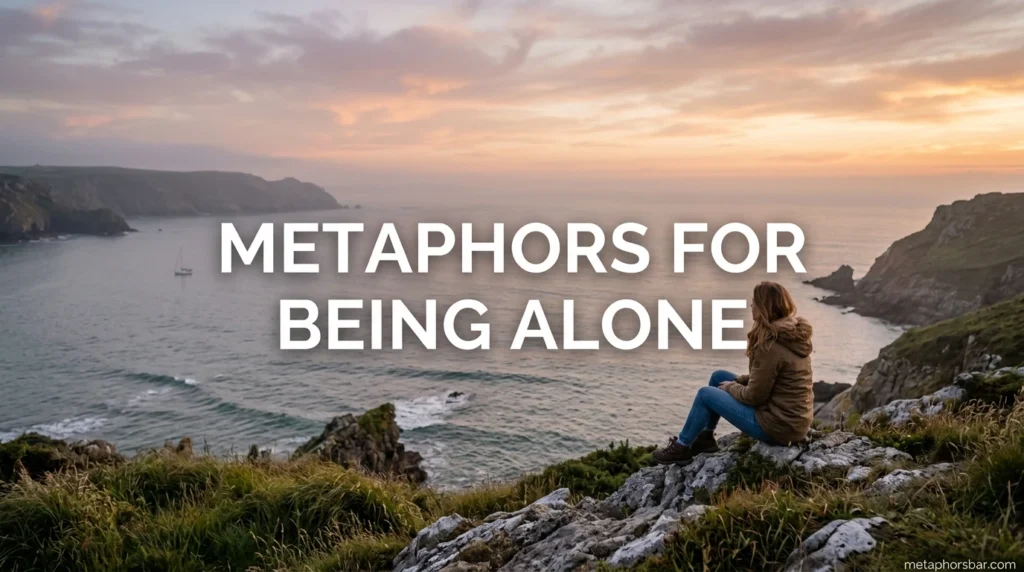
Not the soft kind of quiet that feels warm and safe. This was a deep, echoing quiet. The clock ticked louder than usual. The wind tapped the window like a shy guest. I sat at the kitchen table with a cup of tea, and for a moment, it felt like I was the only person left in the world.
Have you ever felt that way?
Being alone can feel heavy. It can feel calm. It can feel scary, It can feel freeing, It depends on the moment. That is why metaphors for being alone matter. They help us explain feelings that are hard to say in plain words. They give shape to silence, They turn empty rooms into stories.
In this article, you will explore three powerful metaphors for being alone. Each one comes with meaning, examples, and simple ways to use it. You will also find one helpful tip, creative prompts, and bonus ideas for writing or daily life. Let’s step into the quiet together.
Understanding Metaphors for Being Alone
A metaphor is when we say something is something else to show meaning. We do not mean it in a real way. We mean it in a feeling way.
For example:
- “My heart is a stone.”
- “Time is a thief.”
- “Life is a journey.”
When we talk about being alone, we can say:
- “I am an island.”
- “I am a lone wolf.”
- “I am a single star in the sky.”
These images help people see and feel what we feel.
Metaphors are important because:
- They make writing more interesting.
- They help others understand our emotions.
- They help us understand ourselves.
- They are useful in poems, stories, social media captions, and even daily talks.
Now, let’s explore three strong metaphors for being alone.
1. Being Alone Is an Island in the Ocean
Picture a small island in the middle of a wide blue sea. Waves crash against its edges. Birds circle above. The island stands alone.
Meaning and Explanation
When someone says, “I feel like an island,” they mean they feel cut off from others. They feel separate. They may feel strong, but also lonely.
This metaphor is very old. In fact, the English poet John Donne once wrote, “No man is an island.” He meant that humans need each other.
Example Sentence or Scenario
- “After moving to a new city, I felt like an island surrounded by strangers.”
- A student sits in a new classroom. Everyone else laughs and talks. She looks down at her desk. She feels like a small island in a sea of noise.
Another Way to Say It
- “I feel cut off.”
- “I feel surrounded but alone.”
- “I’m drifting away from everyone.”
Sensory and Emotional Details
You might imagine:
- Cold wind.
- Loud waves.
- Empty sand.
- A wide sky with no one in sight.
The island can feel sad. But it can also feel strong. It stands firm, even when storms hit.
Mini Story Moment
Think about a character like Robinson Crusoe from the novel Robinson Crusoe. He lived alone on an island. At first, he felt scared and lost. Later, he learned to survive. The island became a place of growth.
Being alone can feel like that too. Hard at first. Powerful later.
2. Being Alone Is a Lone Wolf in the Forest
Now picture a gray wolf walking through a dark forest. Leaves crunch under its paws. The moon shines above. The wolf moves alone.
Meaning and Explanation
A “lone wolf” is someone who prefers to be alone or works alone. Sometimes it means strength. Sometimes it means isolation.
Wolves usually live in packs. So a lone wolf stands apart. It may feel free. It may feel left out.
Example Sentence or Scenario
- “He has always been a lone wolf, choosing quiet nights over loud parties.”
- A teenage boy eats lunch by himself. He reads a book. He is not sad. He just likes his own space. He is a lone wolf.
Another Way to Say It
- “I walk my own path.”
- “I keep to myself.”
- “I don’t follow the crowd.”
Sensory and Emotional Details
Imagine:
- Cool night air.
- Silver moonlight.
- Tall dark trees.
- Soft howls in the distance.
The lone wolf may feel proud. It may feel calm. But it may also long for a pack.
Cultural Note
In movies and stories, the lone wolf is often the hero. Think of quiet characters who stand apart but stay strong. They do not need noise to feel alive.
This metaphor shows that being alone is not always weakness. It can be independence.
3. Being Alone Is a Star in the Empty Sky
Look up at the night sky. See one bright star shining far away from the others. It glows quietly in the dark.
Meaning and Explanation
When someone says, “I feel like a star in an empty sky,” they mean they feel alone but visible. They may feel small in a big world. Yet they still shine.
Stars are far from each other. Yet they are beautiful.
Example Sentence or Scenario
- “At the party, I felt like a single star in a dark sky.”
- A girl moves abroad for school. She stands on her balcony at night. She looks at the sky and whispers, “I am just one star out here.”
Another Way to Say It
- “I’m one in a million.”
- “I’m small in a big world.”
- “I shine even when I’m alone.”
Sensory and Emotional Details
Imagine:
- Cool night breeze.
- Deep blue sky.
- Soft glittering light.
- Silence all around.
This metaphor feels quiet and soft. It shows beauty in solitude.
Literary Touch
Many poems compare people to stars. Stars guide travelers in the dark. So even if you feel alone, you might still guide someone else.
The Difference Between Loneliness and Solitude
Not all being alone is bad.
Loneliness hurts. It feels heavy. It feels unwanted.
Solitude is chosen. It feels peaceful. It feels calm.
An island can feel lonely during a storm. A lone wolf can feel strong during a quiet walk. A star can feel proud while shining alone.
Understanding this difference helps us use metaphors in the right way.
Ask yourself:
- Am I lonely?
- Or am I enjoying my own space?
The answer changes the image.
Why Metaphors for Being Alone Matter in Writing
Metaphors:
- Make stories more powerful.
- Help readers feel emotions.
- Create strong images in the mind.
- Make social media posts deeper.
Instead of saying:
- “I feel lonely.”
You can say:
- “I feel like an island lost in fog.”
Which one paints a stronger picture? The second one.
Writers, poets, bloggers, and even students can use these metaphors to add color to simple sentences.
1 Helpful Tip: Match the Metaphor to the Mood
Here is one simple but powerful tip:
Choose your metaphor based on how you truly feel.
If you feel strong and proud:
- Use the lone wolf.
- Use the shining star.
If you feel cut off and sad:
- Use the island in a storm.
- Use an empty room with echoes.
Example
Bad match:
- “I feel like a bright star” (but you are very sad).
Better match:
- “I feel like an island in heavy fog.”
When your image matches your feeling, your words feel real.
Interactive Exercise
Let’s practice.
Step 1: Think About a Time You Felt Alone
Was it:
- In a crowd?
- At home?
- In school?
- In a new city?
Close your eyes for 10 seconds and picture it.
Step 2: Ask These Questions
- What did it feel like?
- Cold or warm?
- Loud or silent?
- Dark or bright?
Step 3: Finish This Sentence
- “Being alone feels like ______.”
Maybe you write:
- “Being alone feels like a book with no one to read it.”
- “Being alone feels like a bench in an empty park.”
- “Being alone feels like a boat drifting without a map.”
There is no wrong answer.
Using Metaphors for Being Alone in Social Media and Daily Life
Here are bonus tips:
For Instagram or Facebook Captions
Instead of:
- “Feeling lonely tonight.”
Try:
- “Just a lone wolf under the moon.”
- “An island in a sea of noise.”
- “A single star in a wide sky.”
Short. Deep. Beautiful.
For Journaling
Write:
- “Today I felt like…”
Then describe it with images. This helps you understand your emotions better.
For Stories or Poems
Use sensory words:
- Sound: wind, echo, silence.
- Sight: moon, shadow, fog.
- Touch: cold air, rough sand.
The more senses you add, the more alive your writing feels.
FAQs
1. What is a metaphor for being alone?
A metaphor for being alone is a figurative comparison that describes solitude, isolation, independence, or emotional distance through vivid imagery. For example, “He was an island in a restless sea.”
2. Why are metaphors for being alone useful in writing?
They help express complex emotions connected to loneliness or solitude in a more emotional and relatable way. Metaphors make feelings easier to visualize and understand.
3. What are some common metaphors for being alone?
Popular metaphors include:
- an island in the ocean
- a single star in the night sky
- a lone wolf wandering the woods
- an empty room echoing with silence
- a candle burning in the dark
Each metaphor captures different emotions, from peaceful solitude to deep loneliness.
4. Can metaphors for being alone have positive meanings?
Yes. Being alone is not always negative. Some metaphors suggest independence, peace, or self-discovery.
For example:
“She was a quiet forest untouched by noise.”
This metaphor reflects calm solitude rather than sadness.
5. How can I create my own metaphor for being alone?
Think about what solitude feels like to you—silent, peaceful, distant, or empty—and compare it to an image from nature, objects, or experiences.
Example:
“His thoughts drifted like a boat alone on still water.”
6. Are metaphors for being alone only used in poetry?
No. They are commonly used in novels, songs, journals, speeches, films, social media captions, and personal reflections.
7. What makes a strong metaphor for being alone?
A strong metaphor is emotionally honest, vivid, and easy to imagine. It should capture the mood of solitude clearly, whether peaceful or painful.
Conclusion
Being alone can carry many meanings. Sometimes it feels heavy and isolating, like standing in an empty landscape. Other times, it feels peaceful, like sitting quietly beneath the stars. Metaphors help us express these layered emotions in ways that plain words often cannot.
An island, a lone wolf, a single candle in the dark—these images turn solitude into something visible and deeply human. They remind us that being alone is not always the same as being lost. It can also mean reflection, independence, healing, and self-discovery.
Whether you are writing poetry, telling a story, or exploring your own emotions, metaphors for being alone can bring depth, beauty, and emotional truth to your words. Sometimes, the quietest feelings leave the strongest echoes.