
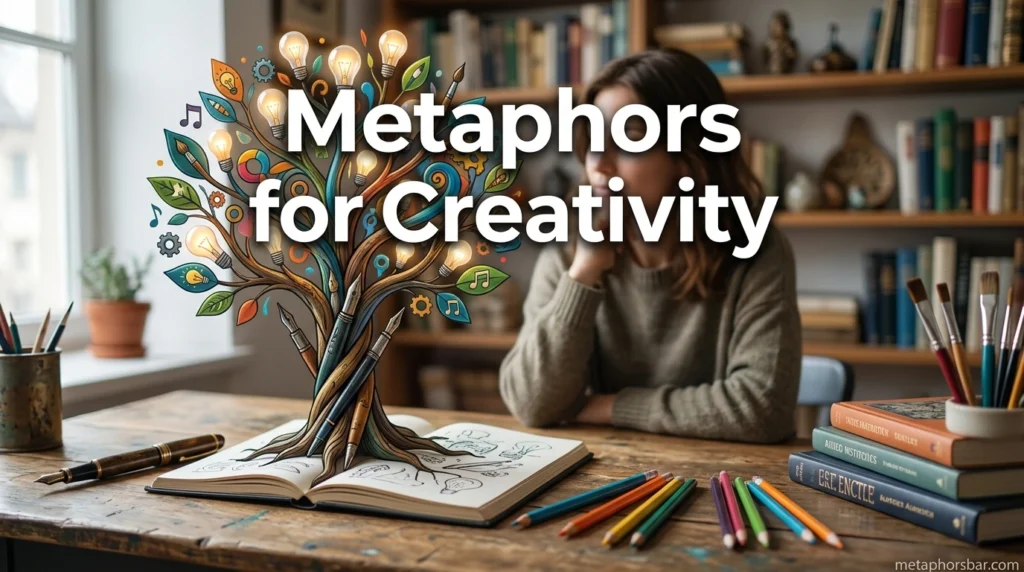
Creativity often begins in a way that feels almost invisible. A half-formed idea arrives while you are washing dishes. A line of dialogue appears in the middle of a walk. A color, a rhythm, a phrase, a shape—something small and spark-like—lands in the mind and refuses to leave. Then, slowly, it gathers into something larger. Creativity is both mysterious and familiar, both wild and carefully shaped. It is the moment when the ordinary begins to glow.
That is why metaphors for creativity matter so much. Creativity can be hard to pin down because it is not one simple act. It is invention, revision, curiosity, courage, play, and persistence all moving together. A strong metaphor helps us describe that process in a way that feels vivid and alive. It turns the invisible work of imagination into an image readers can see, feel, and remember.
Whether you are writing poetry, storytelling, social media captions, essays, speeches, or daily journal entries, metaphors for creativity can make your language warmer, sharper, and more inspiring.
Why Metaphors for Creativity Matter in Writing and Communication
They make an invisible process easier to see
Creativity often happens inside the mind first. A metaphor gives that private process shape, making it easier to understand and share.
They help describe different kinds of creativity
Some creativity feels slow and nourishing. Some feels fast and electric, Some feels fluid, playful, or disciplined. The right metaphor can match the exact mood.
They make your language more memorable
A sentence like “I had a creative idea” is clear. A sentence like “an idea bloomed in my mind like a wildflower after rain” leaves an impression.
They encourage creative thinking
Metaphors do not just describe creativity—they can spark it. They invite the mind to make new connections, which is often the heart of creativity itself.
Three Powerful Metaphors for Creativity
1. Creativity as a Garden
A garden is one of the richest metaphors for creativity because it suggests growth, patience, tending, and bloom. Creativity often begins as a seed: a tiny idea that needs time, attention, and care before it becomes something visible. Like a garden, creativity is not always instant. It needs watering, pruning, sunlight, and seasons.
Meaning and explanation
When creativity is compared to a garden, it emphasizes cultivation rather than accident. Ideas are planted, nurtured, protected from weeds, and allowed to grow at their own pace. This metaphor works especially well when creativity is something you develop over time instead of something that arrives fully formed.
It also suggests that not every idea blooms immediately. Some seeds lie hidden before sprouting. Others need patience, rest, or a change in conditions. That makes this metaphor especially helpful for artists, writers, and anyone who is waiting for inspiration to take root.
Example sentence or scenario
Her creativity was a garden, each project planted carefully and given time to bloom in its own season.
This metaphor works beautifully in memoirs, essays, coaching language, and writing about the creative process.
Alternative ways to express it
- a seedbed of ideas
- a field of possibility
- a blooming mind
- a living patch of imagination
- a place where thoughts grow
Sensory and emotional details
You can imagine the smell of damp earth, the warm weight of sun on leaves, the quiet patience of roots spreading underground, and the bright surprise of flowers opening. Emotionally, this metaphor feels nurturing, hopeful, and patient. It suggests creativity as something alive, tended, and full of promise.
Mini storytelling touch
A novelist once described her first draft process as “throwing seeds into soil I could not yet see.” Months later, the story had grown into a book. That image stays because it captures the slow miracle of creativity: you plant, wait, revise, and then one day the work seems to bloom under your hands.
Literary or cultural reference
Gardens have long symbolized cultivation, renewal, and hidden growth in literature and culture. As a metaphor for creativity, the garden feels timeless because it honors both effort and emergence.
2. Creativity as a River
A river is always moving. It bends, widens, narrows, deepens, and keeps finding its way forward. As a metaphor for creativity, a river suggests flow, momentum, flexibility, and the ability to move around obstacles without losing its direction. It is especially useful when creativity feels alive, spontaneous, or continuous.
Meaning and explanation
When creativity is described as a river, it emphasizes movement and continuity. Ideas do not always arrive in a straight line. They meander, loop, gather speed, or slow down. A river metaphor allows for that freedom. It suggests that creative thought can flow through a person naturally, carrying one idea into the next.
This metaphor is especially powerful for writers and artists who experience a “flow state,” or for any creative work that feels more like movement than construction. It also reminds us that creativity can adapt. When it hits a rock, it does not stop—it curves.
Example sentence or scenario
Her creativity flowed like a river, carrying her from one image to the next until the page felt alive with motion.
This metaphor is ideal for describing inspiration, brainstorming, freewriting, and the experience of being immersed in creative work.
Alternative ways to express it
- a current of ideas
- a stream of imagination
- a flowing path of thought
- a moving force
- a channel of inspiration
Sensory and emotional details
You can hear water moving over stone, see sunlight flashing on the surface, and feel the quiet power of motion beneath the current. Emotionally, this metaphor feels freeing, alive, and gently unstoppable. It suggests creativity as something that carries us if we let it.
Mini storytelling touch
A poet once said that on her best writing days, “the words knew the road before I did.” That is the essence of the river metaphor. Creativity can feel like following something already in motion beneath the surface, rather than forcing it into existence.
Literary or cultural reference
Rivers are among the oldest literary symbols of life, change, and passage. As a metaphor for creativity, they capture the idea that imagination is not a fixed thing—it is movement, rhythm, and transformation.
3. Creativity as Fire
Fire is a powerful metaphor for creativity because it suggests spark, warmth, energy, transformation, and the ability to illuminate. Creativity often begins with a spark of interest, a flash of insight, or a moment of excitement that catches and spreads. Fire is also a perfect image for the way creativity can consume attention and turn raw material into something new.
Meaning and explanation
When creativity is compared to fire, it emphasizes intensity and transformation. A spark can become a flame. A flame can become a blaze. The image works especially well when creativity feels passionate, urgent, or electrifying. It also captures the fact that creativity can light the way, revealing what was previously hidden.
This metaphor is especially strong for moments of inspiration or for describing the emotional energy behind making something meaningful.
Example sentence or scenario
His creativity burned like a fire, turning scraps of memory and observation into a brilliant new story.
This metaphor works beautifully in poetry, artist statements, and descriptions of creative urgency.
Alternative ways to express it
- a spark of invention
- a flame of imagination
- a blaze of ideas
- a glowing mind
- a fire that transforms
Sensory and emotional details
You can imagine the crackle of flame, the warm light flickering across a room, and the way a fire changes whatever it touches. Emotionally, this metaphor feels passionate, powerful, and alive. It suggests creativity as something that can warm, reveal, and transform all at once.
Mini storytelling touch
A painter once described the start of a new series as “the moment something catches in the dark.” That is the heart of the fire metaphor. Creativity can begin with a spark so small that you almost miss it, but once it catches, it changes everything around it.
Literary or cultural reference
Fire appears throughout myth and literature as a symbol of inspiration, knowledge, and transformation. As a metaphor for creativity, it connects the act of making to one of humanity’s oldest symbols of change.
How to Choose the Right Metaphor for Creativity
Use garden when creativity feels patient and nurturing
Choose this metaphor if your process involves care, growth, and gradual blooming.
Use river when creativity feels flowing and spontaneous
This is the best choice when inspiration moves naturally, bends easily, and carries you along.
Use fire when creativity feels intense and transformative
Choose this image when creativity arrives as a spark, a rush, or a powerful act of making something new.
The best metaphor depends on the stage and feeling of your creative work. Creativity can grow, flow, and burn—and sometimes it does all three in the same day.
Interactive Exercises for Practicing Metaphors for Creativity
Exercise 1: Complete the sentence
Finish this prompt in three different ways:
“Creativity is like ______ because ______.”
Try one answer that feels patient, one that feels fluid, and one that feels passionate.
Example: Creativity is like a garden because even the smallest seed can become something beautiful with time and care.
Exercise 2: Sensory mapping
Think of a moment when you felt especially creative. Write down:
- one sound
- one texture
- one color
- one movement
- one emotion
Then turn those details into a metaphor.
For example: Creativity sounded like rain tapping a window, felt like soil in my hands, looked like a river catching sunlight, moved like a spark racing through dry grass, and carried the emotion of hope.
Exercise 3: Story starter
Begin a short paragraph with:
“Creativity felt like…”
Let the image guide the tone. You can make it poetic, reflective, playful, or intense.
Exercise 4: Social media or journal prompt
Try writing a one-line reflection:
- “My creativity is a garden I keep returning to.”
- “Ideas move through me like a river.”
- “Today my imagination caught fire.”
Bonus Tips for Using Metaphors for Creativity in Writing, Social Media, and Daily Life
In writing
Use creativity metaphors in essays, memoirs, poems, artist statements, and reflections on process. They help you describe not just what you made, but how making felt.
On social media
A short metaphor can make a caption about your creative life feel memorable and authentic. “My ideas are flowing like a river today” can feel more vivid than “I’m inspired.”
In everyday conversation
Metaphors can help you explain the creative process in a more colorful way. Instead of saying “I’m working on new ideas,” you might say, “My garden is blooming this week.”
In journaling
If you are trying to understand your own creativity, metaphor can help you notice whether it feels planted, flowing, or burning. That awareness can guide your process.
Keep the image honest
The strongest metaphor is the one that truly fits your creative moment. Some days creativity grows slowly, some days it rushes forward, and some days it arrives with a sudden spark. Let the image match the truth.
FAQs
1. What is a metaphor for creativity?
A metaphor for creativity is a figurative comparison that describes the creative process using another image, such as a garden, river, or fire.
2. Why are metaphors for creativity useful?
They help make inspiration and imagination easier to visualize, understand, and express in writing or speech.
3. What is a simple metaphor for creativity?
A simple example is: Creativity is like a garden. It suggests growth, patience, and care.
4. Can these metaphors be used in teaching or workshops?
Yes. They are especially useful for explaining inspiration, brainstorming, and creative development to others.
5. How do I create my own metaphor for creativity?
Think about what creativity feels like—growing, flowing, burning, building, or blooming—and compare it to something with similar qualities.
6. Are these metaphors only for artists or writers?
No. Creativity metaphors can be used by anyone—students, teachers, entrepreneurs, speakers, designers, or people reflecting on ideas and innovation.
7. What makes a strong metaphor for creativity?
A strong metaphor is vivid, emotionally accurate, and easy to picture. It should help the reader feel the process of creativity, not just define it.
Conclusion
Creativity is one of the most fascinating human experiences because it is both a spark and a process. It can grow quietly like a garden, move steadily like a river, and transform everything it touches like fire. That is why metaphors matter—they help us describe not only what creativity produces, but what it feels like to make something new.
A garden reminds us that ideas need care. A river reminds us that creativity moves and adapts. A fire reminds us that inspiration can illuminate and transform. Together, these images show that creativity is not just a skill—it is a living, breathing way of seeing the world.
So when you write about creativity, do not settle for plain description alone. Let it grow, flow, or burn through your language. A good metaphor can make creativity feel unforgettable.