
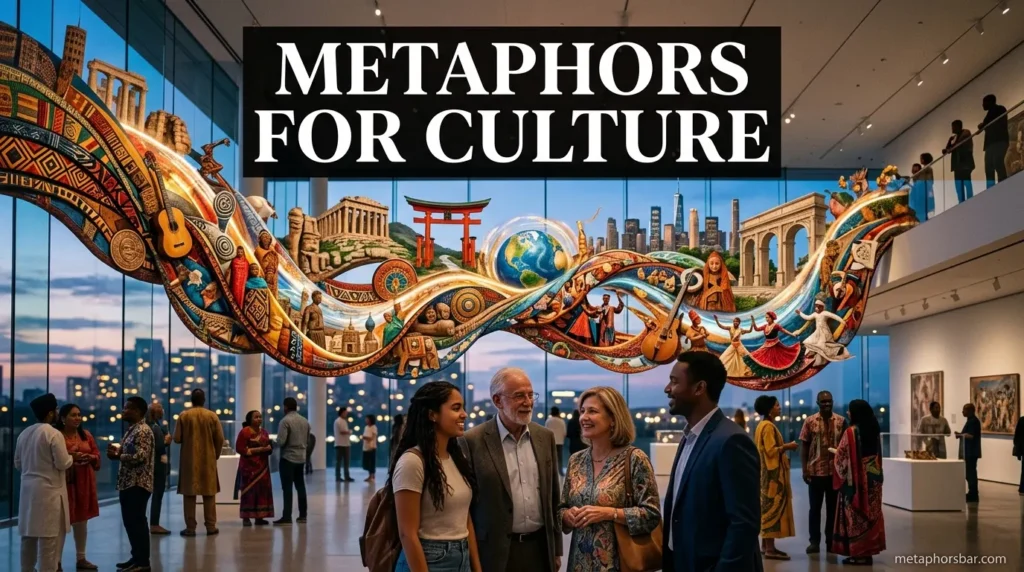
Stepping into a bustling festival in the warm glow of lanterns, you feel the scent of spices, hear laughter in many tongues, and see vivid colors blending in movement. In that moment, culture isn’t just a concept – it’s alive all around you, complex and rich. But how do we put culture into words? Anthropologists define culture broadly as “that complex whole which includes knowledge, beliefs, arts, morals, law, customs… acquired by man as a member of society”.
Because this “whole” is intangible, we often reach for metaphors to describe it. Metaphors help us give shape to something vast: they let us say culture is something visible or tangible, like a tapestry or a flowing river. This enriches our understanding and communication. In the next sections we explore three vivid metaphors for culture, why they work, and how you can use them creatively.
Culture as a Tapestry of Traditions
Meaning and Explanation
Imagine culture as a tapestry or mosaic, a piece of art woven from countless threads or tiles. Each thread is a custom, each tile a belief or tradition. Just as threads in a tapestry cross and connect to form a picture, so do customs, languages, foods, and stories intertwine to form a culture. This metaphor emphasizes diversity and harmony: each element is unique yet contributes to one beautiful whole. A tapestry is carefully arranged but also full of surprises—a rich pattern where every color matters. In the same way, culture is not a flat list of traits but a layered fabric.
Example in Practice
Consider a community celebrating a cultural fair with dance, music, and cuisine from many backgrounds. One might describe the scene: “Our city’s culture is a tapestry, woven from threads of generations – the new immigrant stories glint beside the old, traditional patterns.” This sentence uses the metaphor to highlight how different traditions overlap. In real life, you could say, “This festival is a cultural tapestry: French pastries, African drumming, and Indian henna all appear side by side.” Each component adds to the overall richness.
Alternative Expressions
Sometimes we say mosaic instead of tapestry. Both suggest many pieces making one image. You might call something a “cultural quilt” or “patchwork of traditions.” For example: “American culture has long been described as a mosaic, each immigrant group adding its own tile.” These alternatives carry the same idea of variety and unity.
Sensory and Emotional Details
A tapestry metaphor can evoke a tactile sense of fabric or color. You might imagine the rough weave of wool or the smooth shine of silk threads. The image can feel warm and human, even comforting – like being wrapped in a blanket of shared heritage. The emotional tone is often one of appreciation or celebration: each thread is valued.
Mini-Story: In a small town, an artist began a community quilt project. Each family was invited to sew a patch representing their heritage (a flag, a symbol, a family recipe written in fabric). When stitched together, the quilt told a story: “This quilt became a cultural tapestry, each square a family’s story,” said the town librarian. Seeing neighbors’ patches side by side helped everyone feel part of one community.
Culture as a Living Garden
Meaning and Explanation
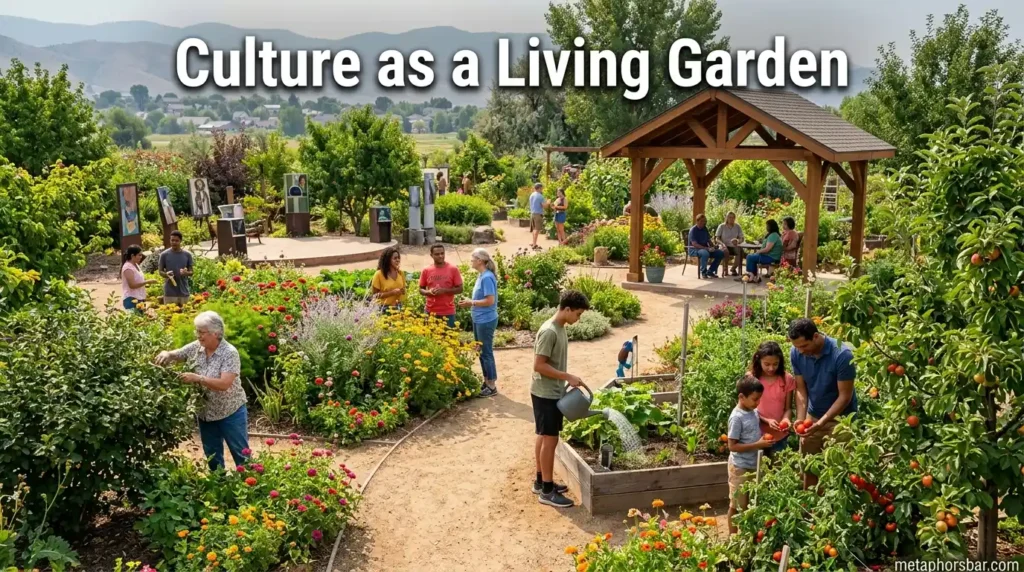
Another powerful metaphor is to see culture as a living garden. Like a garden, culture must be sown, tended, and nurtured over time. This idea comes from organizational thinkers and reminds us that culture is not static. It grows and changes as people plant seeds of tradition and remove weeds of bad habits. A garden is partly designed and partly wild. We set intentions (planting seeds) but the plants ultimately grow on their own (people practicing the culture).
Example in Practice
Imagine describing a workplace or community: “Our team’s culture is like a garden. Leaders plant the seeds of teamwork and respect, then everyone waters them with everyday actions. Sometimes we have to pull out the weeds of gossip or fear. Over time, that care yields a healthier culture.” In a family setting, one might say, “Our family’s culture is a garden – we nurture tradition like flowers. Storytelling is the sunshine, our shared meals the water, and laughter the fertile soil.”
Alternative Expressions
Related metaphors include calling culture an ecosystem or forest. These suggest complex life where different parts support each other. For instance: “Culture is an ecosystem – every practice and tradition is a species that must find its balance.” Or even “culture as soil,” implying a foundation that allows ideas to grow. But “garden” is vivid because it also implies choice and care.
Sensory and Emotional Details
Garden metaphors bring to mind sights and smells: rich soil, green leaves, blooming flowers, or even rotten mulch we have to clean up. The emotional sense can be hopeful and nurturing: you can almost feel the warmth of the sun or the refreshment of rain in your writing. It also acknowledges effort – gardening is work – which can subtly reflect that building culture takes time and attention.
Mini-Story: A tech startup once invited employees to a “culture gardening day.” They literally planted flower beds together and then talked about the company values. One engineer later said, “Working side by side in the garden helped me see our culture is something we cultivate together. It made the idea tangible.” Using the garden metaphor in that workshop helped the team think about how small actions (watering, weeding) support the whole culture’s health.
Culture as a River of Change
Meaning and Explanation
For our third metaphor, picture culture as a river flowing through time. Like water in a stream, culture is dynamic and fluid. It carries old customs along but is constantly shaped by new influences – just as a river’s course can bend around rocks or widen into a lake. This metaphor highlights movement and change. Cultures are not fixed snapshots; they are ongoing journeys.
Example in Practice
A travel writer might capture this: “The culture of this city is a wide, slow river – centuries of tradition flow here, but each wave reflects a new influence from migrants and technology.” Or imagine an immigrant reflecting: “I bring my grandmother’s recipes from the old country, and over time they mix with local spices. Our family culture flows like a river, changing direction with each generation.”
Alternative Expressions
Similar images include saying culture is a tide or current: “Cultural currents are shifting with globalization.” Another is “the fabric of culture is woven on a loom of history” – more static-sounding. The river metaphor emphasizes adaptation: “Culture is like a river – it may be influenced by outside streams, but it keeps moving forward.”
Sensory and Emotional Details
River imagery can evoke sound (gentle rushing water), touch (cool flow), and sight (reflective surface under moonlight). Emotionally, it can feel peaceful or powerful, depending on the speed of the flow. The metaphor can convey the sense of being carried along, or the awe of something that simply never stops moving.
Mini-Story: In a music ensemble blending Western and Eastern styles, the band’s leader described their evolving sound: “Our culture is a river of melodies. We took the river of jazz and merged it with the river of traditional songs. Now we have a confluence where old and new meet.” Listeners could nearly hear the mixing of rhythms as if listening to two rivers join.
Interactive Exercises and Prompts
Describe Your Culture Metaphorically.
Pick one of the metaphors above (tapestry, garden, river) and write a short paragraph about your own culture or community. For example, “My culture is like a garden where…”. Focus on vivid details.
Picture It.
Draw or find images of a tapestry, a garden, and a river. Label parts of each with elements of culture (customs, values, traditions). How do these visuals change your thinking?
Metaphor Mix-Up.
Take two metaphors (e.g. “river” and “tapestry”) and create a hybrid metaphor: “Culture is a garden tangled with rivers.” What new meaning emerges?
Group Story.
With friends or classmates, start a story about culture using a metaphor (e.g. “Once there was a garden where everyone’s ideas bloomed…”). Each person adds a sentence. Notice how the metaphor guides the story.
Bonus Tips for Using Metaphors in Writing and Life

Match Mood to Image.
Choose a metaphor that fits the feeling. Use a garden or tapestry for warmth and growth; use a river or fire metaphor for energy and change.
Be Specific.
Add details. Instead of saying “culture is a garden,” say “a garden of spices, weathered by history.” Specific details (colors, scents) make the metaphor vivid.
Use Metaphors Sparingly.
One or two strong metaphors are better than a dozen weak ones. Let each image breathe, rather than stacking many in one sentence.
Adapt to Your Audience.
Different metaphors resonate with different people. An artist might prefer “canvas,” a scientist “ecosystem,” a chef “recipe.” Think about who you’re talking to.
Cite Where Helpful.
In formal writing, you can reference established metaphors (e.g. “often called a cultural iceberg” in social science). In casual writing, just use the image without citation.
Test It Out.
Say the metaphor aloud: does it capture the idea? If it feels forced or confusing, try another image.
FAQs
What is a metaphor for culture?
A metaphor for culture is a figurative comparison that describes culture using another image or concept (e.g. “Culture is a tapestry”). It helps us understand the complex idea of culture by linking it to something concrete.
Why use metaphors for culture?
Because culture is abstract, metaphors make it tangible. They help readers and listeners visualize and feel what culture means, making communication more vivid and relatable.
What are common culture metaphors?
Many exist. Some popular ones are culture as an iceberg (most is hidden), tapestry or mosaic (made of many pieces), melting pot or salad bowl (culture blending or coexisting), garden (needs nurturing), and river or stream (always flowing). Each highlights a different aspect of culture.
How do metaphors help in writing about culture?
Metaphors create imagery and emotion. Saying “culture is a quilt” immediately conveys ideas of warmth, variety, and history. They engage readers and can make abstract points easier to understand.
Can cultural metaphors be offensive?
Sometimes. A metaphor like “culture is an iceberg” has no obvious offense. But others like “melting pot” vs “salad bowl” can carry political or historical connotations. Always consider context: ensure your metaphor respects the people and ideas involved.
How can I create my own culture metaphor?
Start with what stands out about your culture. Is it dynamic, old and venerable, a blend of peoples? Then imagine something similar in nature or life (river, tree, recipe, etc.). Try writing “Culture is like a ___ because ___,” and refine it until it feels right.
Can metaphors change over time?
Yes. Just as culture evolves, our metaphors can shift. An old metaphor like “culture as a melting pot” is now often supplemented with “kaleidoscope” or “mosaic,” reflecting new understanding of diversity. Metaphors grow with language and experience.
Conclusion
Culture is as rich and complex as the human life that creates it. By using metaphors – tapestry, garden, river, and many more – we give it shape and color in our minds and words. These images remind us that culture can be woven, nurtured, and carried forward in time. Whether writing an essay, giving a speech, or simply sharing a story on social media, a good metaphor can make culture come alive.
The next time you encounter culture – maybe tasting a traditional dish, or learning a custom – think of a metaphor that fits. Let your own creativity thread it into a tapestry, plant it in your garden of ideas, or watch it flow in the river of history.
Sources: We drew on anthropological definitions and metaphor studies to frame our discussion, and have woven in practical writing tips and creative exercises to help bring the ideas to life.