
The moment before something wonderful begins has a special kind of electricity. A concert hall going dark. A message lighting up your phone with good news. A child at the top of the stairs on their birthday morning. Excitement often arrives before the event itself—it lives in the chest, the breath, the fingertips, and the quickened beat of thought. It makes the world feel brighter, faster, and a little less ordinary.
That is why metaphors for excitement matter so much. Excitement is easy to feel, but not always easy to explain. A good metaphor can turn that rush into an image readers can see, hear, and almost feel in their own bones. It gives language motion, sparkle, and lift.
Whether you are writing a poem, a story, a social media caption, a speech, or a journal entry, metaphors for excitement can make your words more vivid, energetic, and memorable.
Why Metaphors for Excitement Matter in Writing and Communication
They turn a feeling into a picture
Excitement is a burst of emotion, but a metaphor gives it shape. It can become fireworks, a storm of light, a bouncing drumbeat, or a bubbling glass.
They help match the exact kind of excitement
Not all excitement feels the same. Some is sudden and explosive. Some is nervous and restless, Some is bright and joyful. The right metaphor helps you capture the precise shade of energy.
They make writing more memorable
A sentence like “I was excited” tells the reader the fact. A sentence like “I felt like a spark waiting to catch” leaves a lasting image behind.
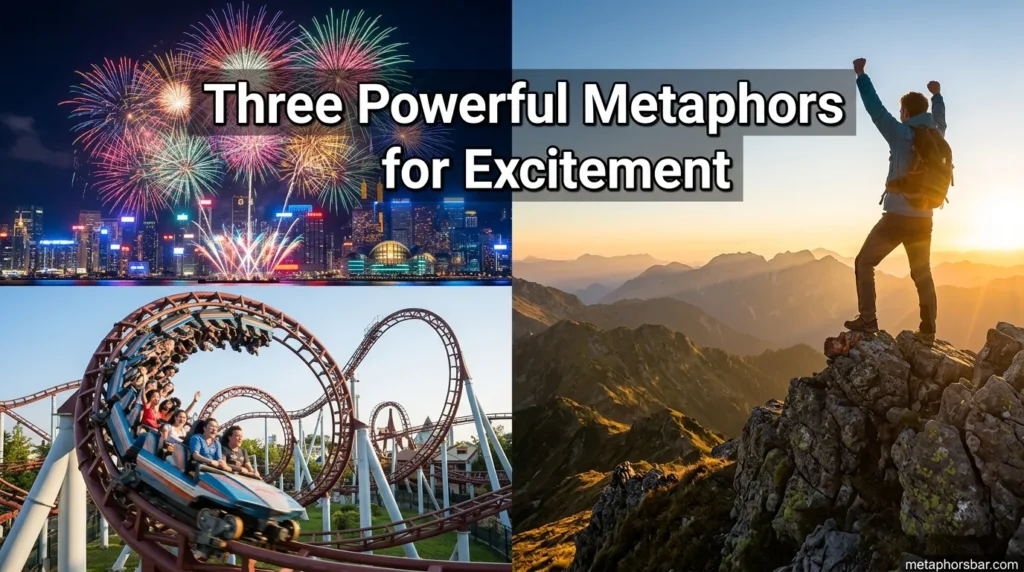
Three Powerful Metaphors for Excitement
1. Excitement as Fireworks
Fireworks are one of the most fitting metaphors for excitement because they are bright, dramatic, and impossible to ignore. They burst into the sky with color and sound, just like a feeling that suddenly fills the whole body.
Meaning and explanation
When excitement is compared to fireworks, it suggests surprise, celebration, and a burst of energy that seems to light up everything around it. Fireworks do not creep quietly into the night—they announce themselves. This makes the metaphor perfect for moments of joyful anticipation, happy news, or a thrilling event about to begin.
It works especially well when excitement feels outward, visible, and full of sparkle.
Example sentence or scenario
Her excitement was like fireworks, bursting through her as soon as she heard she got the job.
This metaphor works beautifully in personal writing, celebration posts, and scenes where joy feels big and sudden.
Alternative ways to express it
- a burst of sparks
- a sky full of color
- a celebration in the chest
- a dazzling explosion of joy
- a light show in the heart
Sensory and emotional details
You can imagine a crack in the dark sky, brilliant colors spreading outward, and the delighted gasp that follows. Emotionally, this metaphor feels joyful, electric, and triumphant. It suggests excitement as something radiant and outward-facing.
Mini storytelling touch
A child once stood in a crowd on New Year’s Eve and shouted, “That’s what my heart feels like!” as the fireworks filled the sky. That image captures the beauty of this metaphor. Excitement often feels like the inside of us has turned into the night sky.
Literary or cultural reference
Fireworks have long symbolized celebration, triumph, and spectacle in many cultures. As a metaphor for excitement, they fit perfectly because they turn feeling into light.
2. Excitement as a Roller Coaster
A roller coaster is thrilling because it moves quickly, rises high, drops suddenly, and leaves your stomach somewhere between fear and delight. As a metaphor for excitement, it works especially well when the feeling is intense, fast-moving, and a little overwhelming in the best possible way.
Meaning and explanation
When excitement is compared to a roller coaster, it suggests motion, anticipation, suspense, and release. There is the climb before the drop, the sudden plunge, the wild twists, and the breathless laughter afterward. This metaphor is ideal when excitement comes with a little nervousness, like waiting for something important or stepping into a new experience.
It is especially effective when the excitement is not just happy, but full of momentum and tension.
Example sentence or scenario
Waiting for the results felt like a roller coaster, with excitement climbing higher every minute until my stomach could hardly keep up.
This metaphor is great for describing suspense, anticipation, and emotional highs and lows.
Alternative ways to express it
- a thrill ride of emotion
- a rush of ups and downs
- a wild twist of feeling
- a looping surge of energy
- a breathless ride of anticipation
Sensory and emotional details
You can hear the clack-clack of the track, feel your stomach lift, and imagine the wind rushing past your face. Emotionally, this metaphor feels exhilarating, unpredictable, and full of motion. It suggests excitement with a bit of nervous energy attached.
Mini storytelling touch
A student once said that waiting to hear whether she had been accepted into her dream school felt “like being strapped into a ride I didn’t want to end and couldn’t stop.” That is what makes the roller coaster metaphor so strong—it captures the beauty of excitement mixed with fear.
Literary or cultural reference
Roller coasters often symbolize adventure, risk, and emotional fluctuation in film and storytelling. As a metaphor for excitement, they bring a vivid sense of movement to the feeling.
3. Excitement as a Spark or Electric Current
A spark is small, quick, and full of potential. An electric current carries energy through a system in a way you can feel even if you cannot always see it. As metaphors for excitement, both spark and electricity capture immediacy, ignition, and the sense that something is about to happen.
Meaning and explanation
When excitement is compared to a spark or electric current, it emphasizes quick ignition and energy passing through the body. This metaphor works especially well when excitement is sudden, contagious, or buzzing beneath the surface. It can describe the first moment of inspiration, the thrill of good news, or the charged atmosphere before an event.
The image is especially useful because excitement often feels like it starts small and then spreads quickly.
Example sentence or scenario
The room crackled with excitement, like a spark had touched every corner at once.
Or:
Her excitement shot through her like a current, quick and bright and impossible to hide.
These metaphors are ideal for writing that wants to feel fast, bright, and alive.
Alternative ways to express it
- a flash of energy
- a jolt of joy
- a current of anticipation
- a burst of electricity
- a spark that caught fire
Sensory and emotional details
You can imagine static in the air, a quick breath, and the prickling feeling of energy under the skin. Emotionally, this metaphor feels lively, sharp, and immediate. It suggests excitement that races through a person before they can even name it.
Mini storytelling touch
A musician once said the best audiences were the ones that “felt electric before the first note even played.” That is a beautiful way to understand this metaphor. Excitement can exist as a current in the air, passing invisibly from one person to another.
Literary or cultural reference
Electricity and sparks often symbolize inspiration, attraction, and sudden energy in literature and music. As a metaphor for excitement, they give the feeling a quick, radiant pulse.
How to Choose the Right Metaphor for Excitement
Use fireworks when excitement feels celebratory and dazzling
Choose this metaphor when the feeling is bold, bright, and full of outward joy.
Use a roller coaster when excitement feels thrilling and suspenseful
This is the best choice when the feeling includes anticipation, motion, and emotional ups and downs.
Use a spark or electric current when excitement feels immediate and energetic
Choose this image when the feeling is quick, buzzing, and ready to ignite.
The best metaphor depends on the kind of excitement you want to describe. Excitement can burst, race, and spark—and sometimes it does all three.
Interactive Exercises for Practicing Metaphors for Excitement
Exercise 1: Complete the sentence
Finish this prompt in three different ways:
“My excitement felt like ______ because ______.”
Try one answer that feels visual, one that feels physical, and one that feels energetic.
Example: My excitement felt like fireworks because it lit up every thought in my mind at once.
Exercise 2: Sensory mapping
Think of a moment when you felt excited. Write down:
- one sound
- one movement
- one color
- one body sensation
- one emotion
Then turn those details into a metaphor.
For example: It sounded like a drumroll, moved like a roller coaster climbing fast, looked like a burst of gold, felt like electricity in my hands, and carried the emotion of joyful anticipation.
Exercise 3: Story starter
Begin a short paragraph with:
“Excitement was like…”
Let the image guide the tone. You can make it playful, dramatic, poetic, or reflective.
Exercise 4: Social media or journal prompt
Try writing a one-line reflection:
- “Today my excitement felt like fireworks in my chest.”
- “Waiting for the news was a roller coaster.”
- “The room crackled like an electric current.”
Bonus Tips for Using Metaphors for Excitement in Writing, Social Media, and Daily Life
In writing
Use these metaphors in fiction, poems, essays, and stories to make excitement feel vivid and emotionally true. They help readers feel the rush rather than just recognize it.
On social media
A short metaphor can make a post or caption more memorable. “Feeling like fireworks today” or “My excitement is a roller coaster” adds personality and energy.
In everyday conversation
Metaphors can help you describe your mood more vividly. Instead of saying “I’m really excited,” you might say, “I feel like a spark waiting to catch.”
In character writing
If you are writing a scene where a character is excited, the metaphor can reveal whether their energy is joyful, nervous, or both.
Keep the image honest
The strongest excitement metaphor is the one that truly fits the feeling. Some excitement is loud and explosive, some is nervous and shifting, and some is bright and electric. Let the image reflect the truth of the moment.
FAQs
1. What is a metaphor for excitement?
A metaphor for excitement is a figurative comparison that describes excitement using another image, such as fireworks, a roller coaster, or a spark.
2. Why are metaphors for excitement useful?
They help make a strong feeling easier to picture, understand, and express in writing or speech.
3. What is a simple metaphor for excitement?
A simple example is: Excitement is like fireworks. It suggests brightness, celebration, and explosive joy.
4. Can these metaphors be used in fiction or poetry?
Yes. They are especially effective in fiction and poetry because they capture emotion and movement in a vivid way.
5. How do I create my own metaphor for excitement?
Think about what excitement feels like—fast, bright, buzzing, or rising—and compare it to something with similar qualities.
6. Are these metaphors only for happy excitement?
Mostly, yes, but they can also describe anticipation, nervous thrill, or the tension before something wonderful happens.
7. What makes a strong metaphor for excitement?
A strong metaphor is vivid, emotionally fitting, and easy to imagine. It should help the reader feel the excitement, not just name it.
Conclusion
Excitement can feel like a burst of color, a sudden drop, or a spark running through the air. That is why metaphors matter—they help us describe not only the energy itself, but the way it changes the whole atmosphere around us.
A firework gives excitement its brilliance and celebration. A roller coaster gives it motion and suspense. A spark or electric current gives it instant energy and ignition. Together, these images remind us that excitement is not just a feeling—it is a rush, a rise, a charge.
So when you write about excitement, do not settle for the obvious. Let it burst, race, and spark through your language. A good metaphor can make excitement unforgettable.