
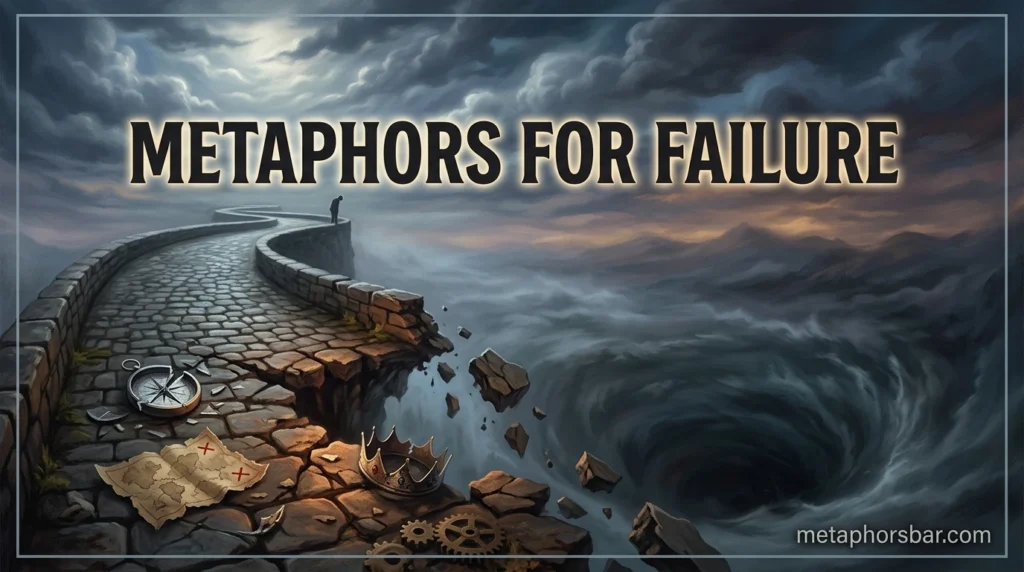
Failure is rarely a single moment. More often, it arrives in stages: the pause before bad news lands, the quiet after a plan falls apart, the strange heat in your face when something you hoped for slips beyond reach. Sometimes it feels loud and public. Sometimes it is private, almost tender in its sting. A failed exam, a missed deadline, a relationship that does not hold, a dream that cracks in your hands—failure can make the world feel oddly smaller and more fragile.
That is why metaphors for failure are so useful. The word failure is plain, but the experience behind it is often layered with disappointment, embarrassment, grief, resilience, and possibility. A good metaphor gives that experience shape. It helps writers, speakers, and readers understand what failure feels like, what it can do, and how it might change us.
Whether you are writing a poem, a memoir, a speech, a journal entry, or a social media caption, metaphors for failure can make your language more vivid, honest, and memorable.
Why Metaphors for Failure Matter in Writing and Reflection
They make disappointment easier to describe
Failure can be hard to talk about directly because it often carries shame or self-doubt. A metaphor softens the edges just enough to make the feeling easier to see.
They reveal the kind of failure you mean
Not all failure feels the same. Some failures are sudden. Some are structural, Some feel like a loss of direction, while others feel like a temporary collapse. Metaphors help distinguish those differences.
They make writing more memorable
A sentence like “I failed” is clear, but “I felt like a bridge snapping under too much weight” stays in the reader’s mind longer.
They can carry both hurt and hope
The best failure metaphors do not stop at the fall. They often suggest recovery, learning, or rebuilding. That makes them emotionally honest and useful in growth-oriented writing.
Three Powerful Metaphors for Failure
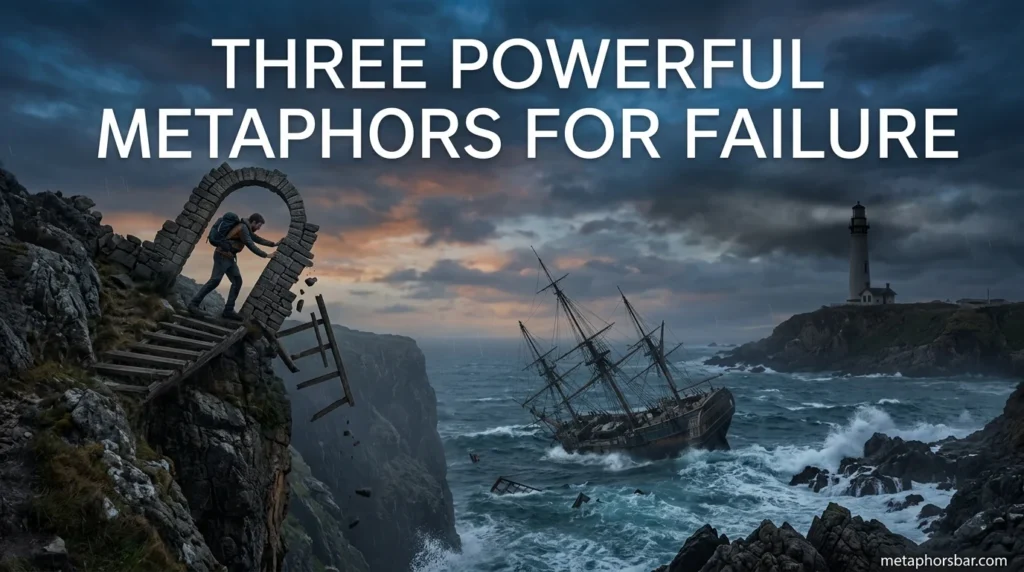
1. Failure as a Storm
A storm is one of the clearest metaphors for failure because it captures sudden force, disruption, and the feeling that something larger than you has swept through your plans. It can be frightening, messy, and impossible to control, but it also passes. That makes it a strong metaphor when failure feels overwhelming yet temporary.
Meaning and explanation
When failure is compared to a storm, it suggests turbulence, pressure, and a loss of stability. A storm can arrive fast, darken everything, and leave damage behind. In the same way, failure can shake confidence, interrupt progress, and make the future feel hard to see. This metaphor works especially well when the failure is public, dramatic, or emotionally intense.
It is also useful because storms do not last forever. Even when they leave debris, they eventually move on. That gives the metaphor a built-in sense of endurance and renewal.
Example sentence or scenario
The launch failure hit like a storm, darkening the mood of the whole team and leaving everyone trying to steady the pieces.
This metaphor works beautifully in essays, fiction, and reflective writing about setbacks, crisis, or emotional upheaval.
Alternative ways to express it
- a thunderstorm of disappointment
- a cloudburst of loss
- a weather front of setbacks
- a tempest of failure
- rough weather for the heart
Sensory and emotional details
You can imagine low gray clouds, wind rattling the windows, and rain that makes it hard to see the road ahead. Emotionally, this metaphor feels heavy, urgent, and disorienting. It suggests failure as a force that changes the atmosphere around you.
Mini storytelling touch
A young entrepreneur once described the closing of her first business as “a storm that wiped the table clean.” That image is striking because it captures both destruction and a strange kind of reset. The storm metaphor is powerful when failure feels like a sudden weather system you must survive before rebuilding.
Literary or cultural reference
Storms have long symbolized turmoil, conflict, and change in literature. In stories, the storm often arrives before a turning point, which makes it a natural metaphor for failure that leads to growth.
2. Failure as a Broken Bridge
A bridge is meant to connect one side to another. When it breaks, the path forward is interrupted. As a metaphor for failure, a broken bridge is especially strong because it suggests not only a setback, but a gap between intention and outcome. It works well when failure feels structural, relational, or difficult to cross.
Meaning and explanation
When failure is described as a broken bridge, it suggests a route that has collapsed under pressure or was never stable enough to begin with. The image works for situations where progress was supposed to lead somewhere but suddenly could not. It can represent a business failure, a broken promise, a failed relationship, or a plan that simply could not hold.
This metaphor is especially useful because it includes distance. You can see the other side, but getting there is no longer simple. That makes the emotional experience of failure feel more exact.
Example sentence or scenario
The project failure felt like a broken bridge—everything we had built pointed forward, but suddenly there was no safe way to cross.
This metaphor works well in memoir, leadership writing, and fiction when the failure creates a gap that must be repaired or reimagined.
Alternative ways to express it
- a collapsed crossing
- a gap in the road
- a span that gave way
- a path cut in two
- a connection snapped under pressure
Sensory and emotional details
You can picture rusted cables, splintered wood, water rushing below, and the uneasy feeling of standing at the edge of what used to work. Emotionally, this metaphor feels unfinished, fragile, and frustrating. It suggests that failure is not always a dead end; sometimes it is a missing middle.
Mini storytelling touch
A teacher once described a student’s first failed presentation as “a bridge that taught her where the weak planks were.” That line captures the unusual wisdom in failure: the bridge breaks, but the break reveals where to reinforce. The broken-bridge metaphor is powerful because it shows both interruption and lesson.
Literary or cultural reference
Bridges often symbolize transition, connection, and trust in literature and culture. A broken bridge reverses that symbolism, making failure feel like an interrupted crossing between who you were and who you hoped to become.
3. Failure as an Unfinished Draft
An unfinished draft is not the final story. It is messy, incomplete, and full of revisions, but it still holds possibility. As a metaphor for failure, this image is especially useful when you want to frame failure as part of the process rather than the end of the road. It works well for creative work, personal growth, learning, and any situation where something has not yet become what it could be.
Meaning and explanation
When failure is compared to an unfinished draft, it suggests that the work is incomplete, not worthless. The draft may have awkward phrasing, crossed-out lines, and half-formed ideas, but it is still evidence of movement. This metaphor is particularly helpful because it keeps the door open to revision and improvement.
It is a gentle metaphor, but not a weak one. It says that failure may simply mean “not yet finished.”
Example sentence or scenario
Her first attempt at the novel was an unfinished draft of who she was becoming as a writer.
This metaphor works especially well in artistic writing, journaling, self-development, and educational contexts.
Alternative ways to express it
- a rough first version
- a page still being written
- a story in revision
- a work in progress
- a chapter not yet shaped
Sensory and emotional details
You can imagine pencil marks, pages crowded with notes, coffee stains on a desk, and the quiet persistence of trying again. Emotionally, this metaphor feels hopeful, honest, and flexible. It suggests that failure may be a stage of becoming rather than a permanent label.
Mini storytelling touch
A novelist once kept a note above her desk that read, “A bad draft is just a brave beginning.” That phrase fits the unfinished-draft metaphor beautifully. Failure can feel less like a verdict and more like the raw material of something better.
Literary or cultural reference
The idea of revision has deep roots in literature. Great works are rarely created perfectly the first time. As a metaphor for failure, the unfinished draft aligns with the creative truth that first attempts are often pathways, not destinations.
How to Choose the Right Metaphor for Failure
Use storm when failure feels sudden and overwhelming
Choose this metaphor when the event arrives quickly and disrupts everything at once.
Use broken bridge when failure feels like a structural interruption
This is the best choice when the sense of failure is tied to a path that no longer connects one side to the next.
Use unfinished draft when failure feels temporary or developmental
Choose this image when you want to emphasize learning, revision, or a process that is still unfolding.
The best metaphor depends on what kind of failure you want to describe. Failure can storm, collapse, or remain unfinished—and each image tells a different truth.
Interactive Exercises for Practicing Metaphors for Failure
Exercise 1: Complete the sentence
Finish this prompt in three different ways:
“Failure felt like ______ because ______.”
Try one answer that feels chaotic, one that feels structural, and one that feels hopeful.
Example: Failure felt like a storm because it came so fast that I could barely tell what had changed first.
Exercise 2: Sensory mapping
Think of a time you experienced failure or a setback. Write down:
- one sound
- one texture
- one color
- one object
- one feeling
Then turn those details into a metaphor.
For example: It sounded like thunder in a quiet room, felt like broken wood under my feet, looked like gray water below a snapped bridge, resembled a draft full of crossed-out lines, and carried the emotion of disappointment mixed with determination.
Exercise 3: Story starter
Begin a paragraph with:
“The failure was like…”
Let the image guide the tone. You can make it reflective, dramatic, poetic, or blunt.
Exercise 4: Journal or caption prompt
Try writing a one-line reflection:
- “Failure was a storm that showed me what needed rebuilding.”
- “That setback felt like a broken bridge, but the other side was still visible.”
- “My failure was an unfinished draft, not the end of the story.”
Bonus Tips for Using Metaphors for Failure in Writing, Social Media, and Daily Life
In writing
Use these metaphors in memoirs, essays, fiction, and poetry to make failure feel vivid and emotionally true. They are especially effective when you want to show how a setback changes a person, not just what went wrong.
On social media
A short metaphor can make a post about a setback feel thoughtful and relatable. “Feeling like an unfinished draft today” is more expressive than “I messed up.”
In everyday conversation
Metaphors can help you explain failure without making it sound final. Saying “It feels like a bridge we need to rebuild” can communicate both difficulty and hope.
In journaling
If you are reflecting on a difficult season, metaphor can help you see whether your failure feels sudden, structural, or unfinished. That clarity can make self-reflection easier.
Keep the image honest
The strongest failure metaphor is the one that truly fits the experience. Some failures are storms, some are broken crossings, and some are simply drafts still in progress. Let the image match the truth.
FAQs
1. What is a metaphor for failure?
A metaphor for failure is a figurative comparison that describes failure using another image, such as a storm, a broken bridge, or an unfinished draft.
2. Why are metaphors for failure useful?
They help make disappointment, setback, and uncertainty easier to picture and more emotionally meaningful.
3. What is a simple metaphor for failure?
A simple example is: Failure is a storm. It suggests disruption, force, and emotional turbulence.
4. Can these metaphors be used in fiction or essays?
Yes. They are especially effective in fiction, essays, memoirs, and poetry because they help create emotional depth and atmosphere.
5. How do I create my own metaphor for failure?
Think about how the failure feels—sudden, broken, unfinished, or heavy—and compare it to something with similar qualities.
6. Are these metaphors only for serious writing?
No. They can also be used in reflective captions, speeches, and journaling when the tone is appropriate.
7. What makes a strong metaphor for failure?
A strong metaphor is vivid, emotionally fitting, and easy to imagine. It should help the reader feel the setback, not just label it.
Conclusion
Failure can feel like the sky breaking open, a bridge giving way, or a page still waiting to be finished. That is why metaphors matter—they help us turn disappointment into language that carries shape, meaning, and even a little hope.
A storm captures the force of failure. A broken bridge captures interruption and distance. An unfinished draft captures the truth that failure is often not the end, but a beginning in rough form. Together, these images remind us that failure is not one thing—it can disrupt, separate, and revise.
So when you write about failure, do not settle for the plain word alone. Let it storm, crack, or draft itself through your language. A good metaphor can make failure feel less final—and sometimes, that is where resilience begins.