
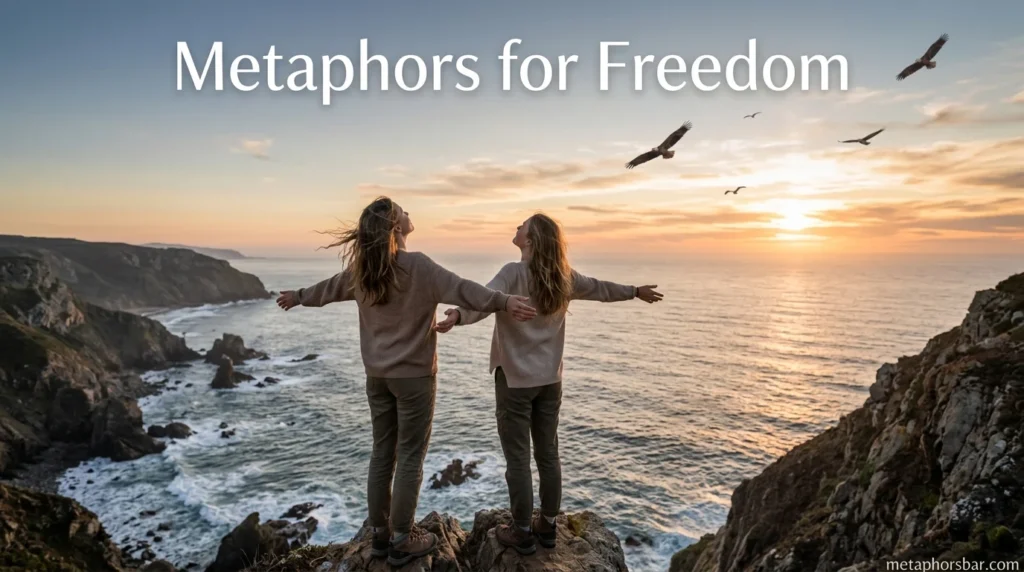
The first breath after stepping into open air can feel like a small miracle. A window swings wide, wind slips across your skin, and for a moment the room, the day, even the body itself seems to loosen its grip. Freedom often feels like that: not always loud, not always dramatic, but unmistakable. It is the feeling of pressure lifting, of space opening, of possibility arriving before words can fully name it.
That is why metaphors for freedom matter. Freedom is one of the most powerful ideas we have, but it is also one of the hardest to describe directly. It can mean independence, choice, movement, release, courage, or even the simple right to breathe without fear. Metaphors help us turn that abstract idea into something readers can see, feel, and remember.
Whether you are writing poetry, stories, speeches, captions, or personal reflections, metaphors for freedom can make your language feel wider, lighter, and more alive.
Why Metaphors for Freedom Matter in Writing and Reflection
They Make an Abstract Idea Visible
Freedom is not a thing you can hold in your hand. It is a feeling, a condition, a possibility. Metaphors give it shape—sky, wings, roads, rivers, doors—so readers can imagine what freedom looks and feels like.
They Add Emotional Depth
The word freedom can mean many different things depending on the moment. A metaphor can show whether it feels thrilling, quiet, hard-won, or expansive. It gives freedom a mood.
They Make Writing More Memorable
A strong image can stay with readers long after the page is turned. “Freedom is a door flung open” is harder to forget than “freedom is important” because it creates movement, sound, and feeling.
Three Powerful Metaphors for Freedom
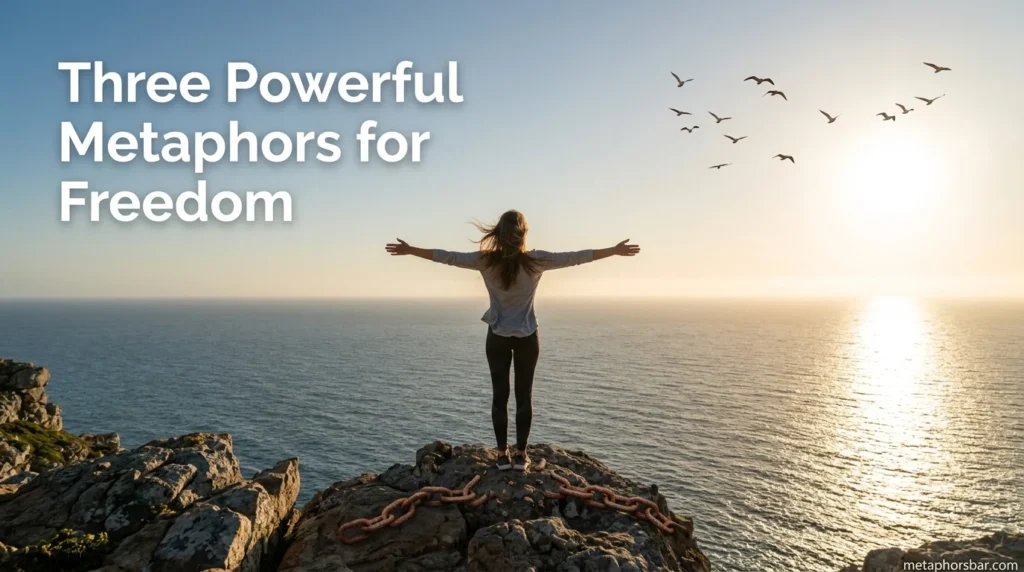
1. Freedom as an Open Sky
Meaning and Explanation
An open sky suggests vastness, breath, and unlimited space. It carries the feeling that nothing is pressing down, nothing is enclosing, and the horizon stretches farther than the eye can reach. This metaphor is ideal when freedom feels expansive, peaceful, or full of possibility.
It works especially well for emotional freedom, creative freedom, or the feeling of finally being able to choose your own path.
Example Sentence or Scenario
After years of living by other people’s rules, her life opened like an open sky—wide, bright, and full of directions she could finally call her own.
This metaphor is especially powerful in reflective writing, poetry, and motivational speech because it suggests both release and possibility.
Alternative Ways to Express It
- a horizon without fences
- a sky with no ceiling
- endless air
- a field of blue
- a horizon of possibility
Sensory or Emotional Details
Imagine warm sunlight, a breeze across your face, and the almost startling sense of being surrounded by space. Emotionally, this metaphor feels hopeful, calm, and unconfined. It suggests that freedom is not just absence of restraint, but presence of room to grow.
Mini Storytelling Touch
A woman once left a job that had consumed her for years. On her first morning away, she walked outside, looked up at a cloudless sky, and cried without knowing why. Later, she said it was not sadness—it was the feeling of realizing how large life could be again. That is the power of the open sky metaphor: it captures the emotional spaciousness freedom can bring.
Literary or Cultural Reference
In literature and song, the open sky often symbolizes hope, transcendence, and new beginnings. It is one of the oldest and most universal images for release because it naturally evokes openness and lift.
2. Freedom as a Bird Unchained
Meaning and Explanation
Birds have long represented movement, choice, and soaring beyond boundaries. When paired with the idea of being unchained, the metaphor becomes especially strong: it suggests not only motion, but the release from something that once held you back.
This metaphor is perfect when freedom feels like escape, awakening, or the first bold flight after being confined.
Example Sentence or Scenario
His spirit felt like a bird unchained, hesitant at first, then rising higher with every beat of its wings.
This image works well for writing about breaking away from oppression, fear, shame, or limitation.
Alternative Ways to Express It
- wings freed from a cage
- a bird rising into wind
- flight after captivity
- a skyward leap
- a winged release
Sensory or Emotional Details
Picture the sudden flutter of wings, the lightness in the air, the rush of movement after stillness. Emotionally, this metaphor feels triumphant, relieved, and alive. It suggests freedom not just as a feeling, but as action.
Mini Storytelling Touch
A young musician once said that after years of being told his style was “too strange,” he finally shared a song that sounded exactly like him. “It felt,” he said, “like something inside me had been a bird in a cage, and suddenly the door opened.” That image captures the emotional truth of freedom: the relief of being able to move as yourself.
Literary or Cultural Reference
Birds often symbolize the soul, aspiration, and transcendence in poetry and folklore. When a bird is unchained, the image carries both the joy of release and the vulnerability of first flight.
3. Freedom as a River Flowing
Meaning and Explanation
A river moves continuously, following its own path around obstacles and through landscapes. As a metaphor for freedom, it suggests movement, direction, and the ability to keep going without being stopped in one place. It is especially useful when freedom feels natural, forceful, or quietly determined.
Unlike the open sky, which emphasizes space, or the bird, which emphasizes release, the river emphasizes motion. It says freedom is not only about being unbound—it is about being in motion.
Example Sentence or Scenario
Her freedom was like a river flowing through stone, patient enough to move around obstacles yet strong enough to change the land itself.
This metaphor works beautifully for stories about resilience, personal growth, or the steady pursuit of a life chosen on one’s own terms.
Alternative Ways to Express It
- a current of choice
- a stream with no barrier
- water finding its way
- a path cut by flow
- a moving tide of selfhood
Sensory or Emotional Details
You can hear water moving over rocks, feel cool air near the bank, and imagine sunlight flashing on the surface. Emotionally, this metaphor feels persistent, natural, and quietly powerful. It suggests that freedom does not always arrive in a burst; sometimes it keeps moving until the world reshapes around it.
Mini Storytelling Touch
An artist who spent years painting what others expected finally followed her own style, even when it was risky and unpopular. Years later, she said, “It did not feel like I broke free in one moment. It felt like a river finding its channel.” That is what makes the river metaphor so fitting—it captures freedom as movement that continues to deepen over time.
Literary or Cultural Reference
Rivers appear throughout literature as symbols of life, change, and passage. As a metaphor for freedom, they remind us that movement itself can be a form of liberation.
How to Choose the Right Metaphor for Freedom
Use Open Sky When Freedom Feels Expansive
Choose this metaphor when you want to emphasize space, breath, possibility, and emotional release. It works especially well when freedom feels peaceful and wide open.
Use Bird Unchained When Freedom Feels Like Escape
This is the best choice when the focus is on release from confinement, the thrill of flight, or the first moment of self-expression after silence.
Use River Flowing When Freedom Feels Dynamic
Choose this image when freedom is about movement, persistence, adaptation, or shaping your own path over time.
The best metaphor depends on the emotion you want to convey. Freedom can widen, lift, or flow—and each image gives it a distinct voice.
Interactive Exercises to Practice Metaphors for Freedom
Exercise 1: Complete the sentence
Finish this prompt in three different ways:
“Freedom is like ______ because ______.”
Try one answer that feels peaceful, one that feels powerful, and one that feels personal.
Example: Freedom is like an open sky because it gives you room to breathe and choose where to go.
Exercise 2: Sensory mapping
Think of a time when you felt free in some meaningful way. Write down:
- one sound
- one color
- one texture
- one movement
- one emotion
Then turn those details into a metaphor.
For example: Freedom sounded like wind through trees, looked like a bright morning sky, felt like bare feet on grass, moved like a river, and carried the emotion of relief.
Exercise 3: Story starter
Begin a paragraph with:
“My freedom felt like…”
Let the image guide the tone. Make it hopeful, reflective, dramatic, or simple.
Exercise 4: Social media or journal prompt
Try writing a one-line reflection:
- “Freedom is an open sky with no ceiling.”
- “Some freedoms feel like birds remembering they can fly.”
- “I am learning to flow like a river.”
Bonus tips for using metaphors for freedom in writing, social media, and daily life
In writing
Use freedom metaphors in essays, fiction, poetry, and speeches to create emotional depth. They are especially effective when describing transformation, independence, or self-discovery.
On social media
A short metaphor can make a caption feel thoughtful and memorable. A line like “Today feels like open sky” can communicate joy and relief without needing extra explanation.
In everyday conversation
Metaphors can make it easier to describe personal growth or a major life change. Instead of saying “I feel more independent now,” you might say, “I feel like a bird that finally found the open air.”
In journaling
If you are reflecting on change, metaphor can help you understand what freedom means to you. Is it a sky, a bird, a river, a doorway, or something else entirely?
Keep the image true to the moment
The strongest metaphors for freedom are the ones that match the feeling you are actually trying to express. Sometimes freedom is thrilling. Sometimes it is quiet, Sometimes it is hard-won. Let the image fit the truth.
FAQs
1. What is a metaphor for freedom?
A metaphor for freedom is a figurative comparison that describes freedom using another image, such as an open sky, a bird, or a flowing river.
2. Why are metaphors for freedom useful?
They make the idea of freedom more vivid, emotional, and memorable in writing and speech.
3. What is a simple metaphor for freedom?
A simple example is: Freedom is an open sky. It suggests space, possibility, and release.
4. Can freedom metaphors be used in poetry?
Yes. They are especially effective in poetry because they naturally evoke movement, hope, and emotional openness.
5. How do I create my own metaphor for freedom?
Think about what freedom feels like—expansive, light, moving, or earned—and compare it to something with similar qualities.
6. Are freedom metaphors only for political topics?
No. They can be used in personal growth writing, stories, journals, speeches, and everyday reflection.
7. What makes a strong metaphor for freedom?
A strong metaphor is clear, sensory, emotionally accurate, and easy for the reader to picture and feel.
Conclusion
Freedom is one of those ideas that seems simple until you try to define it. Then it becomes wide as the sky, swift as a bird, and steady as a river. That is why metaphors matter: they help us give shape to something deeply human and difficult to contain.
An open sky reminds us that freedom can feel spacious and full of possibility. A bird unchained shows the power of release and self-expression. A river flowing captures the motion, persistence, and quiet strength of a life moving on its own terms. Together, these images help us see freedom not just as a concept, but as an experience.
So when you write about freedom, do not stop at the word itself. Let it rise, move, and open through your language. A strong metaphor can make freedom feel not only understood, but truly alive.