

The old library was silent except for the soft turning of pages and the ticking of a distant clock. In the corner sat a student solving equations faster than anyone else in the room. Questions that confused others seemed to unfold naturally in his mind, like puzzle pieces sliding perfectly into place. Watching him work felt almost magical—not because he knew every answer, but because his thoughts moved with clarity and purpose.
That’s the power of intelligence, and it’s why metaphors for smart are so compelling. Being smart is more than memorizing facts or speaking confidently. Intelligence can feel sharp like lightning, deep like the ocean, bright like a lantern, or precise like a master key opening locked doors.
Metaphors help us describe intelligence in vivid, emotional, and memorable ways. Whether you are writing creatively, describing a character, motivating students, or creating engaging social media captions, smart metaphors can bring depth and imagination to your words.
Why Metaphors for Smart Matter in Writing
Intelligence is abstract. You cannot physically see a thought forming or an idea connecting in someone’s mind. That’s why metaphors are useful—they transform invisible mental abilities into vivid imagery readers can easily picture and feel.
Using metaphors for smart can help you:
- describe intelligence creatively
- make character descriptions more vivid
- explain different types of intelligence
- add personality and emotional depth to writing
- create memorable comparisons and imagery
Instead of saying, “She was very smart,” you might write: “Her mind worked like a lighthouse cutting through fog.”
That comparison feels stronger, more visual, and emotionally meaningful.
Smart as a Sharp Blade: Metaphors for Quick Thinking

Meaning and Explanation
One common metaphor compares intelligence to a sharp blade or knife. A sharp object cuts quickly and precisely, just as a smart person can understand problems rapidly and think clearly.
This metaphor emphasizes speed, focus, and mental precision.
Example Sentence or Scenario
His mind was as sharp as a freshly honed blade, cutting through confusion with ease.
This metaphor works especially well for analytical or quick-thinking individuals.
Alternative Ways to Express It
- razor-sharp thinking
- a mind like a precision tool
- thoughts slicing through problems
- intelligence sharpened by experience
Sensory or Emotional Details
You can almost hear the clean slice of steel through paper or feel the crisp clarity of something perfectly precise. Emotionally, this metaphor feels confident and powerful.
Mini Storytelling Touch
During a tense debate competition, one student responded to every argument almost instantly. By the end, people whispered that his mind “moved sharper than a blade.”
Literary or Cultural Reference
Detective stories often describe brilliant characters with “sharp minds” because the metaphor suggests both intelligence and precision.
Smart as a Lighthouse: Metaphors for Guidance and Clarity
Meaning and Explanation
A lighthouse shines through darkness and fog, helping lost ships find direction. Comparing intelligence to a lighthouse emphasizes wisdom, guidance, and clarity during confusion.
This metaphor works beautifully for teachers, mentors, or thoughtful problem-solvers.
Example Sentence or Scenario
Her ideas were like a lighthouse guiding the team through uncertainty.
This metaphor highlights calm intelligence and leadership.
Alternative Ways to Express It
- a lantern in the dark
- a guiding star
- light cutting through confusion
- wisdom illuminating the path
Sensory or Emotional Details
Imagine beams of light sweeping across stormy waves while everything else remains uncertain. Emotionally, this metaphor feels reassuring and steady.
Mini Storytelling Touch
When the company faced a crisis, everyone panicked except one quiet manager who calmly organized solutions step by step. Later, employees described her as “the lighthouse during the storm.”
Real-Life Connection
People often value intelligence not just for knowledge, but for the ability to guide others during difficult situations.
Smart as a Puzzle Master: Metaphors for Creativity and Problem-Solving
Meaning and Explanation
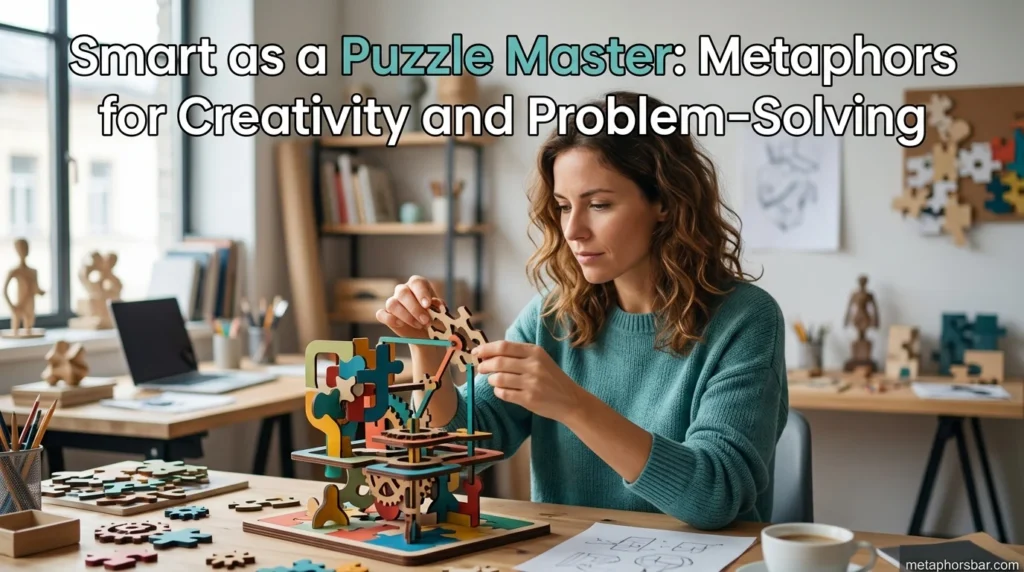
Some forms of intelligence involve seeing connections others miss. Comparing a smart person to a puzzle master emphasizes creativity, strategy, and the ability to solve complex problems.
This metaphor works especially well for inventors, strategists, writers, or creative thinkers.
Example Sentence or Scenario
He approached every challenge like a puzzle master fitting scattered pieces into a complete picture.
This image highlights patience, logic, and imagination.
Alternative Ways to Express It
- solving life like a chess game
- weaving ideas together
- unlocking hidden patterns
- connecting invisible dots
Sensory or Emotional Details
You can imagine puzzle pieces clicking into place or the satisfying moment when a difficult mystery suddenly makes sense. Emotionally, this metaphor feels rewarding and inspiring.
Mini Storytelling Touch
A young engineer once spent weeks struggling with a design problem no one else could solve. One evening, while staring at scattered notes across his desk, the answer suddenly connected in his mind. “It felt,” he later said, “like finding the missing piece of a puzzle.”
Literary Reference
Brilliant fictional detectives and inventors are often portrayed as puzzle-solvers who notice hidden patterns invisible to others.
How to Choose the Right Metaphor for Smart
Different metaphors highlight different kinds of intelligence:
- Use sharp blade metaphors for speed and precision
- Use lighthouse metaphors for wisdom and guidance
- Use puzzle metaphors for creativity and problem-solving
The best metaphor depends on the type of intelligence you want to emphasize.
Interactive Exercises for Creating Smart Metaphors
Exercise 1: Complete the Sentence
Finish this thought:
“Her intelligence was like ______ because ______.”
Example: “Her intelligence was like lightning because it arrived suddenly and brilliantly.”
Exercise 2: Describe a Smart Character
Write three sentences describing a smart person without using the word “smart.”
Use metaphor and imagery instead.
Exercise 3: Match Intelligence to Objects
Think of objects that symbolize intelligence:
- keys
- maps
- stars
- mirrors
- bridges
Now create a metaphor using one of them.
Exercise 4: Social Media Caption Practice
Try creative captions like:
- “A sharp mind cuts through every storm.”
- “Wisdom shines brighter than noise.”
- “Intelligence is seeing patterns where others see chaos.”
Bonus Tips for Using Smart Metaphors
In Creative Writing
Use smart metaphors to make characters feel more memorable and layered.
In Motivational Content
Intelligence metaphors can inspire learning, creativity, and growth.
In Social Media
Unique metaphors make captions stand out and feel more thoughtful.
In Everyday Conversation
Creative comparisons often make compliments feel more personal and meaningful.
Avoid Overused Comparisons
Try fresh imagery instead of repeating common clichés whenever possible.
FAQs
1. What is a metaphor for smart?
A metaphor for smart is a figurative comparison that describes intelligence using vivid imagery like light, sharpness, puzzles, or strategy.
2. Why are metaphors for smart useful in writing?
They make intelligence easier to visualize and help descriptions feel more creative and emotional.
3. What are common metaphors for smart?
Common examples include:
- a sharp mind
- a lighthouse in the fog
- a puzzle master
- lightning-fast thinking
4. Can smart metaphors describe emotional intelligence too?
Yes. Some metaphors focus on wisdom, empathy, guidance, or understanding rather than academic ability.
5. How do I create my own smart metaphor?
Think about what intelligence feels like—quick, deep, bright, strategic—and compare it to an object or experience with similar qualities.
6. Are metaphors for smart only used in books?
No. They are also used in speeches, films, social media, education, and everyday conversation.
7. What makes a strong metaphor for intelligence?
A strong metaphor is vivid, meaningful, and clearly connected to the type of intelligence being described.
Conclusion
Intelligence is difficult to capture with plain words alone. Some minds move like lightning, others guide like lighthouses, and some patiently solve life like giant puzzles. Metaphors help transform intelligence into something visible, emotional, and memorable.
They remind us that being smart is not only about facts or grades. Intelligence can mean creativity, wisdom, adaptability, curiosity, or the ability to help others find clarity during confusion.
Whether you are writing stories, crafting character descriptions, motivating students, or simply looking for more imaginative language, metaphors for smart can add brilliance and depth to your words. Because sometimes, the brightest minds are best described not through definitions, but through imagery that lets readers truly see their light.