

A classroom can look ordinary from the outside—rows of desks, a chalky whiteboard, the soft scrape of chairs, the low murmur before a lesson begins. But inside that room, something extraordinary is happening. Minds are stretching. Confidence is taking shape. Questions are turning into understanding. A student who once hesitated to raise a hand may suddenly speak with certainty. Another who felt lost in confusion may, at last, see the pattern in the problem.
That is why metaphors for students are so useful. Students are not just learners sitting in a room. They are explorers, builders, sprouting seeds, bright sparks, and moving pieces of a much bigger story. Metaphors help us describe their growth, effort, curiosity, and resilience in ways that feel vivid and true.
Whether you are a teacher writing about your class, a student reflecting on your own journey, a parent describing a child’s progress, or a writer looking for fresh imagery, metaphors can turn “student” into something far more alive: a traveler, a flame, a tree, a lantern, a work in progress.
Why Metaphors for Students Matter in Writing and Everyday Expression
Students are often described in plain terms: hardworking, smart, shy, curious, determined. Those words are useful, but they do not always capture the full emotional texture of learning. Metaphors add depth. They show struggle, progress, personality, and promise.
Using metaphors for students can help you:
- express learning as a journey rather than a test score
- describe effort, growth, and confidence in a vivid way
- make school-related writing more engaging and memorable
- celebrate the human side of education, not just the academic side
A simple sentence says, “She is a good student.” A metaphor says, “She is a lantern in a room of questions, lighting her own way forward.” That is the kind of image that stays with a reader.
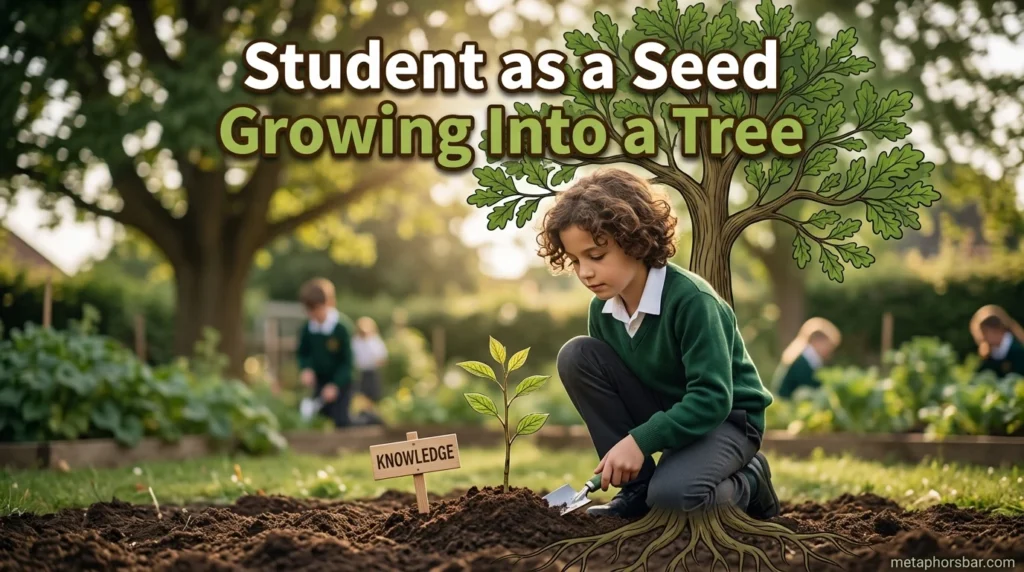
Student as a Seed Growing Into a Tree
Meaning and Explanation
This is one of the most beautiful metaphors for students because it captures the slow, steady, and often invisible process of growth. A seed does not become a tree overnight. It needs time, care, patience, sunlight, water, and quiet strength. In the same way, students grow through learning, guidance, setbacks, and persistence.
This metaphor is especially meaningful when describing development over time. It reminds us that a student may seem small or uncertain now, but their potential is already there, waiting to unfold.
Example Sentence or Scenario
At first, the student seemed quiet and unsure, but over the year, she grew like a seed becoming a tree—rooted, patient, and stronger with every lesson.
This could describe a child learning to read, a teenager discovering their voice, or a college student gaining confidence in their field. The image suggests that learning is organic, living, and gradual.
Alternative Ways to Express It
- a seed of potential
- growing into strong branches
- rooted in learning
- unfolding like leaves in spring
- a young sapling reaching for the light
Sensory or Emotional Details
You can imagine warm soil, fresh rain, tiny roots spreading underground, and the soft pressure of upward growth. Emotionally, this metaphor feels hopeful, patient, and tender. It honors the quiet work that happens before visible success appears.
Mini Storytelling Touch
A teacher once noticed a student who rarely spoke in class. Month by month, the student began to answer more questions, then ask them, then lead a group discussion. By the end of the year, the change felt almost miraculous—but only because it had been so gradual. “She didn’t suddenly become confident,” the teacher said. “She grew into herself, like a tree that had been waiting for spring.”
Literary or Cultural Reference
Across many cultures, trees symbolize wisdom, endurance, and life cycles. Using a tree to describe a student connects education to a deeper natural rhythm: learning as growth, not pressure.
Student as a Spark or Flame
Meaning and Explanation
This metaphor highlights energy, creativity, curiosity, and potential. A spark is small, but it can start something much larger. A flame gives light, warmth, and movement. Students often begin with questions, interest, or a moment of inspiration that leads to deeper learning.
This metaphor works well when describing bright ideas, enthusiasm, or the beginning of a passion. It is especially fitting for students who are creative, lively, or full of initiative.
Example Sentence or Scenario
The student was a spark in the classroom, always bringing energy, ideas, and a fresh way of seeing things.
This might describe a student who asks thoughtful questions, inspires classmates, or shows unusual curiosity. The flame image suggests not just intelligence, but presence and influence.
Alternative Ways to Express It
- a bright spark of curiosity
- a flame of ambition
- a light in the classroom
- a glowing mind
- a fire of ideas
Sensory or Emotional Details
This metaphor brings in warmth, flicker, glow, and motion. It can feel exciting and alive. Emotionally, it suggests inspiration, possibility, and the power of a small beginning that can lead to something big.
Mini Storytelling Touch
A boy once struggled with school because he thought he was “bad at everything.” Then one art project changed him. He poured himself into it with such imagination that his teacher stopped mid-sentence to admire it. That tiny moment was a spark. It did not solve everything at once, but it lit something in him that never quite went out.
Real-Life Example
Think of the student who volunteers to help, starts a debate, or brings a fresh perspective to a group project. That spark can energize an entire classroom. Sometimes the smallest flame changes the atmosphere of the whole room.
Student as a Traveler on a Long Road

Meaning and Explanation
This metaphor emphasizes the journey of education. A traveler does not reach every destination immediately. They move step by step, learning from the road, the weather, the obstacles, and the changing scenery. Similarly, students move through grades, lessons, mistakes, discoveries, and growth.
This is a powerful metaphor for students because it reduces pressure. It reminds us that learning is not a race to perfection. It is a journey with many stages, pauses, and turns.
Example Sentence or Scenario
Each student is a traveler on a long road, carrying questions, hopes, and lessons they will use long after the journey changes course.
This image works especially well when talking about education in a broad sense—school life, personal development, or the pursuit of a dream.
Alternative Ways to Express It
- a traveler on a winding path
- walking toward understanding
- journeying through knowledge
- a path of discovery
- moving step by step through learning
Sensory or Emotional Details
You can picture dusty paths, open horizons, backpacks, maps, and long stretches of road. Emotionally, it feels steady, reflective, and honest. It acknowledges both progress and uncertainty.
Mini Storytelling Touch
A student once told her mentor that she felt behind because she had changed majors twice. Her mentor smiled and said, “You’re not behind. You’re traveling.” That small shift in language changed everything. She stopped seeing her path as failure and began seeing it as movement.
Literary or Cultural Reference
Many classic stories use the journey as a symbol of learning and transformation. In that sense, the student as traveler connects education with adventure, perseverance, and becoming.
How to Choose the Right Metaphor for Students
Different metaphors highlight different qualities of student life.
Use a seed or tree when you want to show growth, patience, and long-term development. Use a spark or flame when you want to show energy, curiosity, and inspiration, Use a traveler on a long road when you want to show learning as a journey with challenges and discovery.
The best metaphor depends on the message you want to convey. A shy beginner, a creative thinker, and a determined achiever may each need a different image. The goal is not to force one symbol onto all students, but to choose the one that feels closest to their experience.
Interactive Exercises: Practice Creating Your Own Metaphors for Students
Exercise 1: Describe a Student You Know
Think of a student, maybe yourself or someone you’ve observed.
Complete this sentence: “This student is like ______ because ______.”
Example: “This student is like a river because they keep moving forward, even when the path bends.”
Exercise 2: Sensory Mapping
Write five words connected to a student’s learning journey:
- one sound
- one texture
- one color
- one movement
- one emotion
Then turn them into a metaphor.
Example: Learning sounded like pencil scratches and turning pages, felt like rough notebook paper, looked like morning light on a desk, moved like a steady climb, and carried the emotion of hope.
Exercise 3: Story Starter
Write a short paragraph beginning with: “The student was like…”
Let the metaphor guide the mood. You can make it uplifting, reflective, dramatic, or gentle.
Exercise 4: Caption or Quote Practice
Try turning your metaphor into a short caption, classroom motto, or social media post.
Examples:
- “Every student is a seed with its own season.”
- “Some students are sparks; others are slow-burning flames.”
- “Learning is a road, and every step counts.”
Bonus Tips for Using Metaphors for Students in Writing, Social Media, and Daily Life
Writing
Use metaphors for students in essays, teacher reflections, school speeches, graduation messages, and creative writing. They make educational language more emotional and memorable.
Social media
A short metaphor can turn a simple school post into something meaningful. It works beautifully for back-to-school captions, graduation posts, classroom photos, and student recognition messages.
Everyday conversation
Metaphors can make encouragement feel warmer and more personal. Instead of saying, “Keep going,” you might say, “You’re growing into something strong.”
For teachers and parents
Metaphors can help adults see students not just as performers, but as developing people. That perspective can encourage patience, empathy, and support.
Keep the image honest
Choose a metaphor that fits the student’s real experience. A high-energy student may fit the spark image, while a quiet but steadily improving student may fit the seed or tree.
FAQs
1. What is a metaphor for a student?
A metaphor for a student is a figurative comparison that describes a student using another image, such as a seed, spark, or traveler.
2. Why are metaphors for students useful?
They help express learning, growth, curiosity, and effort in a vivid and meaningful way.
3. Can metaphors for students be used in school writing?
Yes. They are useful in essays, speeches, reflections, teacher messages, and creative assignments.
4. What is a simple metaphor for a student?
A simple example is: A student is a seed. It shows growth and potential.
5. How do I create my own student metaphor?
Think about a student’s qualities, then compare them to something with similar traits or movement.
6. Are student metaphors only for teachers?
No. Students, parents, counselors, and writers can all use them.
7. What makes a strong metaphor for a student?
A strong metaphor is clear, emotionally fitting, and easy to imagine.
Conclusion
Students are not finished products. They are in motion—learning, growing, changing, and discovering what they are capable of. That is why metaphors matter. They help us honor the full shape of student life, from uncertainty to confidence, from first steps to lasting growth.
A student may be a seed, a spark, or a traveler. They may be all three in different moments. And that is what makes the image so rich: it reminds us that education is not only about results. It is about becoming.
So the next time you write about students, reach for language that feels alive. Let your words show their possibility, their effort, their curiosity, and their light. Because every student is more than a learner in a classroom. Every student is a story unfolding.