
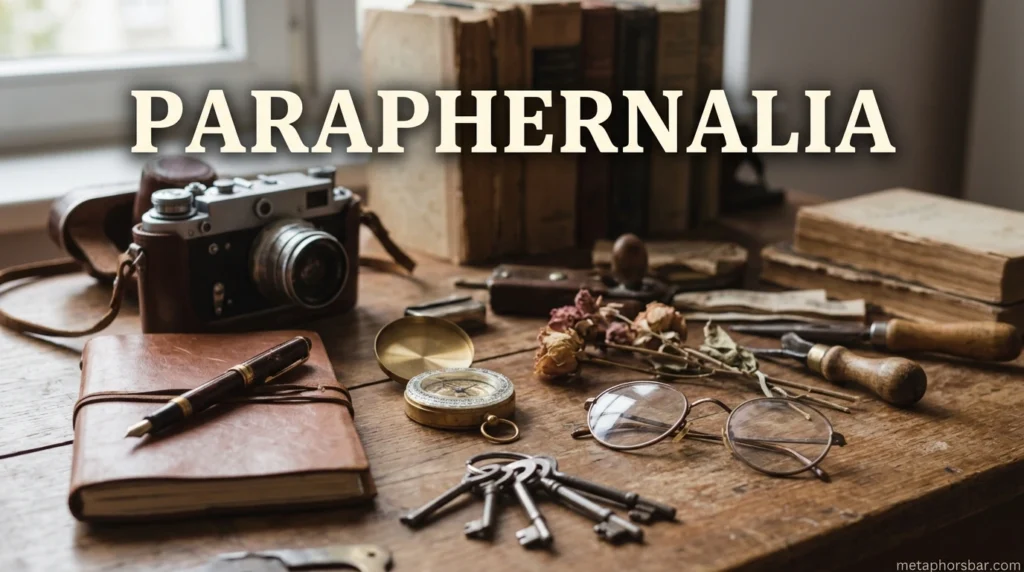
People often get confused by paraphernalia because it looks formal, sounds a little unusual, and is sometimes used in legal or academic writing where precision matters. Some learners also wonder whether it is singular or plural, how to pronounce it, and whether it has different spellings in British and American English. Since this word appears in exams, articles, reports, and everyday speech, understanding it clearly can help you write and speak with more confidence.
In simple terms, paraphernalia refers to a collection of objects, tools, equipment, or personal belongings connected with a particular activity, purpose, or profession. It is a useful word, but only when used correctly. This guide explains the meaning, correct usage, spelling, grammar, pronunciation, examples, and common mistakes in a beginner-friendly way.
Meaning of Paraphernalia
Paraphernalia means a set or collection of items used for a specific purpose. It often refers to things that are associated with an activity, job, hobby, or lifestyle.
Here are some everyday meanings:
- tools and equipment used for a task
- personal belongings
- items connected to a particular activity
- a group of objects that seem scattered or numerous
Simple definition
Paraphernalia = a collection of related things
Examples of meaning in context
- The kitchen was full of cooking paraphernalia.
- The camping paraphernalia was packed into the car.
- Police found drug paraphernalia in the room.
What kind of noun is it?
Paraphernalia is usually treated as a singular mass noun in modern English, even though it refers to many items. That means we often use it with singular verbs:
- The paraphernalia is on the table.
- His fishing paraphernalia was expensive.
It can also be used in a more general or formal way to describe the whole set of items linked to something.
Correct Usage and Grammatical Role
Paraphernalia is mainly a noun. It is not usually used as a verb or adjective.
Part of speech
| Word | Part of speech | Meaning |
| paraphernalia | noun | items or equipment connected with a purpose |
How it is used in sentences
It often appears after words like:
- of
- for
- associated with
- medical / legal / camping / office / drug
Correct examples
- The office paraphernalia includes staplers, folders, and files.
- She gathered all her baking paraphernalia before starting.
- The police searched for drug paraphernalia.
- His travel paraphernalia was scattered across the bed.
Incorrect examples
- She paraphernalia the kitchen. ❌
- They bought a paraphernalia. ❌
- The paraphernalias were missing. ❌
Better alternatives depending on context
Sometimes paraphernalia sounds formal or slightly heavy. In simpler writing, you can use:
- equipment
- tools
- supplies
- gear
- belongings
- items
- accessories
| Instead of paraphernalia | You can say |
| cooking paraphernalia | cooking tools / kitchen equipment |
| camping paraphernalia | camping gear / camping supplies |
| office paraphernalia | office supplies / office equipment |
| drug paraphernalia | drug-related items |
Spelling and Word Form
One reason people search for paraphernalia is that it looks difficult to spell. The word is long, but the spelling is stable and does not usually change between British and American English.
Correct spelling
paraphernalia
Common misspellings
| Incorrect | Correct |
| paraphenalia | paraphernalia |
| paraphernelia | paraphernalia |
| paraphenelia | paraphernalia |
| paraphernaliah | paraphernalia |
| paraphenalia | paraphernalia |
A helpful trick is to remember the middle part:
para + pher + nalia
It is not always easy to break logically, but repeating the word slowly can help.
British vs American spelling
There is no major spelling difference between British English and American English for this word.
| English variety | Spelling |
| British English | paraphernalia |
| American English | paraphernalia |
That makes the word easier than many others. You do not need to remember two versions.
Grammar Rules: Singular, Plural, and Agreement
This is one of the most confusing parts of the word. Even though paraphernalia refers to multiple objects, it usually behaves like a singular uncountable noun in modern usage.
Singular or plural?
In modern English, paraphernalia is usually treated as singular.
Correct verb agreement
- The paraphernalia is in the box.
- His paraphernalia was stolen.
Incorrect verb agreement
- The paraphernalia are in the box. ❌
- His paraphernalia were stolen. ❌
However, in some older or very formal uses, you may see plural-style agreement because the word has historical plural roots. In everyday modern writing, singular agreement is usually safest.
Can we say “one paraphernalia”?
Usually, no. Since the word refers to a collection, it is not commonly used with one.
- Correct: He carried his travel paraphernalia.
- Less natural: He carried one paraphernalia. ❌
Can we make it plural?
Not usually in standard modern usage.
- Incorrect: paraphernalias ❌
Grammar summary
| Feature | Correct usage |
| Verb agreement | singular: is, was, has |
| Article use | usually no “a” or “an” |
| Plural form | generally not used |
| Countability | usually uncountable / collective in meaning |
Pronunciation
The pronunciation of paraphernalia can look intimidating, but it becomes easier when broken into parts.
Common pronunciation
par-uh-fer-NAY-lee-uh
IPA is often given as:
/ˌpær.ə.fəˈneɪ.li.ə/
Syllable breakdown
A simple way to say it is:
para + pher + na + lia
Or:
par-uh-fer-NAY-lee-uh
Pronunciation tips
- Stress the NAY sound.
- Do not rush the middle syllables.
- Say it slowly at first, then build speed.
Incorrect pronunciation habits
People often say it too quickly and blur the middle sounds. Others put stress on the wrong syllable.
Try this rhythm:
par-uh-fer-NAY-lee-uh
If you say it aloud a few times, it becomes much easier to remember.
Sentence Examples in Everyday English
The best way to learn a word is through real examples. Paraphernalia can appear in formal, everyday, academic, and legal contexts.
Everyday examples
- I packed all my gym paraphernalia into one bag.
- The drawer was full of school paraphernalia.
- She keeps her sewing paraphernalia in a small box.
Formal examples
- The report described the tools and paraphernalia used in the workshop.
- The museum displayed paraphernalia from the 19th century.
Legal or official examples
- Police found drug paraphernalia during the search.
- The statement listed various items of paraphernalia found at the scene.
- Laws in some places regulate drug paraphernalia.
Examples in different contexts
| Context | Example |
| home | The kitchen paraphernalia was stored neatly. |
| hobby | His fishing paraphernalia cost a lot. |
| work | The office paraphernalia was organized in drawers. |
| law | The police seized illegal paraphernalia. |
Correct and incorrect examples
| Correct | Incorrect |
| The paraphernalia is on the table. | The paraphernalia are on the table. |
| She bought camping paraphernalia. | She bought a paraphernalia. |
| They found drug paraphernalia. | They found drug paraphernalias. |
| The paraphernalia was expensive. | The paraphernalia were expensive. |
Common Mistakes Learners Make
Because the word is long and uncommon, learners often make a few predictable mistakes. Avoiding them will make your writing sound more natural and polished.
Mistake 1: Treating it as a plural count noun
Many people think paraphernalia must take a plural verb because it refers to many things.
- Incorrect: The paraphernalia are in the garage. ❌
- Correct: The paraphernalia is in the garage. ✅
Mistake 2: Adding “a” or “an”
Since the word already refers to a collection, using a paraphernalia usually sounds wrong.
- Incorrect: He bought a paraphernalia. ❌
- Correct: He bought paraphernalia. ✅
Mistake 3: Trying to pluralize it
- Incorrect: paraphernalias ❌
- Correct: paraphernalia ✅
Mistake 4: Misspelling the word
The most common spelling errors happen in the middle section.
- Incorrect: paraphenalia ❌
- Correct: paraphernalia ✅
Mistake 5: Using it where a simpler word would be better
Paraphernalia is fine, but sometimes it sounds too formal or vague.
- Better simple choice: tools, equipment, supplies, gear
For example:
- Wordy: He carried all his school paraphernalia.
- Simpler: He carried all his school supplies.
Mistake 6: Using it without clear context
Paraphernalia works best when the surrounding words make the meaning clear.
- Clear: medical paraphernalia
- Clear: camping paraphernalia
- Less clear: paraphernalia on the shelf
Without context, the reader may not know what type of items you mean.
Paraphernalia in British vs American English
This word is not one of those that causes major regional spelling confusion. Still, learners sometimes wonder whether it is used differently in the UK and US.
Spelling
There is no difference:
- British English: paraphernalia
- American English: paraphernalia
Meaning
The general meaning is also the same in both varieties: items, equipment, or belongings associated with a purpose or activity.
Usage differences
The main difference is not spelling, but how commonly it appears and in what contexts.
- In everyday speech, both varieties often prefer simpler words like stuff, equipment, gear, or supplies.
- In legal, formal, or descriptive writing, paraphernalia appears more often.
Example usage in both varieties
| Variety | Example |
| British English | The camping paraphernalia was stored in the shed. |
| American English | The camping paraphernalia was stored in the garage. |
The sentence structure is the same.
Comparison Tables for Easy Learning
The tables below make the word easier to remember and use.
1: Paraphernalia vs simpler alternatives
| Word | Meaning | Best use |
| paraphernalia | a collection of related items | formal, academic, legal, descriptive writing |
| equipment | tools or machines used for a purpose | everyday and formal writing |
| gear | tools or clothes for an activity | casual writing |
| supplies | materials needed for a task | school, office, household context |
| belongings | personal possessions | personal context |
2: Correct vs incorrect usage
| Correct | Incorrect | Why |
| The paraphernalia is missing. | The paraphernalia are missing. | singular agreement is preferred |
| He packed his paraphernalia. | He packed a paraphernalia. | usually uncountable |
| They found drug paraphernalia. | They found drug paraphernalias. | no standard plural |
| She cleaned her baking paraphernalia. | She cleaned her baking paraphernalium. | wrong form |
3: Context and meaning
| Context | What paraphernalia may refer to |
| home | tools, belongings, supplies |
| hobby | equipment connected with the hobby |
| work | office or technical tools |
| law | items linked to illegal activity |
| travel | personal items, packing accessories |
Real-Life Writing Tips
If you are a student, writer, or English learner, here is how to use the word well.
Use paraphernalia when:
- you want a formal or precise tone
- you mean a collection of related items
- the items are linked to a specific activity
- the phrase sounds natural in legal, technical, or descriptive writing
Prefer simpler words when:
- your audience is beginner-level
- the sentence needs to be short and direct
- a simpler synonym fits better
Good writing examples
- The scientist arranged the laboratory paraphernalia carefully.
- She packed all her travel paraphernalia the night before.
Simpler versions
- The scientist arranged the laboratory equipment carefully.
- The garage was filled with gardening tools.
- She packed all her travel items the night before.
Both styles can be correct. The best choice depends on tone and audience.
FAQs
1. What does paraphernalia mean in simple English?
It means a collection of items, tools, or objects used for a purpose.
2. Is paraphernalia singular or plural?
In modern English, it is usually treated as singular, even though it refers to many items.
3. What is the plural of paraphernalia?
It is generally not pluralized in standard modern English. The word itself already refers to a collection.
4. How do you pronounce paraphernalia?
A common pronunciation is par-uh-fer-NAY-lee-uh.
5. Can I say “a paraphernalia”?
Usually, no. It is better to say paraphernalia or use a simpler word like equipment or gear.
6. What is a common example of paraphernalia?
Examples include cooking paraphernalia, camping paraphernalia, office paraphernalia, and drug paraphernalia.
7. Is paraphernalia formal?
Yes, it often sounds formal, descriptive, or legal.
Conclusion
Paraphernalia is a useful English noun that means a collection of items, tools, or belongings connected with a particular purpose or activity. The most important things to remember are simple: it is usually spelled paraphernalia, pronounced par-uh-fer-NAY-lee-uh, and treated as a singular noun in modern usage. You usually do not say a paraphernalia, paraphernalias, or use plural verbs like are and were with it.
If you remember one rule, remember this: paraphernalia refers to many items but usually behaves like one collection. That makes it singular in grammar, even though it describes multiple things in meaning.
For clear, correct writing, use it when you need a formal word for equipment, supplies, tools, or related objects. For simpler communication, choose words like equipment, gear, supplies, or belongings. With a little practice, you will be able to use paraphernalia confidently and correctly in both writing and speech.