
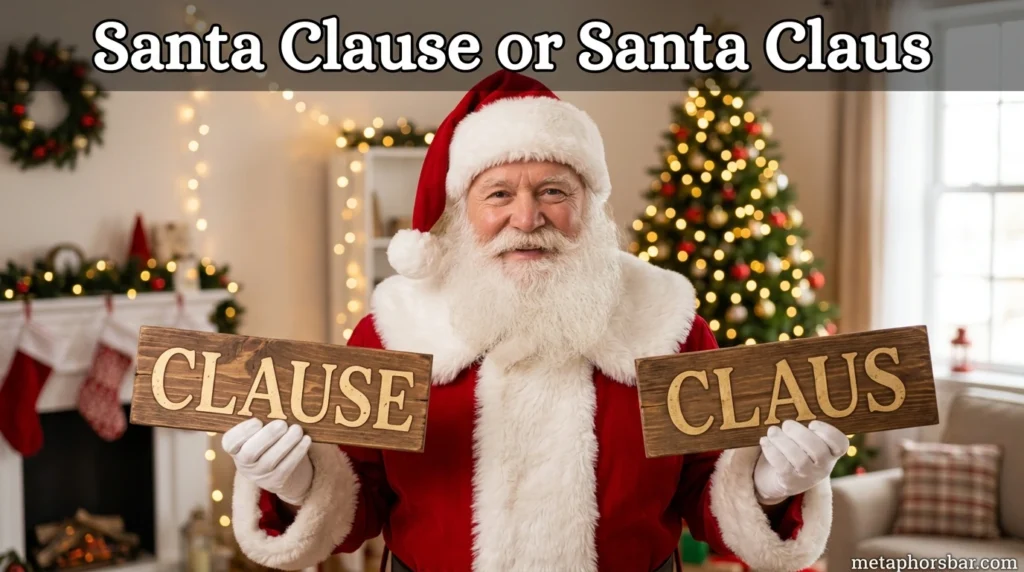
People often get confused by Santa Clause or Santa Claus because the two phrases look almost identical and sound the same in speech. That makes the mistake easy to miss, especially in holiday messages, school writing, captions, and casual conversation. But in everyday writing, exams, and professional communication, spelling still matters. A small error can make a sentence look careless, even when the meaning is obvious.
The good news is that this topic is very simple once you know the rule. The correct spelling is Santa Claus. Santa Clause is incorrect when you mean the Christmas figure. In this article, you will learn the meaning, spelling difference, grammar rules, pronunciation, sentence examples, common mistakes, and easy memory tips so you can use the correct form confidently.
What Does “Santa Claus” Mean?
Santa Claus is the name of the well-known Christmas character who brings gifts to children, especially in Christmas traditions around the world.
Simple meaning
- the Christmas gift-giver
- the jolly man in red
- a holiday character associated with Christmas
- a symbol of festive cheer and gift giving
Examples
- Children wrote letters to Santa Claus.
- Santa Claus comes on Christmas Eve in many stories.
- The movie showed Santa Claus flying in a sleigh.
Why the phrase matters
Because Santa Claus is a proper name, it is treated like a person’s name in English. That means:
- both words are capitalized
- the spelling must be exact
- it should not be changed to a common noun phrase unless the context is playful or fictional
Comparison table: what Santa Claus refers to
| Term | Meaning | Type |
| Santa Claus | Christmas gift-bringer | proper noun |
| Father Christmas | Christmas figure, especially in British English | proper noun |
| Saint Nicholas | historical figure linked to the legend | proper noun |
Key idea
When you write Santa Claus, you are referring to the holiday character. It is not a phrase you can change freely without altering the meaning.
What Does “Santa Clause” Mean?
In standard English, Santa Clause is usually a spelling mistake when you mean the Christmas figure.
Why people make the mistake
The word clause is a real English word, so learners may accidentally replace Claus with Clause because:
- both sound almost the same
- both begin with cla-
- both look reasonable at first glance
What “clause” actually means
A clause is a grammar term. It is a group of words with a subject and a verb.
Examples:
- When I arrived, he was already there.
- She left because she was tired.
These are clauses. The word clause has nothing to do with the Christmas character.
Comparison table: Claus vs Clause
| Word | Meaning | Use |
| Claus | part of the name Santa Claus | Christmas character |
| clause | a grammar unit or legal provision | grammar, law |
Correct vs incorrect examples
| Incorrect | Correct |
| Santa Clause | Santa Claus |
| I saw Santa Clause on TV. | I saw Santa Claus on TV. |
| The children waited for Santa Clause. | The children waited for Santa Claus. |
Important note
The word Clause can appear in legal or grammatical contexts, but never as the correct spelling of the Christmas name.
Spelling Differences: Claus vs Clause
The difference is just one letter, but that one letter changes the word completely.
Correct spelling
- Claus with au
Incorrect spelling
- Clause with au + e
Why this matters
Because Claus is part of a proper noun, the spelling is fixed. You cannot replace it with a similar-looking English word.
Spelling comparison table
| Form | Correct? | Notes |
| Santa Claus | yes | correct Christmas name |
| Santa Clause | no | common misspelling |
| Claus | yes | surname form in the name |
| clause | yes | separate English word, not the name |
Why the confusion happens
English speakers hear:
- Claus
- clause
These sound very similar in many accents. That makes the spelling easy to mix up, especially when typing quickly.
Memory trick
Think of Santa Claus as a name, not a grammar term.
- Claus = the name
- clause = grammar word
If you remember that clause is a grammar term, you are less likely to use it in the Christmas name.
Correct and incorrect examples
| Incorrect | Correct |
| Santa Clause brings gifts. | Santa Claus brings gifts. |
| We wrote a letter to Santa Clause. | We wrote a letter to Santa Claus. |
| The children believe in Santa Clause. | The children believe in Santa Claus. |
Grammar Rules and Word Form
Because Santa Claus is a proper noun, it follows the rules of names in English.
Capitalization
Proper nouns are capitalized:
- Santa
- Claus
Examples:
- Santa Claus is coming.
- I saw Santa Claus at the mall.
No apostrophe
There is no apostrophe in the name:
- Santa Claus
- not Santa’s Claus
- not Santa Clause
Comparison table: grammar facts
| Feature | Correct form | Example |
| proper noun | Santa Claus | Santa Claus waved to the children. |
| capitalization | both words capitalized | Santa Claus |
| apostrophe | none | Santa Claus, not Santa’s Claus |
| plural form | not usually needed | Santa Claus is singular |
Can “Santa Claus” be plural?
Usually, no. You do not normally say:
- Santas Claus
- Santa Clauses
However, in a story or joke, you might hear:
- “There were several Santa Claus figures at the parade.”
That is a different use, referring to people dressed as Santa, not the proper name itself.
What about “the Santa Claus”?
Usually, no article is needed when referring to the character.
- Correct: Santa Claus came down the chimney.
- Less natural: The Santa Claus came down the chimney.
Basic rule
Treat Santa Claus like a person’s name:
- capitalize both words
- do not add punctuation inside the name
- do not change Claus to Clause
Sentence Examples: Correct and Incorrect Usage
Examples help make the difference unforgettable.
Correct examples
- Santa Claus wears a red suit.
- The children waited for Santa Claus.
- My niece wrote a letter to Santa Claus.
- Santa Claus is a popular Christmas character.
- The movie showed Santa Claus delivering presents.
More real-life examples
- We left cookies for Santa Claus.
- The school play included Santa Claus and his helpers.
- Children around the world recognize Santa Claus.
- The decorations made Santa Claus look even more cheerful.
Incorrect examples
- Santa Clause wears a red suit.
- The children waited for Santa Clause.
- My niece wrote a letter to Santa Clause.
- Santa Clause is a popular Christmas character.
- We left cookies for Santa Clause.
Correct vs incorrect table
| Incorrect | Correct |
| Santa Clause | Santa Claus |
| wrote to Santa Clause | wrote to Santa Claus |
| believed in Santa Clause | believed in Santa Claus |
| Santa Clause came at midnight | Santa Claus came at midnight |
A useful observation
The phrase works in the same sentence patterns as other proper names:
- Santa Claus brings gifts.
- Santa Claus is friendly.
- Children love Santa Claus.
If you can remember that it behaves like a name, spelling becomes much easier.
Common Mistakes Learners Make
This is one of the most common Christmas spelling mistakes in English.
1: Using clause instead of Claus
- Wrong: Santa Clause
- Right: Santa Claus
2: Lowercasing the name
- Wrong: santa claus
- Right: Santa Claus
3: Adding an apostrophe
- Wrong: Santa’s Claus
- Right: Santa Claus
4: Confusing clause with a grammar term
Some learners know clause from grammar lessons and mistakenly think it belongs in the Christmas name. It does not.
5: Not checking holiday writing carefully
This mistake often appears in:
- cards
- captions
- blog posts
- school assignments
- social media posts
Common mistake table
| Wrong | Correct |
| santa claus | Santa Claus |
| Santa Clause | Santa Claus |
| Santa’s Claus | Santa Claus |
| Clause Claus | Santa Claus |
Easy memory tip
If the word is about:
- Christmas
- gifts
- a red suit
- reindeer
then it is Santa Claus, not Santa Clause.
Another helpful trick
Say it this way:
- Santa Claus is a name
- clause is a grammar word
That difference is enough to keep the spellings separate in your mind.
Pronunciation, British vs American English, and Style
Pronunciation
The two phrases sound nearly identical in many accents:
- Santa Claus → SAN-tuh KLAWZ
- Santa Clause → sounds similar, which is why the spelling mistake happens
Pronunciation table
| Word | Approximate pronunciation | Notes |
| Santa Claus | SAN-tuh KLAWZ | correct name |
| clause | KLAWZ | grammar/legal word |
| Claus | KLAWZ | surname in the name |
British vs American English
There is no major British vs American English difference in the spelling of Santa Claus itself. Both varieties use the same spelling.
However, there is a vocabulary difference in the broader Christmas tradition:
- Santa Claus is common in both
- Father Christmas is also used in British English
Comparison table: regional usage
| Variety | Common term | Notes |
| American English | Santa Claus | very common |
| British English | Santa Claus / Father Christmas | both understood |
| spelling difference | none for Santa Claus | same spelling |
Style note
When writing for children, holiday cards, captions, or festive stories, Santa Claus is the standard and correct form.
Practical takeaway
The correct spelling is the same in both major varieties of English. The only thing to remember is:
- Claus
- not Clause
FAQs
Is “Santa Clause” ever correct?
No, not when you mean the Christmas character. The correct spelling is Santa Claus.
Why do people write “Santa Clause”?
Because clause is a real English word and sounds almost the same as Claus. It is a very common spelling error.
Is “Claus” a real name?
Yes. Claus is part of the traditional name Santa Claus.
Is Santa Claus the same as Father Christmas?
They refer to the same Christmas figure in many contexts, but Father Christmas is more common in British English.
Should both words be capitalized?
Yes. Santa Claus is a proper noun, so both words are capitalized.
Can I write “santa claus” in lowercase?
Not in standard writing. Proper names should be capitalized:
- Santa Claus
Is there a difference between clause and Claus in meaning?
Yes.
- Claus = name in Santa Claus
- clause = grammar unit or legal provision
What is the easiest way to remember the correct form?
Remember that Santa Claus is a name, and names are capitalized and spelled exactly as written.
Conclusion
The correct spelling is Santa Claus, not Santa Clause. The difference is only one letter, but that letter changes the meaning completely. Claus is part of the Christmas character’s name, while clause is a grammar or law word that has nothing to do with Santa.
Here is the easiest way to remember it:
- Santa Claus = correct
- Santa Clause = incorrect
- Claus = the name
- clause = grammar term
So write:
- Santa Claus brings gifts.
- Children wait for Santa Claus.
- We left cookies for Santa Claus.
If you remember only one thing, remember this: the Christmas character is Santa Claus, with an “s,” not Santa Clause, with an “e.” That simple rule will help you avoid one of the most common holiday spelling mistakes in English.