
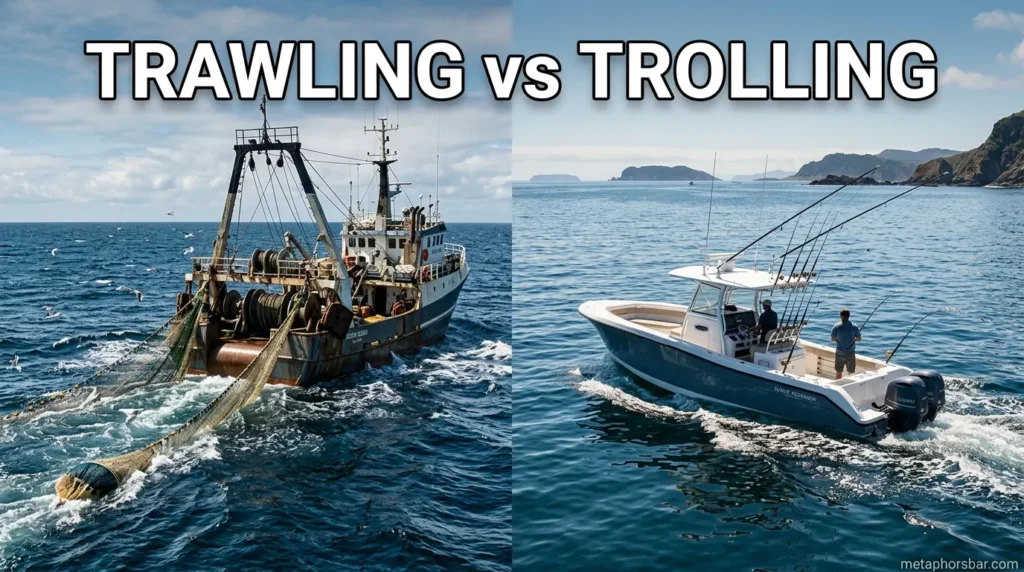
People often confuse trawling and trolling because the two words look similar, sound similar, and are both used in modern English in more than one context. One word is connected to fishing and searching, while the other is strongly connected to online behavior and provocation. That confusion matters in everyday writing, speaking, exams, and professional communication because using the wrong word can change your meaning completely. This guide explains the difference in simple language, with clear examples, so you can use both words confidently and correctly.
Meaning: What Each Word Really Means
The easiest way to understand trawling vs trolling is to separate their main meanings.
Trawling
Trawling usually means:
- dragging a fishing net through water to catch fish
- searching carefully through a large amount of information, messages, or files
In modern English, trawl is often used figuratively too.
Examples:
- The fishermen were trawling the sea for shrimp.
- I spent hours trawling through old emails to find the invoice.
Trolling
Trolling usually means:
- posting or saying something online to upset people, provoke reactions, or start arguments
- behaving in a deliberately annoying or offensive way on the internet
Examples:
- He was trolling people in the comments section.
- The post looked like simple criticism, but it was actually trolling.
Table 1: Core Meaning Comparison
| Word | Main Idea | Typical Context | Tone |
| Trawling | Searching or fishing | Fishing, research, data searching | Neutral |
| Trolling | Provoking or annoying online | Social media, forums, comment sections | Negative |
A simple memory trick helps:
- trawling = searching or dragging a net
- trolling = provoking or baiting people
Spelling Differences and Word Formation
The spelling difference is very small, but the meaning difference is very large.
Why they look confusing
The words differ by only one letter:
- trawling
- trolling
That single vowel change can be easy to miss when typing quickly, reading fast, or using speech-to-text tools.
Word roots
Both words come from different older verbs:
- trawl → trawling
- troll → trolling
Even though they are now used in modern contexts, the base words still matter.
Table 2: Spelling and Base Form Comparison
| Base Word | Present Participle | Meaning |
| trawl | trawling | drag a net; search carefully |
| troll | trolling | provoke, bait, or annoy; also fish by dragging a lure in some contexts |
Important spelling note
Do not confuse:
- trawling with trolling
- trawl with troll
They are not interchangeable.
Incorrect examples
- The fisherman was trolling for fish in the net.
This is wrong if you mean dragging a net. - She spent the afternoon trawling people in the comments.
This is wrong if you mean provoking people online.
Correct examples
- The fisherman was trawling for fish.
- She was trolling the discussion on purpose.
Grammar Rules and Correct Usage in Sentences
Both words can function as verbs, but they are used in different sentence patterns and contexts.
1. Trawling as a verb
Trawling often appears with:
- through
- for
- across
- around
Examples:
- He was trawling through the archive.
- Researchers are trawling for useful data.
- The team spent hours trawling across the database.
2. Trolling as a verb
Trolling often appears with:
- online
- on social media
- in the comments
- people
- users
- a forum
Examples:
- Someone was trolling online.
- They accused him of trolling users.
- The account is trolling in the comments.
3. As gerunds or nouns
Both words can also appear in noun-like forms in some contexts.
- Trawling can refer to the activity of trawling.
- Trolling can refer to online provocation.
Example:
- Trolling has become a serious issue on many platforms.
Table 3: Usage Patterns
| Word | Common Verb Pattern | Example |
| Trawling | trawling through / for / across | She was trawling through the files. |
| Trolling | trolling online / trolling people | He was trolling people in the chat. |
Correct and incorrect usage
Correct:
- I was trawling through old notes.
- The journalist was trawling for details.
- The teenager was trolling strangers online.
Incorrect:
- I was trolling through old notes.
This is usually wrong unless you mean upsetting people, which does not fit the context. - The journalist was trawling people online.
This should usually be trolling if the meaning is provoking.
Helpful grammar rule
Ask yourself:
- Is the action about searching carefully? Use trawling.
- Is the action about provoking or irritating people? Use trolling.
That is the safest rule for students and writers.
British vs American English: Is There Any Difference?
There is no major British vs American spelling difference in the words trawling and trolling. The spelling is the same in both varieties of English.
However, there can be a difference in frequency and style.
Trawling
In both British and American English, trawling is used for fishing and searching. It is a standard, neutral word.
Trolling
In both British and American English, trolling is widely used for online harassment, baiting, or annoying behavior. It is especially common in internet culture, social media, and news coverage.
Table 4: Regional Use Comparison
| Feature | British English | American English |
| Spelling | Same | Same |
| Trawling meaning | Fishing, searching | Fishing, searching |
| Trolling meaning | Provoking online | Provoking online |
| Formality | Same general usage | Same general usage |
A small note on context
In older or specialist fishing language, trolling can also mean fishing with a lure or line dragged behind a boat. That meaning exists in both British and American English, but in everyday modern conversation, trolling usually means online provocation.
So if someone says “He is trolling,” most readers will think of the internet meaning, not fishing.
Pronunciation: How to Say Them Clearly
These two words sound similar, which is another reason they are often confused.
Pronunciation guide
- trawling: sounds like TRAW-ling
- trolling: sounds like TROH-ling
The difference is mainly in the vowel sound:
- trawling has an aw sound
- trolling has an oh sound
Simple pronunciation tip
Think of:
- trawling = “draw” with a t
- trolling = “troll” with -ing
Common speaking mistake
Because the words are close, fast speech may blur them. That is why learners should slow down and emphasize the vowel sound.
Example pronunciation contrast
- trawling: The fishermen were trawling at dawn.
- trolling: The account was trolling everyone in the thread.
Even if a listener understands from context, accurate pronunciation helps in presentations, interviews, and exams.
Sentence Examples: Correct, Incorrect, and Practical Use
Examples are the best way to master trawling vs trolling in real English.
Trawling examples
Correct:
- The boat was trawling near the coast.
- She spent the afternoon trawling through job listings.
- Researchers are trawling the data for patterns.
- He kept trawling through old photos until midnight.
Incorrect or awkward:
- The boat was trolling near the coast.
This is wrong if you mean fishing with a net or searching. - She spent the afternoon trolling through job listings.
This sounds like she was annoying job listings, which does not make sense.
Trolling examples
Correct:
- Someone was trolling in the comment section.
- Stop trolling people online.
- The post looked harmless, but it was clearly trolling.
- He admitted that he was trolling to get attention.
Incorrect or awkward:
- She was trawling people in the comments.
This is wrong if the meaning is provoking. - He was trawling the chat to make people angry.
This should usually be trolling.
Side-by-side examples
| Meaning | Correct Word | Example |
| Searching the internet or files | Trawling | She was trawling through research articles. |
| Fishing with a net | Trawling | The boat was trawling offshore. |
| Provoking people online | Trolling | He was trolling users in the forum. |
| Baiting someone for a reaction | Trolling | They accused her of trolling. |
Real-life writing examples
School writing:
- The researcher was trawling through sources to find evidence.
Social media writing:
- Ignore the account; it looks like trolling.
In professional communication:
- The analyst spent the morning trawling through reports.
In news writing:
- The company said it was taking action against trolling on its platform.
Common Mistakes and How to Avoid Them
Even native speakers sometimes mix these words up. Here are the most common mistakes and the easiest ways to avoid them.
1. Using “trolling” when you mean “searching”
This is a very common error.
Wrong:
- I was trolling through the documents.
Right:
- I was trawling through the documents.
2. Using “trawling” when you mean “provoking”
Wrong:
- He was trawling people online.
Right:
- He was trolling people online.
3. Confusing fishing meanings
Both words can relate to fishing, but not in the same way.
- trawling = dragging a net
- trolling = often dragging a lure behind a boat
In everyday English, however, the fishing distinction is less important than the internet distinction.
4. Assuming they are interchangeable
They are not synonyms. They overlap only loosely in fishing contexts, and even then the exact meaning differs.
5. Misspelling them in fast typing
Because the words are so close, people often type the wrong one by accident.
A quick self-check helps:
- If the sentence is about finding information, choose trawling.
- If the sentence is about annoying or provoking, choose trolling.
Table 5: Common Mistakes and Fixes
| Incorrect Sentence | Problem | Correct Sentence |
| She was trolling through the library. | Wrong word for searching | She was trawling through the library. |
| He was trawling users in the chat. | Wrong word for provoking | He was trolling users in the chat. |
| The team was trolling for data. | Wrong word for careful searching | The team was trawling for data. |
| They accused him of trawling online. | Wrong word for online provocation | They accused him of trolling online. |
Easy memory trick
Use this tiny rule:
- trawling = trying to find
- trolling = trying to provoke
That one line will save you from most mistakes.
FAQs
Are trawling and trolling the same?
No. They are different words with different meanings. Trawling means fishing with a net or searching carefully. Trolling means provoking, baiting, or annoying people, especially online.
Which is correct for searching through emails?
Trawling is correct.
- I was trawling through emails.
Which is correct for someone posting rude comments online?
Trolling is correct.
- He was trolling in the comments.
Can trolling mean fishing?
Yes, in some fishing contexts, trolling can mean dragging a lure behind a moving boat. But in everyday modern English, the online meaning is much more common.
Is “trawling” common in British English?
Yes, it is standard in both British and American English. It is especially common in fishing, research, journalism, and data-related writing.
Is “trolling” always negative?
Usually, yes. In modern English, it often means deliberately annoying or provoking people. However, in some fishing contexts, it is neutral.
How can I remember the difference quickly?
Think:
- trawling = searching
- trolling = provoking
Which word should I use in formal writing?
Use the word that matches your meaning exactly. In formal writing, trawling is fine for searching or fishing, and trolling is fine when discussing online behavior, but be precise and clear.
Conclusion
The difference between trawling and trolling is simple once you see it clearly. Trawling is about fishing with a net or searching carefully through information, while trolling is about provoking, baiting, or irritating people, especially online. Because the words look and sound similar, learners often confuse them, but the meaning changes completely depending on which one you choose. That is why this distinction matters in everyday writing, speaking, exams, and professional communication.
The safest way to remember the difference is this: trawling means searching, and trolling means provoking. If you are going through files, articles, messages, or data, use trawling. If someone is trying to upset people online, use trolling. Once you learn that pattern, you can choose the correct word confidently and avoid one of the most common vocabulary mix-ups in English.