
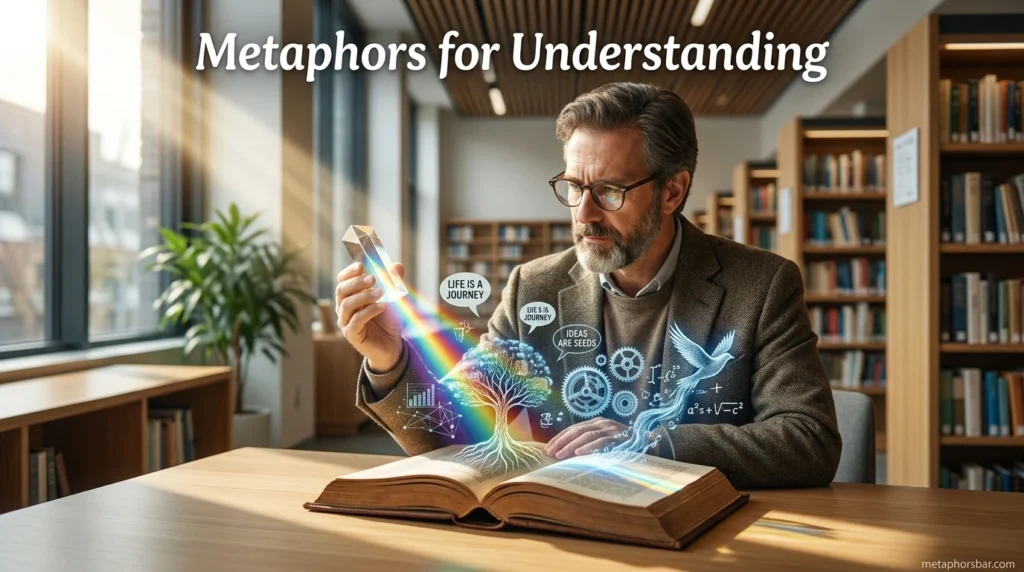
Imagine standing on the edge of a quiet lake at sunrise. The water is still, and the fog drifts gently across its surface. You watch a single ripple spread outward, touching every corner. Suddenly, understanding feels like that ripple: a small spark in your mind that spreads, connecting ideas and feelings, turning confusion into clarity.
Understanding isn’t just about memorizing facts or following instructions—it’s about seeing and feeling the connections. And one of the most magical ways to grasp ideas, emotions, or situations is through metaphors for understanding. Metaphors turn abstract thoughts into vivid pictures, helping us explain, learn, and share ideas in ways that stick.
In this article, we’ll explore metaphors for understanding, how to use them, and ways to practice them in writing, social media, or daily life. Through stories, examples, and exercises, you’ll discover how to make understanding feel alive.
What Are Metaphors for Understanding?
A metaphor is a way of describing one thing as if it were another. When we say “her mind is a library”, we’re not saying her head has bookshelves—but we imagine her mind full of organized knowledge.
Metaphors for understanding help turn invisible ideas into visible, memorable images. They bridge the gap between what we know and what we want to explain. By using metaphors, we can make tricky ideas simple, emotions clear, and abstract concepts vivid.
Think about this: you might understand gravity in physics, but when someone says, “Gravity is a silent hand pulling everything toward the ground”, your brain lights up. Suddenly, understanding isn’t just logic—it’s imagination.
Why Using Metaphors Improves Understanding
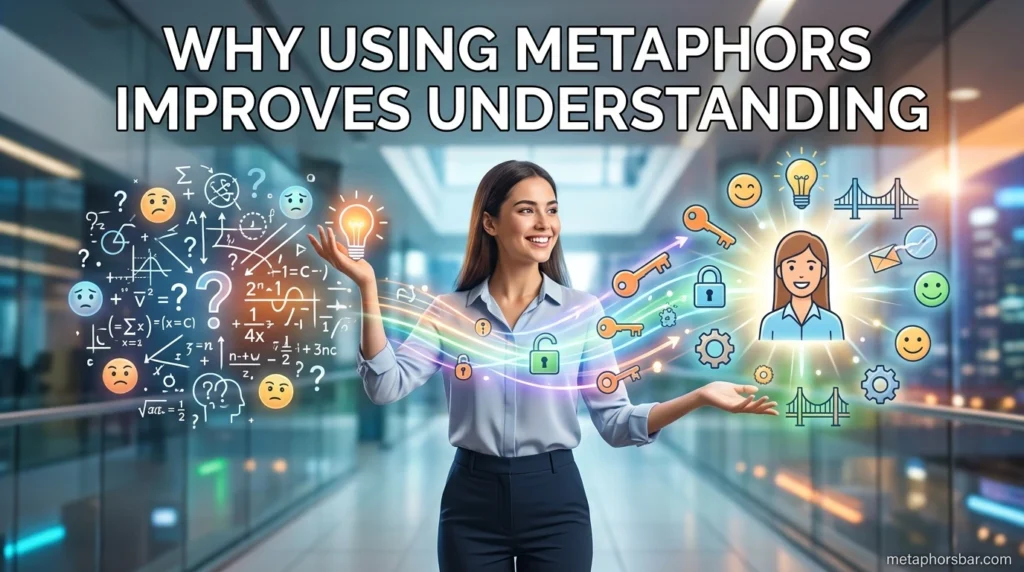
Metaphors are like mental shortcuts. They:
- Help you remember ideas better.
- Make abstract concepts tangible.
- Encourage creativity and new perspectives.
- Strengthen communication—people “see” what you mean.
In short, metaphors don’t just explain—they illuminate. They turn plain ideas into stories, pictures, and experiences.
Understanding as a Map
Meaning: Understanding is like a map—you start with a rough outline and gradually fill in details, seeing where everything connects.
Example: Learning a new subject feels like unfolding a map. At first, it’s just blank paper, but as you study, landmarks appear, paths connect, and suddenly you can navigate the ideas with confidence.
Alternative ways to say it:
- Understanding is a puzzle.
- Knowledge is a constellation.
- Comprehension is a blueprint.
Mini Story: When Leonardo da Vinci studied the human body, he didn’t just memorize muscles—he drew them. Each sketch was a part of a mental map, helping him understand anatomy in a visual, lasting way.
Exercise: Take a concept you’re learning—like photosynthesis—and draw a simple map of how it works. Label sunlight, water, and leaves as stops on a journey.
Understanding as a Key
Meaning: Understanding unlocks hidden doors in your mind. Every new idea you grasp opens a passage to more knowledge.
Example: When you finally grasp how fractions work, it’s like finding the key to a door labeled “Math Confidence.” Behind it, more lessons become accessible.
Alternative ways to say it:
- Comprehension is a lantern.
- Knowledge is a treasure chest.
Cultural Reference: In fairy tales, keys often symbolize discovery and access. Think of Alice in Wonderland finding keys that open doors to fantastical worlds. Understanding works the same way—it gives you access to new mental landscapes.
Exercise: Write down one “locked door” in your life—something you don’t yet understand. Brainstorm three ways you could find the key: a book, a conversation, or a small experiment.
Understanding as a Garden
Meaning: Understanding grows like a garden. Seeds of curiosity, watered by effort and attention, bloom into knowledge and insight.
Example: At first, a topic might seem like a patch of bare soil. But by asking questions and exploring, small sprouts appear. Over time, ideas bloom into a full garden of comprehension.
Alternative ways to say it:
- Knowledge is a tree, growing branches of thought.
- Learning is a river, slowly carving a path through stone.
Mini Story: Imagine Marie Curie in her laboratory, carefully tending experiments like a gardener tending delicate plants. Each observation was a seed of understanding, leading to discoveries that transformed science.
Exercise: Think of a subject you want to understand better. Draw it as a garden: what is the seed? What do you need to water it with? What ideas are blooming?
Understanding Through Storytelling

Humans are wired for stories. When we turn information into a narrative, we remember it better and see connections more clearly.
Tip: Turn your understanding into a mini-story. Even a single concept can be a character on a journey.
Example: Instead of memorizing the water cycle, imagine “Raindrop Ralph” traveling from cloud to river to ocean. Each step becomes a scene in Ralph’s adventure.
Exercise: Pick a concept, like photosynthesis or recycling, and write a 3-sentence story about it.
Visual Metaphors: Seeing Is Believing
Sometimes, words alone aren’t enough. Drawing, diagrams, or simple doodles can make abstract ideas clear.
Example: A timeline of history is a bridge, connecting past events to the present. A bar graph shows growth like climbing stairs to a higher viewpoint.
Tip: Use colors and symbols to make your visual metaphors more vivid. Red for danger, green for growth, blue for calm or water.
Exercise: Create a doodle that represents “learning a new skill.” Use shapes, arrows, or colors to map the process.
Emotional Metaphors for Understanding
Understanding isn’t only mental—it’s emotional. We can use feelings to describe clarity.
Examples:
- Understanding is a sunrise, brightening the dark corners of confusion.
- Comprehension is a warm blanket, comforting and secure.
Mini Story: When a child finally understands how to tie shoelaces, the joy is as warm and comforting as a sunny morning.
Exercise: Think of a moment when you understood something suddenly. Describe it with a metaphor for temperature, light, or texture.
Metaphors in Writing and Social Media
Metaphors make your ideas more shareable and memorable. On social media, a single vivid metaphor can explain an idea in seconds.
Example: Instead of “Learning is hard,” try: “Learning is a climb up a misty mountain—you can’t see the top at first, but every step brings a clearer view.”
Tip: Pair metaphors with images or emojis to make them pop visually.
Exercise: Rewrite a boring sentence from your day as a metaphor. Example: “I woke up early” → “I rose like a sun stretching over the horizon.”
Practice Prompt: Metaphor Challenge
- Pick a concept you find tricky—like fractions, friendship, or patience.
- Think of three unrelated objects, places, or actions.
- Compare your concept to each using like or as (simile) or directly (metaphor).
Example: Patience is:
- A slowly blooming flower.
- A candle burning steadily.
- A river carving stone over centuries.
Bonus Tip: Try writing a short social media post using one metaphor to explain your day or a lesson you learned.
Turning Metaphors Into Habits
Metaphors don’t just help with one idea—they can change how you approach learning itself.
Example: If you think of understanding as a garden, you naturally tend it every day, planting curiosity and pruning confusion.
Tip: Keep a “metaphor journal” where you describe new ideas with images or comparisons. Over time, your ability to understand and explain complex ideas will grow.
Bringing It All Together
Metaphors for understanding are like bridges between imagination and knowledge. They transform confusion into clarity, abstract ideas into pictures, and dull lessons into stories.
- Use maps, keys, and gardens to see learning visually.
- Turn knowledge into stories and emotional images.
- Practice with prompts, exercises, and social media posts to make metaphors a part of your life.
Next time you face a challenging idea, ask yourself: What image can help me understand this? What story can I tell?
Understanding is not just a skill—it’s a creative adventure. And with metaphors as your guides, every idea becomes a landscape to explore, a door to unlock, and a garden to grow.
Interactive Exercises
- Draw a concept as a map or garden.
- Write a story with your concept as the main character.
- Describe understanding as an emotion or sensory experience.
- Turn everyday sentences into metaphors for social media.
- Keep a metaphor journal to practice daily.
Bonus Tips:
- Use metaphors to simplify explanations for teaching or presentations.
- On social media, combine emojis and metaphors for maximum impact.
- Practice daily—soon, metaphors will become your natural thinking tool.
FAQs
What are metaphors for understanding?
Metaphors for understanding are creative comparisons that describe learning, realization, or clarity in vivid and imaginative ways.
Why use metaphors for understanding in writing?
They help explain complex ideas more clearly while making writing more engaging and relatable for readers.
What is an example of a metaphor for understanding?
“A light bulb switched on in her mind” is a metaphor that represents sudden realization or clarity.
Are metaphors for understanding useful in education?
Yes. Teachers and writers often use them to simplify difficult concepts and improve comprehension.
Where are metaphors for understanding commonly used?
They appear in education, speeches, books, poetry, self-help writing, and everyday conversations.
Can metaphors for understanding describe emotions?
Yes. They can express relief, insight, confidence, curiosity, or personal growth connected to learning.
How can I create my own metaphor for understanding?
Think about images connected to clarity and discovery, such as light, keys, maps, bridges, or opening doors.
Do metaphors for understanding improve communication?
Yes. They make ideas easier to visualize, remember, and emotionally connect with.
Conclusion
Metaphors for understanding transform learning and realization into vivid imagery that readers can easily connect with. They make complex thoughts simpler, more emotional, and more memorable through creative language. Whether used in education, storytelling, or everyday communication, these metaphors strengthen clarity and help ideas resonate more deeply with audiences.