
A blank canvas can feel almost alive before the first brush touches it. The quiet is thick, the colors are waiting, and somewhere between the hand and the page, a thought begins to take shape. Art has that strange power: it can hold grief, joy, memory, protest, beauty, and mystery all at once. It can speak without words and still say something unforgettable.
That is why metaphors about art matter so much. Art is difficult to pin down with plain language because it is not only an object or a skill. It is feeling made visible. It is thought turned into texture, color, rhythm, and form. Metaphors help us describe art in ways that are richer, warmer, and more alive than simple definition ever could.
Whether you are writing about painting, music, sculpture, theater, or creativity itself, the right metaphor can make art feel vivid on the page and memorable in the mind.
Why Metaphors About Art Matter in Writing and Communication
They turn creativity into something we can picture
Art often begins as something invisible: an idea, a mood, a spark. Metaphors give that invisible beginning a shape. They help readers see what art does, not just what it is.
They capture emotional depth
Art is rarely just decorative. It can comfort, challenge, expose, or heal. A metaphor can hold more than description—it can hold atmosphere, meaning, and emotion.
They make writing about art more memorable
If you say “art is important,” the idea is clear, but it may not linger. If you say “art is a bridge between silence and speech,” the reader feels it. That kind of image stays.
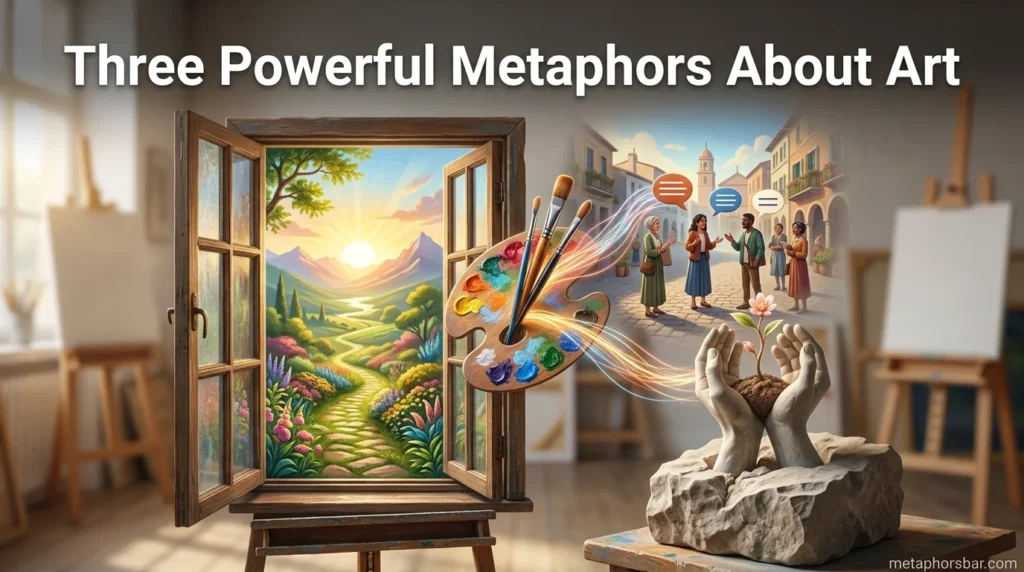
Three Powerful Metaphors About Art
1. Art as a Mirror
Meaning and explanation
A mirror reflects what stands before it. As a metaphor for art, it suggests that art reveals truth—about society, emotions, identity, memory, or the human condition. Art does not always show the world exactly as it is, but it often shows us something worth noticing about ourselves.
This metaphor is especially useful when describing art that is honest, revealing, or deeply personal. A portrait can mirror a face, a novel can mirror a life, and a song can mirror a feeling the listener did not know how to name.
Example sentence or scenario
Her painting was a mirror, reflecting the quiet loneliness of a city street at dusk.
This metaphor works well for writing about self-expression, realism, emotional truth, or art that makes people pause and think.
Alternative ways to express it
- a reflection of the soul
- a surface for truth
- a polished window into feeling
- a revealing image
- a self seen in color
Sensory or emotional details
You can imagine a glossy surface catching light, a face appearing in glass, and the small shock of seeing yourself clearly. Emotionally, this metaphor feels thoughtful, honest, and sometimes unsettling in a good way. It suggests that art can show us things we were not ready to see until it put them in front of us.
Mini storytelling touch
A teenager once stood in a museum and stared at a self-portrait for much longer than she expected. It was not because the figure looked exactly like her, but because the eyes on the canvas seemed to know her. Later she said, “It felt like the painting was holding up a mirror to my own confusion.” That is what makes the mirror metaphor so powerful: it captures art’s ability to reflect us back to ourselves.
Literary or cultural reference
Throughout history, artists have used portraits, poems, and stories as mirrors for their times. From ancient murals to modern novels, art has often served as a way for culture to look at itself.
2. Art as a Bridge
Meaning and explanation
A bridge connects two places that would otherwise remain separate. As a metaphor for art, it suggests connection—between people, generations, cultures, emotions, or ideas. Art often crosses distances that ordinary language cannot, linking one heart to another.
This metaphor is especially helpful when describing art that builds empathy, brings communities together, or connects past and present. A song can bridge grief and hope, a sculpture can bridge history and memory, and a play can bridge strangers in the same room.
Example sentence or scenario
The mural became a bridge, connecting the neighborhood’s past with the dreams of its children.
This metaphor works well for public art, collaborative work, storytelling, and any art that creates relationship or understanding.
Alternative ways to express it
- a pathway between worlds
- a link across silence
- a crossing from one heart to another
- a connection made visible
- a span of shared feeling
Sensory or emotional details
Picture the solid arc of a bridge stretching over water, footsteps echoing as people move across it, and the feeling of reaching the other side. Emotionally, this metaphor feels hopeful, relational, and expansive. It suggests that art can make distance smaller.
Mini storytelling touch
In one small town, a wall once covered with graffiti was transformed into a community mural. Neighbors who had barely spoken came out to paint together. Children watched, elders told stories, and the finished wall seemed to say more than words ever could. One resident said, “It turned into a bridge.” That is the magic of the metaphor: art can connect people who might never have found each other otherwise.
Literary or cultural reference
Across cultures, art has long served as a bridge between voices. Folk songs carry history forward, theater brings strangers into shared feeling, and visual art can connect traditions across time and place.
3. Art as a Garden
Meaning and explanation
A garden grows through care, patience, and time. As a metaphor for art, it emphasizes creativity as something cultivated rather than rushed. Art may begin as a seed—a sketch, a melody, a phrase—but it needs attention, pruning, and seasons before it blooms.
This metaphor is especially useful for describing artistic growth, creative process, or work that changes and deepens over time.
Example sentence or scenario
His poetry was a garden, each poem planted slowly and tended until it could bloom in its own season.
This metaphor works beautifully for writing about creativity, skill-building, artistic patience, or the way art develops through revising and reworking.
Alternative ways to express it
- a field of imagination
- a place where ideas bloom
- a cultivated creation
- a living work of care
- a landscape of expression
Sensory or emotional details
You can smell damp soil, hear bees moving among blossoms, and feel the softness of petals opening in the sun. Emotionally, this metaphor feels patient, nurturing, and full of possibility. It reminds us that art often grows best when given time and attention.
Mini storytelling touch
A young painter once wanted every canvas to become a masterpiece overnight. A mentor told her, “Art is a garden, not a factory.” At first she did not understand. But over time she learned that some ideas needed space, some colors needed reworking, and some pieces only bloomed after being left alone for a while. That is what makes the garden metaphor so useful—it honors the slow, living nature of creativity.
Literary or cultural reference
Gardens appear throughout literature and art as symbols of care, renewal, and creation. They remind us that beauty is often not manufactured; it is tended.
How to Choose the Right Metaphor About Art
Use a mirror when art reveals truth
Choose this metaphor when you want to emphasize honesty, reflection, or the way art helps us see ourselves and our world more clearly.
Use a bridge when art connects people or ideas
This is the best choice when the focus is on communication, empathy, culture, or shared understanding.
Use a garden when art grows slowly and with care
Choose this image when describing creative process, patience, development, or the beauty of art that unfolds over time.
The best metaphor depends on what you want art to do in your sentence. Art can reflect, connect, and bloom all at once—but different moments ask for different images.
Interactive Exercises for Practicing Metaphors About Art
Exercise 1: Complete the sentence
Finish this prompt in three different ways:
“Art is like ______ because ______.”
Try one answer that feels reflective, one that feels connective, and one that feels alive.
Example: Art is like a mirror because it shows us what we might not notice on our own.
Exercise 2: Sensory mapping
Think of a work of art you remember clearly. Write down:
- one color
- one sound
- one texture
- one image
- one emotion
Then turn those details into a metaphor.
For example: The painting looked like a garden after rain, sounded like quiet breath, felt like velvet, held the image of memory, and carried the emotion of longing.
Exercise 3: Story starter
Begin a paragraph with:
“The artwork was like…”
Let the image guide the tone. You can make it poetic, simple, emotional, or thoughtful.
Exercise 4: Social media or journal prompt
Try turning your metaphor into a short caption or reflection:
- “Art is a mirror we hold to the soul.”
- “Great art is a bridge across distance.”
- “Every creative work begins as a seed.”
Bonus tips for using metaphors about art in writing, social media, and daily life
In writing
Use art metaphors to describe creativity, emotion, and human expression in essays, stories, poems, and reviews. They can help readers feel the work’s significance.
On social media
A short metaphor can make a caption about creativity or a finished project feel more thoughtful and memorable. “This piece grew like a garden” sounds more alive than “I made this.”
In everyday conversation
Metaphors can make appreciation of art more vivid. Instead of saying “That song moved me,” you might say, “That song was a bridge to a memory I forgot I had.”
In journaling
If you create art yourself, metaphor can help you understand your process. Is your work a mirror, a bridge, or a garden today? That question can reveal where you are creatively.
Keep the image honest
The strongest metaphor is the one that feels true to the art you are describing. Some pieces reflect. Some connect, Some grow slowly. Let the image fit the work.
FAQs About Metaphors About Art
1. What is a metaphor about art?
A metaphor about art is a figurative comparison that describes art using another image, such as a mirror, bridge, or garden.
2. Why are metaphors about art useful?
They help explain artistic meaning, process, and emotion in a vivid and memorable way.
3. What is a simple metaphor about art?
A simple example is: Art is a mirror. It suggests reflection, truth, and self-understanding.
4. Can metaphors about art be used in essays or reviews?
Yes. They are especially effective in essays, criticism, poetry, and creative writing.
5. How do I create my own metaphor about art?
Think about what art does—reflects, connects, grows, heals, provokes—and compare it to something with similar qualities.
6. Are these metaphors only for fine art?
No. They can be used for music, dance, film, theater, poetry, design, and any kind of creative expression.
7. What makes a strong metaphor about art?
A strong metaphor is vivid, emotionally fitting, and easy for the reader to picture or feel.
Conclusion
Art is one of the most human things we make, and one of the hardest things to explain. It can reveal, connect, and grow in ways that feel almost larger than language itself. That is why metaphors are so valuable—they give art a shape the imagination can carry.
A mirror shows art as reflection. A bridge shows it as connection. A garden shows it as growth. Together, these images remind us that art is not just an object or a performance. It is a living process of seeing, reaching, and becoming.
So when you write about art, do not settle for flat description. Let it reflect, bridge, or bloom through your language. A good metaphor can make art feel not only understood, but deeply alive.