
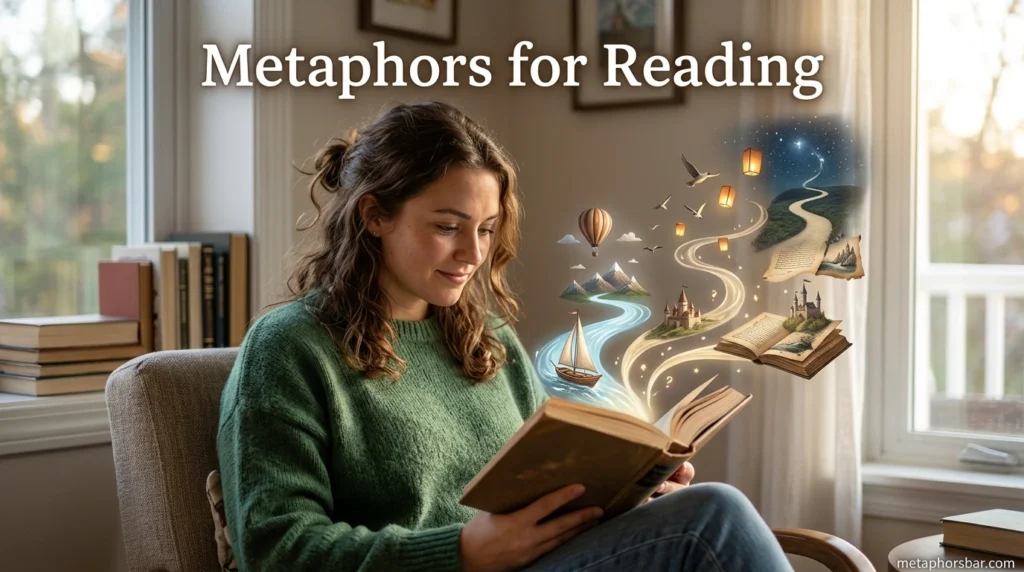
A reader opens a book and the world shifts.
The room is still there, of course—the chair beneath them, the hum of a fan, the half-finished cup of tea on the table—but now something else has entered the air. A forest of ideas. A train of voices. A secret door at the edge of a page. Reading has always been like that: quiet on the outside, vast on the inside.
That is why metaphors for reading matter so much. Reading is not just decoding words. It is entering worlds, gathering meaning, crossing thresholds, and sometimes being changed by a single sentence. Metaphors help us describe that experience in ways that feel alive, memorable, and emotionally true. They are useful for essays, poetry, captions, speeches, reviews, journal entries, and everyday conversation when you want to express what books do to the mind and heart.
Reading can be a lantern, a voyage, a conversation, a garden, a key, or even a home. The right metaphor makes that invisible magic visible.
Metaphors for Reading: Why Reading Imagery Matters in Writing
The emotional power of reading metaphors
Reading is one of the most personal experiences we can have. One person may read to escape. Another may read to learn. Another may read to feel less alone. A metaphor can hold all those meanings at once.
Reading metaphors often suggest:
- discovery
- imagination
- escape
- growth
- companionship
- reflection
- transformation
That makes them especially powerful in creative writing and thoughtful communication.
Why readers connect with these images
Books are already full of images, and reading itself feels visual, sensory, and emotional. When we describe reading through metaphor, we give shape to something that often feels hard to explain directly.
Instead of saying, “I enjoy reading,” we might say, “Reading opens windows in my mind.” Suddenly, the sentence has atmosphere, movement, and light.
3 Powerful Metaphors for Reading With Meanings and Examples
1. Reading is a doorway
Meaning and explanation
This metaphor presents reading as an entry point into another world, another mind, or another level of understanding. Each book becomes a door that opens into new places, ideas, and emotions.
It works beautifully for fiction, fantasy, history, and even nonfiction, because every kind of reading can lead somewhere beyond the present moment.
Example sentence or scenario
“On rainy afternoons, reading felt like a doorway that led her out of the gray apartment and into worlds made of light.”
Alternative ways to express it
- reading is a window to another world
- books are keys to hidden rooms
- reading opens the mind
- each page is an entrance
Optional sensory or emotional details
This metaphor can feel warm, mysterious, and hopeful. You can imagine the creak of a door opening, the hush of a threshold, and the rush of stepping somewhere new.
Mini storytelling touch
A child once discovered a dusty old novel on a library shelf and spent the entire afternoon in another century. When she finally looked up, she whispered, “It feels like I walked through a door and forgot to come back.” That is the power of reading as a doorway—it makes departure feel like discovery.
2. Reading is a journey
Meaning and explanation
This is one of the most enduring metaphors for reading because books often unfold step by step. A reader travels through chapters the way a traveler moves through landscapes—sometimes quickly, sometimes slowly, sometimes with surprise, sometimes with effort.
This metaphor emphasizes process, growth, and change. Reading is not always about arriving at the end; often the value lies in the path itself.
Example sentence or scenario
“Her reading journey began with fairy tales and slowly carried her toward poetry, memoir, and philosophy.”
Alternative ways to express it
- reading is a voyage
- books are roads to new ideas
- every chapter is a mile
- reading carries us forward
Optional sensory or emotional details
This image suggests movement, distance, and the quiet thrill of discovery. You might imagine maps, trains, winding roads, or a ship crossing a wide sea.
Literary or cultural reference
Many cultures treat stories as journeys. In epic literature, the hero travels outward to discover something inward. Reading works the same way: the reader leaves home and often returns changed.
3. Reading is a conversation
Meaning and explanation
This metaphor highlights the exchange between writer and reader. A book speaks through its words, and the reader responds through attention, interpretation, memory, and feeling.
This is a powerful metaphor for essays, literary criticism, and reflective writing because it reminds us that reading is active, not passive.
Example sentence or scenario
“Every time he reread the novel, it felt like a new conversation with an old friend.”
Alternative ways to express it
- reading is a dialogue
- books speak to us
- pages answer questions we did not know we had
- reading is listening with the mind
Optional sensory or emotional details
This metaphor feels intimate, thoughtful, and human. You can imagine a quiet room, a low voice, a pause full of meaning, or the sense of being understood without having to speak.
Real-life example
A person reading a memoir about grief may feel the author is speaking directly to their own hidden pain. In that moment, reading becomes less like study and more like a conversation that brings comfort.
Creative Ways to Use Metaphors for Reading in Writing
In essays and reflective writing
Reading metaphors can make your writing richer and more insightful.
Examples:
- “Books are lanterns carried through darkness.”
- “Reading plants seeds that grow into understanding.”
- “Each chapter is a stepping stone across an unfamiliar river.”
These phrases help you explain why reading matters without sounding dry or mechanical.
In poetry and literary descriptions
Poetry thrives on metaphor, and reading is one of its loveliest subjects.
Examples:
- “A book opened like dawn.”
- “Words drifted into me like rain.”
- “Reading was the quiet music beneath my thoughts.”
These images create mood and wonder.
In social media captions and everyday speech
Metaphors can make reading posts feel thoughtful and engaging.
Examples:
- “Currently wandering through another world.”
- “Books: small doors with huge horizons.”
- “Reading is my favorite kind of travel.”
These lines work especially well for bookstagram posts, reading updates, and study captions.
Interactive Exercises for Practicing Reading Metaphors
Exercise 1: Match reading to an object
Finish this sentence:
- “Reading is like a ______.”
Try:
- lantern
- bridge
- garden
- river
- compass
Example: “Reading is like a lantern that helps me see what I did not notice before.”
Exercise 2: Describe your last reading experience
Think of the last book, article, or poem you read. Now describe what reading felt like using a metaphor.
Example: “Reading that novel felt like walking through a house where every room contained a different memory.”
Exercise 3: Rewrite plain sentences metaphorically
Take simple sentences like:
- “I learned a lot from the book.”
- “She loves reading.”
- “The story was interesting.”
Now rewrite them more vividly:
- “The book opened doors I did not know existed.”
- “She treated reading like a daily return to a beloved home.”
- “The story pulled me in like a tide.”
Bonus Tips for Using Metaphors for Reading Effectively
Match the metaphor to the kind of reading
Different reading experiences call for different imagery:
- fiction → doorway, journey, adventure
- nonfiction → compass, tool, map
- poetry → music, lantern, mirror
- rereading → conversation, home, echo
Keep the image clear and simple
The strongest reading metaphors are easy to picture. One strong image usually works better than several mixed ones.
Instead of: “Reading is a doorway, a ship, a river, and a candle.”
Try: “Reading is a doorway into other lives.”
Use sensory details
Reading is often quiet, so small sensory details make it feel alive:
- the rustle of pages
- the smell of old paper
- the warm glow of a lamp
- the weight of a book in the hands
- the hush of a room absorbed in text
Let the metaphor reflect emotion
Reading can feel comforting, energizing, lonely, exciting, or healing. Choose a metaphor that matches the emotional tone you want.
More Metaphors for Reading You Can Use
Reading is a garden
Books grow ideas, imagination, and patience.
Reading is a mirror
A good book reflects parts of ourselves we did not know were there.
Reading is a compass
It guides thought, values, and understanding.
Reading is a fireplace
Warm, inviting, and full of quiet comfort.
Reading is a treasure hunt
Each page reveals hidden meaning and small discoveries.
FAQs About Metaphors for Reading
1. What is a metaphor for reading?
A metaphor for reading is a creative comparison that describes the act of reading in a vivid, symbolic way.
2. Why are metaphors for reading useful?
They help express how reading feels emotionally and mentally, making writing more engaging and memorable.
3. What are common metaphors for reading?
Popular examples include reading as a doorway, a journey, a conversation, a garden, or a mirror.
4. Can reading metaphors be used in essays?
Yes. They are especially useful in reflective essays, literary analysis, and personal writing.
5. Are reading metaphors good for social media captions?
Absolutely. They make book-related posts more poetic, thoughtful, and shareable.
6. How do I create original reading metaphors?
Think about what reading feels like—moving, opening, listening, discovering, remembering—and compare it to something with a similar emotional shape.
7. Can metaphors for reading describe learning too?
Yes. Reading and learning often overlap, so many reading metaphors can also express growth, discovery, and insight.
Conclusion
Reading may look still from the outside, but inside it is always moving. It is a door opening, a road unfolding, a conversation beginning, a light turning on in a dim room. Through metaphor, we can finally say what books really do: they carry us, change us, and leave echoes in the mind long after the page is turned.
That is the beauty of metaphors for reading. They let us describe not just the act of reading, but its effect—wonder, comfort, discovery, reflection, and the sense that we have traveled somewhere without leaving our chair.
Whether you are writing an essay, sharing a book caption, reflecting in a journal, or simply trying to explain why reading matters so much, these metaphors can help your words feel more alive. After all, every great book is a passage, and every reader is someone brave enough to step through.