
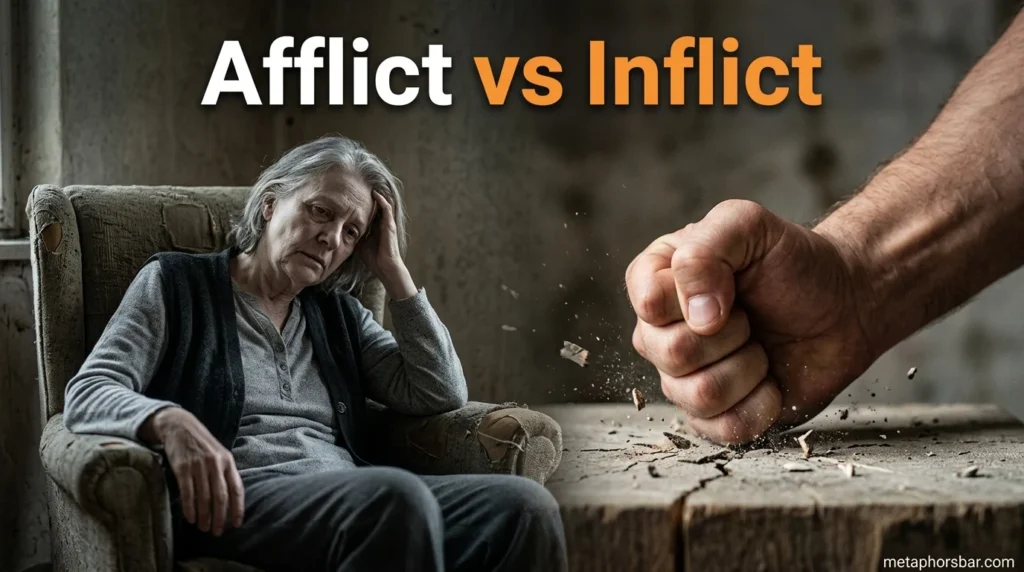
English learners often get confused by afflict vs inflict because the two words look similar, sound similar, and both are used in serious or negative contexts. That makes them easy to mix up in everyday writing, speaking, exams, and professional communication. A small mistake can change the meaning of a sentence, especially when you are describing suffering, harm, pain, or hardship.
The good news is that the difference is simple once you see it clearly. Afflict usually means to cause suffering or to trouble someone or something. Inflict usually means to cause something unpleasant to happen to someone, such as pain, damage, or punishment. In this article, you will learn the meaning, correct usage, grammar patterns, pronunciation, example sentences, common mistakes, and easy memory tips so you can use both words confidently.
What Do “Afflict” and “Inflict” Mean?
The first step is to understand the basic meaning of each word.
Afflict
Afflict means:
- to cause pain, suffering, or distress
- to trouble someone with a serious problem
- to affect someone or something badly
Examples:
- The family was afflicted by poverty.
- He was afflicted with a painful illness.
- Many people are afflicted by anxiety.
Inflict
Inflict means:
- to cause pain, harm, damage, or punishment
- to impose something unpleasant on someone
- to make someone suffer something negative
Examples:
- The storm inflicted damage on the town.
- The teacher did not want to inflict punishment unnecessarily.
- He inflicted pain on his opponent.
Simple meaning table
| Word | Main meaning | Core idea |
| afflict | cause suffering or trouble | a state of being affected badly |
| inflict | cause harm, pain, or punishment | an action done to someone else |
A simple way to remember it
- Afflict = something bad happens to a person or thing
- Inflict = someone does something bad to another person or thing
That difference is the key to using these words correctly.
Which One Is Correct in Which Situation?
The correct choice depends on what you want to say.
Use afflict when:
- you are describing suffering, illness, hardship, or trouble
- the focus is on the person or thing affected
- you want to say someone is burdened by a problem
Examples:
- He is afflicted with a serious disease.
- Many communities are afflicted by unemployment.
- The town was afflicted by floods.
Use inflict when:
- you are describing harm done by someone or something
- the focus is on the source of the harm
- you want to say something unpleasant is being imposed
Examples:
- The accident inflicted severe injuries.
- He inflicted unnecessary stress on the team.
- The punishment was meant to inflict pain.
Side-by-side comparison table
| Situation | Better word | Example |
| suffering caused by illness | afflict | He is afflicted with asthma. |
| harm caused by a storm | inflict | The storm inflicted damage on houses. |
| a person living with hardship | afflict | They were afflicted by poverty. |
| pain caused by another person | inflict | The attacker inflicted pain on the victim. |
Practical rule
If the sentence is about someone suffering from a problem, choose afflict.
If the sentence is about someone or something causing harm, choose inflict.
Grammar Rules Behind Afflict and Inflict
Both words are verbs, but they often appear in different grammatical patterns.
Afflict as a verb
Afflict often appears in passive or descriptive structures.
Common patterns:
- be afflicted with + illness/problem
- be afflicted by + problem
- afflict someone or something
Examples:
- She is afflicted with arthritis.
- The region was afflicted by drought.
- The disease afflicts millions of people.
Inflict as a verb
Inflict usually takes a direct object and often appears with:
- inflict + noun + on + person
- inflict + noun + upon + person
- inflict pain/harm/damage/punishment
Examples:
- The flood inflicted damage on the city.
- They inflicted pain on the prisoner.
- The judge inflicted a fine on the company.
Grammar comparison table
| Word | Common pattern | Example |
| afflict | be afflicted with/by | He is afflicted with a rare illness. |
| afflict | afflict someone/something | Poverty afflicts many families. |
| inflict | inflict something on someone | The attack inflicted injuries on civilians. |
| inflict | inflict pain/harm/damage | The disease inflicted lasting harm. |
Important grammar note
The two verbs are not interchangeable in structure:
- You do not usually say “inflict with”
- You do not usually say “afflict on” in the same way as inflict on
Correct vs incorrect table
| Incorrect | Correct |
| The illness inflicts him. | The illness afflicts him. |
| The storm afflicted damage on the town. | The storm inflicted damage on the town. |
| He was inflicted with anxiety. | He was afflicted with anxiety. |
| The punishment afflicted pain on the prisoner. | The punishment inflicted pain on the prisoner. |
Easy grammar tip
Think:
- afflict = often shows state or condition
- inflict = often shows action and object
Sentence Examples: Correct and Incorrect Usage
Examples are the best way to understand the difference.
Correct examples with afflict
- The country was afflicted by famine.
- He is afflicted with a painful condition.
- Many children are afflicted by poor nutrition.
- The city was afflicted by crime and corruption.
- A serious illness afflicted her for years.
Correct examples with inflict
- The earthquake inflicted heavy damage on the buildings.
- The bully inflicted emotional pain on others.
- The army inflicted losses on the enemy.
- The storm inflicted severe harm on the coast.
- They should not inflict unnecessary suffering on animals.
More real-life examples
- Afflict: “He has been afflicted with migraines for years.”
- Inflict: “The accident inflicted serious injuries.”
- Afflict: “The town was afflicted by floods and illness.”
- Inflict: “The coach did not want to inflict extra pressure on the students.”
Incorrect examples
- The illness inflicted him with pain.
- The storm afflicted damage on the village.
- The teacher afflicted punishment on the class.
- Poverty inflicted many families.
Correct vs incorrect table
| Incorrect | Correct |
| The disease inflicted him. | The disease afflicted him. |
| The storm afflicted damage on the houses. | The storm inflicted damage on the houses. |
| They were inflicted by poverty. | They were afflicted by poverty. |
| The court afflicted a fine on him. | The court inflicted a fine on him. |
Why these examples matter
The wrong word can make the sentence sound unnatural because the verb wants a different structure and different meaning.
Common Mistakes Learners Make
Because these two words are so close in spelling and meaning, learners often make the same mistakes.
1: Using afflict when you mean inflict
- Wrong: The soldier afflicted pain on the prisoner.
- Right: The soldier inflicted pain on the prisoner.
Why it is wrong: inflict is the verb for causing pain or harm to someone.
2: Using inflict when you mean afflict
- Wrong: She was inflicted with a disease.
- Right: She was afflicted with a disease.
Why it is wrong: afflict is the verb for suffering from a condition.
3: Mixing the prepositions
- Wrong: afflicted on
- Wrong: inflicted with
Usually:
- afflicted with/by
- inflicted on/upon
4: Thinking both words are neutral
Both words are usually negative, but they do not describe the same role in the sentence.
5: Overusing them in formal writing
Sometimes simpler words are better.
Instead of:
- The region was afflicted with economic hardship.
You could also say:
- The region suffered from economic hardship.
Instead of:
- The storm inflicted damage on the area.
You could also say:
- The storm caused damage to the area.
Common mistake table
| Wrong sentence | Correct sentence |
| He was inflicted with anxiety. | He was afflicted with anxiety. |
| The war afflicted great damage. | The war inflicted great damage. |
| They afflicted pain on the victim. | They inflicted pain on the victim. |
| The city was inflict by drought. | The city was afflicted by drought. |
Easy memory trick
- Afflict = the person has the problem
- Inflict = the person or thing causes the problem
If you know who is suffering and who is causing, the choice becomes much easier.
Pronunciation and Style
1.Pronunciation
These two verbs can sound similar, so learners should pay attention to the middle sound.
- afflict is usually pronounced like uh-FLIKT
- inflict is usually pronounced like in-FLIKT
2.Pronunciation table
| Word | Approximate pronunciation | Stress |
| afflict | uh-FLIKT | second syllable |
| inflict | in-FLIKT | second syllable |
Style
Both words are somewhat formal and are often found in:
- news reports
- academic writing
- legal or medical contexts
- serious literature
Style comparison table
| Word | Tone | Best use |
| afflict | formal, descriptive | illness, hardship, suffering |
| inflict | formal, strong | harm, pain, damage, punishment |
Style tip
If you want clear and simple English, you can often replace these words with more common verbs:
- afflict → suffer, trouble, affect badly
- inflict → cause, impose, bring about, deal
Examples:
- The illness afflicted him → The illness affected him badly.
- The storm inflicted damage → The storm caused damage.
But in formal writing
These words can be powerful because they sound precise and serious.
British vs American English: Is There a Difference?
There is no major British vs American English difference in the meaning or spelling of afflict and inflict.
In both British and American English
- afflict means to cause suffering or to be affected by suffering
- inflict means to cause pain, damage, or punishment
Comparison table
| Feature | British English | American English |
| spelling | afflict / inflict | afflict / inflict |
| meaning | same | same |
| grammar patterns | same | same |
| major difference | none | none |
Practical note
The real issue is not regional variation. The real issue is choosing the correct verb for the correct meaning.
FAQs
Is “afflict” the same as “inflict”?
No. They are related in tone and both are negative, but they do not mean the same thing.
Which word means “cause suffering to someone”?
- Inflict means to cause pain or harm.
- Afflict means to trouble or burden someone with suffering.
Can I say “afflicted with”?
Yes. That is a very common and correct phrase.
Example:
- He is afflicted with asthma.
Can I say “inflicted on”?
Yes. That is also correct.
Example:
- The storm inflicted damage on the town.
Is one word more formal than the other?
Both are formal, though inflict can sound especially strong because it often appears with harm, punishment, or damage.
Which word should I use in exams?
Use the one that matches the sentence meaning:
- suffering/problem in a person → afflict
- harm/pain caused by someone or something → inflict
Can both words be used in passive voice?
Yes.
- He was afflicted with illness.
- Damage was inflicted on the town.
What is a simple way to remember them?
- Afflict = affected by pain or trouble
- Inflict = causing pain or trouble
Conclusion
The difference between afflict and inflict becomes easy once you focus on the direction of the suffering.
- Afflict means to cause someone or something to suffer, or to be affected by a serious problem.
- Inflict means to cause pain, damage, or punishment to someone or something.
Here is the easiest way to remember it:
- Afflict = the problem is on the person
- Inflict = the person or thing causes the problem
So write:
- He is afflicted with illness.
- The region was afflicted by poverty.
- The storm inflicted damage on the houses.
- The attacker inflicted pain on the victim.
If you remember only one thing, remember this: afflict is about suffering, and inflict is about causing harm. That simple rule will help you use both words correctly in writing, speaking, exams, and professional communication.