
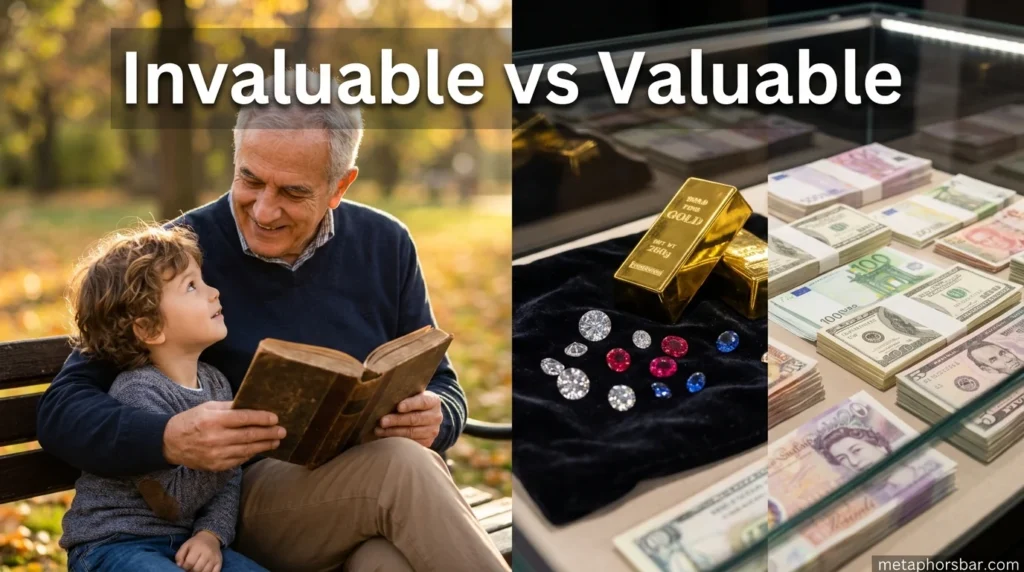
English learners often get confused by invaluable vs valuable because the two words look related and both seem to express “something worth a lot.” The problem is that invaluable does not mean “less valuable” or “not valuable.” In fact, it means something is so valuable that its worth cannot be measured. That small difference matters in everyday writing, speaking, exams, and professional communication because using the wrong word can change the meaning of your sentence.
The good news is that the difference is simple once you see it clearly. Valuable means something has worth, usefulness, or importance. Invaluable means something is extremely useful or important and so precious that you cannot calculate its value. In this article, you will learn the meanings, correct usage, grammar rules, pronunciation, examples, common mistakes, and easy memory tips so you can use both words confidently.
What Do “Valuable” and “Invaluable” Mean?
Let’s begin with the basic meanings.
Valuable
Valuable means:
- worth a lot
- useful
- important
- costly or precious
Examples:
- The necklace is very valuable.
- Her advice was valuable.
- Time is a valuable resource.
Invaluable
Invaluable means:
- extremely valuable
- so useful or important that its worth cannot be measured
- priceless
Examples:
- Her help was invaluable.
- The old manuscript is invaluable to historians.
- Your support has been invaluable during this project.
Why people get confused
The prefix in- often means “not,” so many learners assume invaluable means “not valuable.” That is a very common mistake. But in this word, in- does not mean “not.” The word has a historical meaning that developed to mean extremely valuable.
Simple meaning table
| Word | Meaning | Simple idea |
| valuable | worth a lot / useful / important | has value |
| invaluable | so valuable that it cannot be measured | priceless / extremely useful |
Key idea
- valuable = has value
- invaluable = has such great value that you cannot measure it
That one idea solves most of the confusion.
Which One Is Correct in Which Situation?
Both words are correct, but they are used in different situations.
Use valuable when:
- you want to say something has worth
- you are describing something useful or important
- you are talking about money, importance, or benefit
Examples:
- This is a valuable lesson.
- He gave me valuable advice.
- The watch is valuable.
Use invaluable when:
- you want to say something is extremely useful or precious
- you want to emphasize that the value is beyond measurement
- you want to sound more expressive
Examples:
- Her support was invaluable.
- The experience was invaluable.
- The information is invaluable for our research.
Side-by-side comparison table
| Situation | Better word | Example |
| something has worth | valuable | a valuable painting |
| something is very useful | invaluable | invaluable guidance |
| expensive object | valuable | valuable jewelry |
| priceless help or support | invaluable | invaluable help |
Practical rule
If you can say “worth a lot”, then valuable works well.
If you mean “so important/useful that its worth cannot be measured”, then invaluable is the better word.
Grammar Rules and Word Forms
Both words are adjectives. That means they are usually used to describe nouns.
Valuable as an adjective
Examples:
- a valuable asset
- valuable information
- a valuable lesson
- valuable time
Invaluable as an adjective
Examples:
- invaluable advice
- an invaluable experience
- invaluable help
- an invaluable contribution
Grammar comparison table
| Word | Part of speech | Common pattern | Example |
| valuable | adjective | valuable + noun | valuable advice |
| invaluable | adjective | invaluable + noun | invaluable advice |
Common sentence patterns
- be valuable
- be invaluable
- valuable to someone
- invaluable to someone
- valuable for something
- invaluable for something
Examples:
- The training was valuable to the staff.
- Her experience was invaluable to the team.
- The data is valuable for the study.
- The document is invaluable for historians.
Can both words be used with people?
Yes.
Examples:
- She is a valuable employee.
- He is an invaluable member of the team.
Comparison table: grammar use
| Pattern | Valuable example | Invaluable example |
| adjective + noun | valuable skill | invaluable skill |
| be + adjective | The advice is valuable. | The advice is invaluable. |
| adjective + to + noun | valuable to the team | invaluable to the team |
Important note
The grammar is the same for both. The difference is in meaning and intensity, not in structure.
Sentence Examples: Correct and Incorrect Usage
Examples are the easiest way to understand the difference.
Correct examples with valuable
- This book is very valuable.
- Your opinion is valuable.
- The painting is valuable because it is rare.
- His feedback was valuable to me.
- We had a valuable discussion.
Correct examples with invaluable
- Her advice was invaluable.
- The old records are invaluable to researchers.
- Your help has been invaluable.
- The training was invaluable for new staff.
- His knowledge is invaluable to the company.
More real-life examples
- Valuable: “The company gave us valuable training.”
- Invaluable: “The company gave us invaluable support.”
- Valuable: “This is a valuable chance to learn.”
- Invaluable: “This is an invaluable chance to learn from experts.”
Incorrect examples
- Her advice was not valuable, it was invaluable.
- Your help was unvaluable.
- This is a more invaluable opportunity.
- The information is not invaluable, it is valuable.
Correct vs incorrect table
| Incorrect | Correct |
| unvaluable advice | valuable advice |
| more invaluable than before | more valuable than before |
| not invaluable | valuable / not very valuable |
| an invaluable painting worth a lot | a valuable painting |
Important style note
Because invaluable already means “extremely valuable,” you should not usually combine it with words like:
- very
- more
- extremely
- most
That can sound repetitive or awkward.
Examples:
- Better: Her help was invaluable.
- Less natural: Her help was very invaluable.
Common Mistakes Learners Make
This topic produces a lot of common errors. Here are the biggest ones.
Mistake 1: Thinking “invaluable” means not valuable
This is the most common mistake.
- Wrong: This watch is useless because it is invaluable.
- Right: This watch is extremely valuable because it is invaluable.
Mistake 2: Adding “very” before invaluable
- Less natural: very invaluable
- Better: invaluable
Since invaluable already carries strong meaning, very is unnecessary.
Mistake 3: Using “unvaluable”
- Wrong: unvaluable
- Right: valuable / not valuable / invaluable
There is no standard English word unvaluable in normal usage.
Mistake 4: Confusing the words in formal writing
If you mean something is rare, important, or precious, choose carefully.
- Wrong: The data is valuable to the archive because it cannot be measured.
- Better: The data is invaluable to the archive because it cannot be measured.
Mistake 5: Using valuable when you mean priceless
- Wrong: Her help was valuable beyond measure.
- Better: Her help was invaluable.
Common mistakes table
| Wrong | Correct |
| unvaluable | valuable / invaluable |
| very invaluable | invaluable |
| not invaluable | valuable / not very valuable |
| invaluable means not valuable | invaluable means extremely valuable |
Easy memory tip
Think of invaluable as meaning:
- “too valuable to measure”
- “priceless”
- “extremely useful”
If that sounds too abstract, just remember: invaluable is a stronger positive word than valuable.
British vs American English: Is There a Difference?
There is no major British vs American English difference in the meanings of valuable and invaluable. Both varieties use them in the same general way.
In British English
| Feature | British English | American English |
| valuable | same use | same use |
| invaluable | same use | same use |
| main meaning difference | none | none |
| spelling difference | none | none |
- The necklace is valuable.
- Her advice was invaluable.
- This is a valuable opportunity.
In American English
- The necklace is valuable.
- Her advice was invaluable.
- This is a valuable opportunity.
Comparison table
Practical note
You do not need separate rules for British and American English here. The important thing is understanding the meaning distinction.
Pronunciation and Style
Pronunciation
- valuable is usually pronounced roughly like VAL-yoo-uh-buhl
- invaluable is usually pronounced roughly like in-VAL-yoo-uh-buhl
1.Pronunciation comparison table
| Word | Approximate pronunciation | Stress |
| valuable | VAL-yoo-uh-buhl | first syllable |
| invaluable | in-VAL-yoo-uh-buhl | second syllable after in- |
Style difference
- valuable sounds neutral and common.
- invaluable sounds stronger and more expressive.
Style comparison table
| Word | Tone | Best use |
| valuable | neutral, practical | general writing and speaking |
| invaluable | strong, positive, formal-ish | praise, gratitude, professional writing |
When to choose which
Use valuable when you want to say something has worth.
Use invaluable when you want to praise something as priceless or highly beneficial.
Examples:
- The lesson was valuable.
- The lesson was invaluable.
The second sentence is stronger and suggests a deeper level of usefulness or importance.
FAQs
Does invaluable mean the opposite of valuable?
No. That is the mistake many learners make. Invaluable does not mean “not valuable.” It means extremely valuable or priceless.
Is invaluable a positive word?
Yes. It is a very positive word.
Can I say “very invaluable”?
It is usually better not to. Invaluable is already very strong, so “very” is unnecessary.
What is a simpler synonym for invaluable?
Possible alternatives include:
- priceless
- extremely useful
- highly valuable
- essential
Can both words describe people?
Yes.
- She is a valuable team member.
- He is an invaluable mentor.
Can I say “more invaluable”?
Usually no. Since invaluable is already very strong, comparative forms like “more invaluable” sound awkward. Use more valuable instead if you need comparison.
Is valuable always about money?
No. It can also mean useful, important, or helpful.
Examples:
- valuable advice
- valuable experience
- valuable time
Which word should I use in an exam?
If the question is about something worth a lot or useful, choose valuable or invaluable according to the meaning:
- valuable = worth a lot / useful
- invaluable = extremely useful / priceless
Conclusion
The difference between valuable and invaluable is easy once you learn the real meaning of the prefix. Valuable means something has worth, usefulness, or importance. Invaluable means something is so useful or precious that its value cannot be measured. Even though the prefix in- often means “not,” in this word it does not mean the opposite.
Here is the easiest way to remember it:
- valuable = has value
- invaluable = too valuable to measure
- unvaluable = not standard English
So write:
- a valuable book
- valuable advice
- an invaluable teacher
- invaluable support
If you remember only one thing, remember this: invaluable is not negative; it is a very strong positive word meaning priceless or extremely useful. That one idea will help you choose the right word in writing, speaking, exams, and professional communication with confidence.