
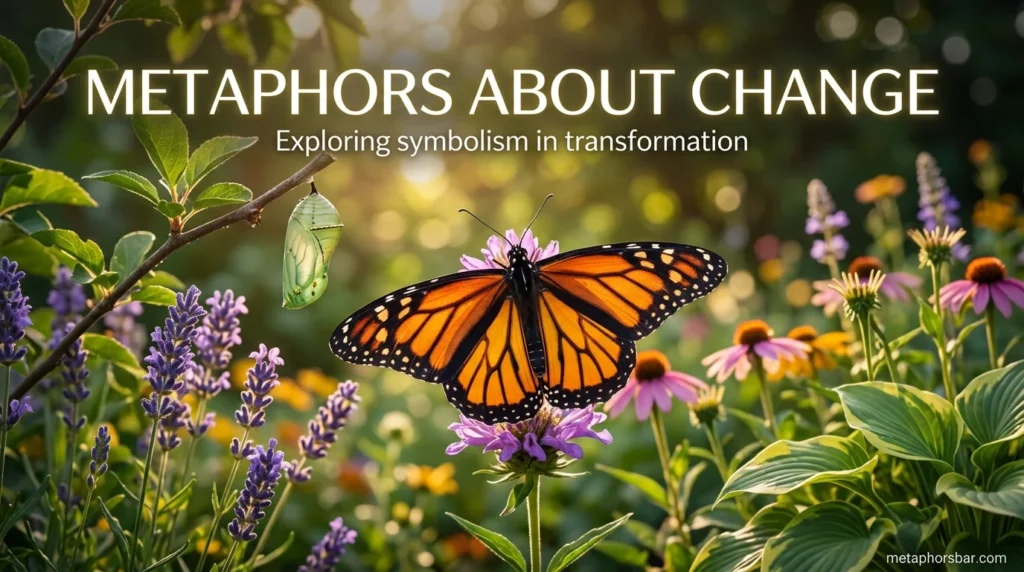
A change rarely arrives with a trumpet. More often, it slips in quietly: a street seen after rain, a room rearranged, a voice that no longer sounds like it used to, a season turning in the trees. You notice it first in the air—something altered, something softened, something no longer exactly the same. Change can be unsettling, exhilarating, painful, or full of promise, but it is always alive with motion.
That is why metaphors about change matter so much. Change is one of the hardest ideas to pin down with plain language because it is not a thing but a process. It happens in stages, in moods, in invisible thresholds. Metaphors help us give that process shape. They let us say not only that something changed, but how it changed, what it felt like, and why it mattered.
Whether you are writing a poem, a personal essay, a speech, a story, or even a social media post, the right metaphor can turn change into something readers can see, feel, and remember.
Why Metaphors About Change Matter in Writing and Reflection
They make transformation visible
Change is often gradual or internal. A metaphor turns it into an image with movement, color, and texture.
They help us express complicated emotions
Change can bring grief, relief, hope, fear, or all of those at once. A metaphor can hold that complexity without flattening it.
They make writing more memorable
Readers may forget a simple statement like “things are different now,” but they are more likely to remember “the old life had shed its skin.”
Three Powerful Metaphors About Change
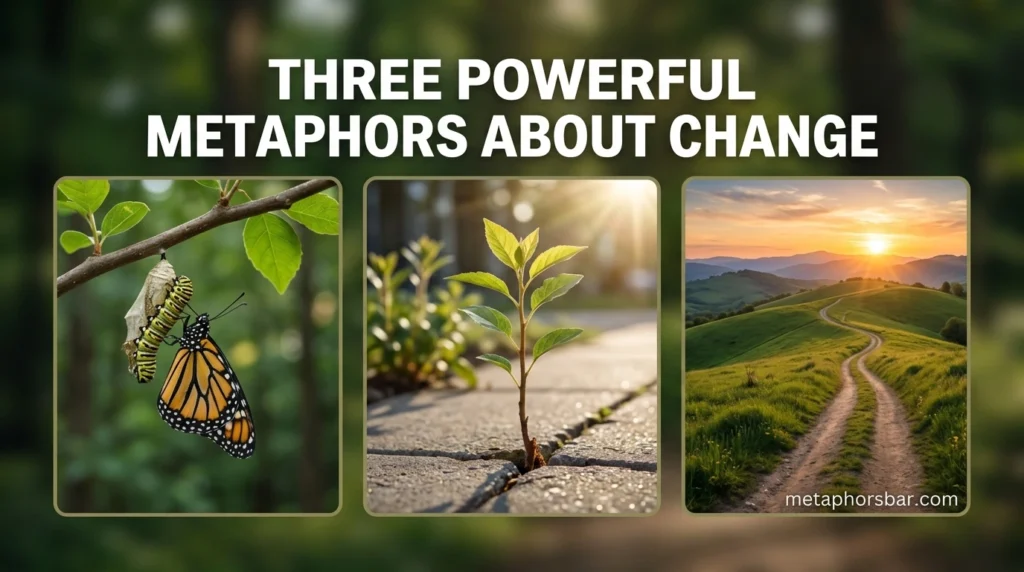
1. Change as a River
Meaning and explanation
A river is never still. It bends, widens, narrows, and keeps moving around whatever blocks it. This makes it a powerful metaphor for change because it shows that transformation is ongoing, flowing, and often shaped by obstacles. Sometimes change feels smooth; sometimes it twists. But either way, it moves.
This metaphor is especially useful when you want to emphasize adaptability, momentum, or the fact that change rarely moves in a straight line.
Example sentence or scenario
Her life changed like a river, curving around grief, widening into new possibilities, and carrying her toward a place she had not yet named.
This metaphor works beautifully in writing about growth, transitions, journeys, healing, or reinvention.
Alternative ways to express it
- a moving current
- a winding stream
- a flow toward something new
- water learning its way
- a path shaped by motion
Sensory or emotional details
You can hear water over stones, see sunlight flickering on the surface, and feel the steady pull of current moving around you. Emotionally, this metaphor feels adaptive, organic, and quietly powerful. It suggests that change is not always forced—it can also be a natural force that carries us.
Mini storytelling touch
A woman once left a job she had held for ten years. At first, she felt as if she had stepped off solid ground. But over time, she realized she was not lost; she was moving. “I think I was a river,” she said later, “and I was just learning how to bend.” That is the beauty of this metaphor—it captures change as movement that does not need to apologize for not being still.
Literary or cultural reference
Rivers appear often in literature as symbols of life, passage, and transformation. Many stories use them because they mirror the truth that life moves forward, whether we are ready or not.
2. Change as a Butterfly Emerging
Meaning and explanation
A butterfly begins as something very different from what it becomes. That makes it one of the most beloved metaphors for change. It captures the idea that transformation can be slow, hidden, and almost unrecognizable until one day it becomes visible and astonishing. This metaphor is ideal for growth, identity, healing, and the surprising beauty that can come from patience and struggle.
Unlike the river, which emphasizes flow, the butterfly emphasizes metamorphosis—the idea that something can become something else entirely.
Example sentence or scenario
She had changed like a butterfly emerging from a cocoon, fragile at first, then brightening as her wings learned the air.
This image is especially useful for stories of self-discovery, recovery, new confidence, or any moment when a person becomes visibly different from their earlier self.
Alternative ways to express it
- a cocoon opening into wings
- a hidden shape becoming visible
- a life learning to fly
- a slow unfolding
- transformation with wings
Sensory or emotional details
You can imagine the stillness of a cocoon, the first trembling movement, and the delicate expansion of wings catching light. Emotionally, this metaphor feels hopeful, tender, and miraculous. It suggests that change can be both fragile and beautiful.
Mini storytelling touch
A student once spent years feeling shy and invisible in every class. Then one day she gave a speech so confident and clear that even she was surprised by her own voice. Her teacher later said, “It was like watching a butterfly leave the cocoon.” That image works because it reveals change as a moment that feels earned, not accidental.
Real-life example
People often use the butterfly metaphor when describing recovery from hardship, personal growth, or new confidence after a long season of uncertainty. It is powerful because it honors the hidden work that comes before visible transformation.
Literary or cultural reference
Butterflies have long symbolized transformation in art and folklore. Their life cycle makes them one of the clearest natural images for becoming something new.
3. Change as a Season Turning
Meaning and explanation
Seasons shift slowly, and each one brings a different kind of beauty. Spring blooms, summer expands, autumn lets go, and winter rests. As a metaphor for change, seasons capture transition as natural, cyclical, and sometimes bittersweet. They remind us that change does not always mean loss; sometimes it means timing, rhythm, and renewal.
This metaphor is especially useful when change feels gradual, emotional, or connected to a larger phase of life. It can describe aging, maturity, grief, recovery, or a turning point that feels both ending and beginning.
Example sentence or scenario
Her life was a season turning, autumn fading into winter and quietly preparing the ground for spring.
This metaphor works well in essays, poetry, memoir, and reflective writing because it carries both beauty and melancholy.
Alternative ways to express it
- a new season arriving
- the weather of life shifting
- autumn giving way to spring
- a cycle of becoming
- the calendar of the soul
Sensory or emotional details
You can smell woodsmoke in the air, hear leaves underfoot, feel cold pressing into warm afternoons, and watch the light change hour by hour. Emotionally, this metaphor feels reflective, tender, and honest. It acknowledges that change can be gentle or painful, but always part of a larger rhythm.
Mini storytelling touch
A father once noticed that his daughter stopped running barefoot in the yard the same way she had when she was small. He said he could not explain the feeling, except that it seemed like “a season had turned inside the house.” That image stays because it captures change as a quiet, natural shift rather than a sudden break.
Literary or cultural reference
Seasons appear throughout literature as symbols of growth, aging, decline, and rebirth. They are enduring metaphors because they help us understand that change is part of a cycle, not a failure of stability.
How to Choose the Right Metaphor About Change
Use a river when you want to show flow and adaptability
Choose this metaphor when change is ongoing, shaped by obstacles, or part of a larger journey.
Use a butterfly when you want to show transformation
This is the best choice when the change is dramatic, deeply personal, or involves becoming something new.
Use seasons when you want to show timing and emotional rhythm
Choose this image when change feels gradual, cyclical, or bittersweet.
The best metaphor depends on the kind of change you want to describe. Some change flows, some transforms, and some simply arrives with the weather.
Interactive Exercises for Practicing Metaphors About Change
Exercise 1: Complete the sentence
Finish this prompt in three different ways:
“Change is like ______ because ______.”
Try one answer that feels hopeful, one that feels difficult, and one that feels surprising.
Example: Change is like a river because it keeps moving, even when the path bends in ways we did not expect.
Exercise 2: Sensory mapping
Think of a change you have experienced—real or imagined. Write down:
- one color
- one sound
- one texture
- one smell
- one feeling
Then turn those details into a metaphor.
For example: Change smelled like rain on dry ground, sounded like a door opening, felt like a current under my feet, looked like shifting light, and carried the feeling of both fear and relief.
Exercise 3: Story starter
Begin a short paragraph with:
“Change felt like…”
Let the image shape the tone. You can make it poetic, calm, dramatic, or personal.
Exercise 4: Journal or caption prompt
Try writing a one-line reflection:
- “I am becoming like a river finding its way.”
- “This season of my life feels like a cocoon opening.”
- “Change arrived like autumn, quiet but undeniable.”
Bonus tips for using metaphors about change in writing, social media, and daily life
In writing
Use change metaphors in poems, stories, personal essays, and speeches to make transformation feel vivid and emotionally grounded.
On social media
A short metaphor can make a caption feel thoughtful and memorable. “Learning to flow like a river” can say more than “I’m going through changes.”
In everyday conversation
Metaphors can help describe change in a way that feels more human. Instead of saying “My life is different now,” you might say, “I feel like a season has turned.”
In journaling
If you are processing transition, metaphor can help you understand what kind of change you are in—flowing, transforming, or seasonally turning.
Keep the image honest
The strongest metaphor is the one that truly matches what the change feels like. Some changes are slow and flowing. Others are abrupt and transformative. Let the metaphor reflect the truth of the moment.
FAQs About Metaphors About Change
1. What is a metaphor about change?
A metaphor about change is a figurative comparison that describes change using another image, such as a river, butterfly, or season.
2. Why are metaphors about change useful?
They help us explain transformation in a way that is vivid, emotional, and easy to remember.
3. What is a simple metaphor about change?
A simple example is: Change is like a river. It suggests movement, flow, and adaptation.
4. Can metaphors about change be used in poetry?
Yes. They are especially effective in poetry because they carry movement, symbolism, and emotional depth.
5. How do I create my own metaphor about change?
Think about what change feels like—slow, sudden, cyclical, or transformative—and compare it to something with similar qualities.
6. Are these metaphors only for personal growth writing?
No. They can also be used in fiction, speeches, captions, essays, and reflective journaling.
7. What makes a strong metaphor about change?
A strong metaphor is vivid, emotionally accurate, and easy to picture. It should help the reader feel the change, not just understand it.
Conclusion
Change is one of the most constant experiences in life, yet it is never exactly the same from one moment to the next. It can move like a river, transform like a butterfly, or arrive like a season turning. That is why metaphors matter—they help us see change not as a vague force, but as something we can recognize, follow, and live through.
The river reminds us that change flows. The butterfly reminds us that change transforms. The season reminds us that change comes in cycles. Together, these images make transformation feel less abstract and more human.
So when you write about change, do not stop at the obvious. Let it move, unfold, or turn through your language. A strong metaphor can make change feel not only understood, but deeply alive.