
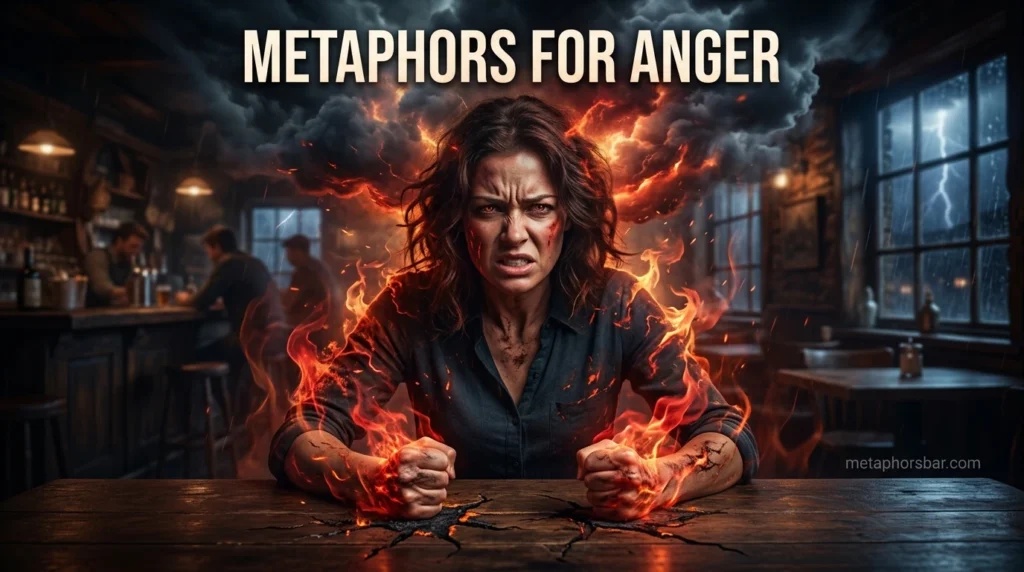
It’s a hot summer afternoon. The sun blazes down, sweat drips from your forehead, and suddenly, someone cuts in front of you in line. Your chest tightens, your face heats up, and you feel a storm brewing inside. That boiling, restless, fiery feeling you feel is anger. But what if you could capture that heat in words? What if anger could be described not just as “mad” or “upset,” but as a roaring, crackling, shifting force? That’s where metaphors come in—powerful tools that turn emotion into vivid, memorable images.
Metaphors help us understand anger in a more colorful way. They make the invisible, visible. They give our readers, friends, or ourselves a deeper sense of what’s happening inside. In this article, we’ll explore metaphors for anger, explain their meaning, show examples, and give tips for using them creatively in writing, social media, or daily life.
What Are Metaphors and Why They Matter for Emotions
A metaphor is when we describe something by saying it is something else. For example, saying, “Her anger was a volcano ready to erupt,” doesn’t mean her body literally became molten rock. It means her anger is intense, sudden, and dangerous—like a volcano. Metaphors give our emotions shape and texture.
Using metaphors for anger is helpful because:
- They make feelings clear – Instead of “I’m mad,” you can paint a picture of stormy seas or fire.
- They connect with others – Readers or listeners can feel what you feel.
- They spark creativity – Writers, poets, and social media creators can make their content more vivid.
Think of anger as a hidden river. Sometimes it flows quietly. Other times it bursts over its banks. Metaphors help us map that river in words.
1. Fire Metaphors for Anger
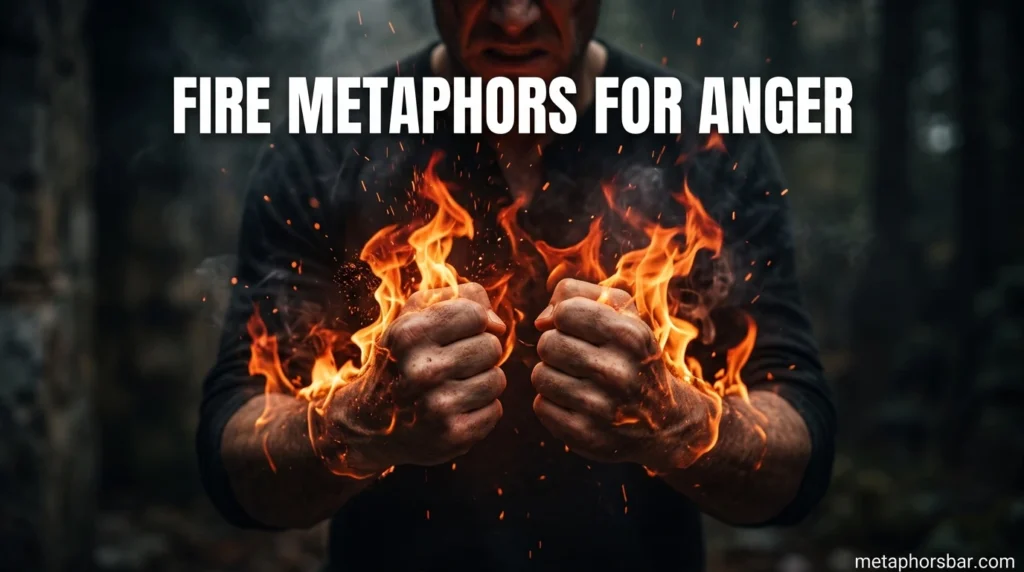
Fire is one of the most common metaphors for anger. Why? Because anger can feel hot, uncontrollable, and all-consuming.
Meaning/Explanation: Fire shows intensity and speed. It can be small and simmering, or it can explode in a wildfire.
Example Sentence: “His words were sparks, igniting the room with anger.”
Alternative Ways to Say It:
- “Her temper flared like a torch.”
- “Anger burned in him, bright and fierce.”
Mini Story: Imagine a child whose toy is taken unfairly. The child’s face turns red, fists clench, and their shouts fill the room. In that moment, they are a tiny flame threatening to blaze into a firestorm.
Interactive Exercise: Write three sentences describing your anger using fire words like blaze, smolder, scorch, ignite. Notice how each word changes the intensity.
2. Storm Metaphors for Anger: Thunder and Lightning in Words
Storms are excellent metaphors for anger because they are sudden, loud, and sometimes destructive.
Meaning/Explanation: Storms represent emotions that come and go, sometimes violently. Thunder is booming rage, lightning is sudden outbursts.
Example Sentence: “She was a storm, and every word was thunder crashing over him.”
Alternative Ways to Express:
- “He raged like a hurricane tearing through a village.”
- “Her fury flashed like lightning, quick and blinding.”
Cultural Reference: In Greek mythology, Zeus threw lightning bolts when angry, showing how storms symbolize divine rage.
Exercise: Imagine your anger as a storm. Is it a gentle drizzle, a heavy downpour, or a hurricane? Write a short paragraph using storm imagery.
3. Animal Metaphors for Anger: Roaring Beasts and Snapping Dogs
Animals can show the wild, instinctive side of anger.
Meaning/Explanation: Anger can feel raw, animalistic, and uncontrolled, like a lion’s roar or a snapping dog.
Example Sentence: “He lunged forward, a wolf cornered by fear and rage.”
Alternative Expressions:
- “Her anger was a tiger prowling in the dark.”
- “He snapped like a chained dog, desperate to break free.”
Mini Story: A traffic jam late at night. A driver honks and yells. Their frustration is a panther pacing in a cage, tense and ready to pounce.
Exercise: Pick an animal and describe your anger through its behavior. Notice what this reveals about your intensity and control.
4. Boiling and Pressure Metaphors: Steam and Volcanoes
Anger often builds quietly before erupting. Pressure metaphors capture this slow buildup and explosive release.
Meaning/Explanation: Pressure can show simmering rage that eventually bursts out.
Example Sentence: “Anger boiled inside him, ready to explode like a volcano.”
Alternative Expressions:
- “She was a pot of water on the stove, steaming and hissing.”
- “His frustration built like gas in a pressure cooker.”
Exercise: Write a scenario where anger builds slowly and erupts. Use at least two pressure metaphors to describe the buildup and release.
5. Dark and Shadow Metaphors: Anger as a Silent Presence
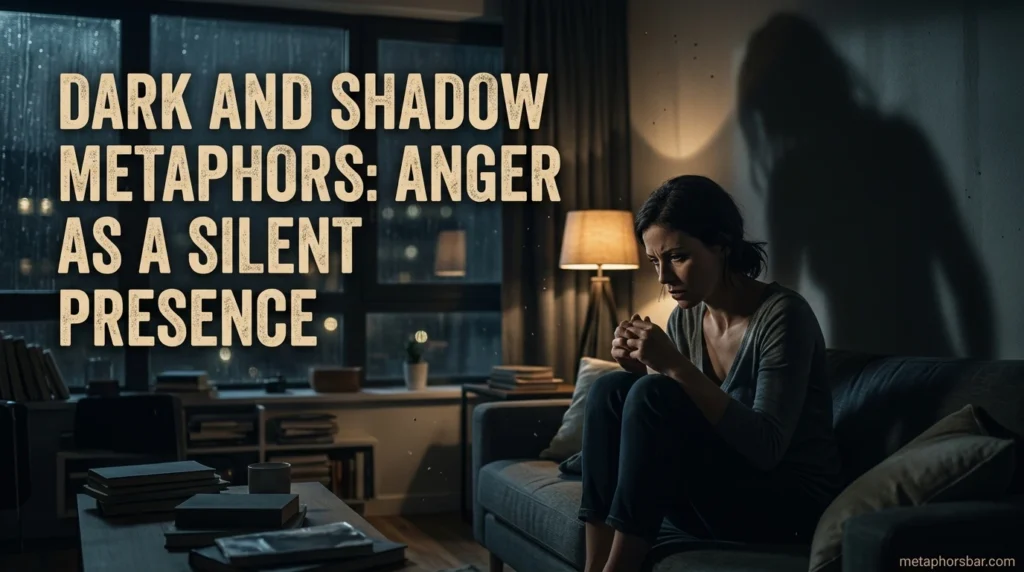
Sometimes anger isn’t loud—it’s quiet, lingering, and heavy.
Meaning/Explanation: Darkness, shadows, or storm clouds can show anger that smolders silently.
Example Sentence: “A shadow of anger hung over him, dark and cold.”
Alternative Expressions:
- “Her anger crept like fog over the room.”
- “He carried a black cloud of fury wherever he went.”
Exercise: Describe a quiet anger using shadow, fog, or darkness. How does silent anger feel different from explosive anger?
6. Natural Disaster Metaphors: Earthquakes and Tsunamis
Anger can be massive and overwhelming, like a force of nature.
Meaning/Explanation: Disasters represent unstoppable power and the aftermath of rage.
Example Sentence: “His anger hit like a tsunami, leaving nothing untouched.”
Alternative Expressions:
- “She shook the room with a quake of fury.”
- “His temper was a landslide, sudden and unstoppable.”
Exercise: Think of a situation where anger could “shake” the environment. Write a paragraph comparing it to a natural disaster.
7. Color and Heat Metaphors: Red, Hot, and Burning
Colors, especially red and black, often represent anger.
Meaning/Explanation: Color metaphors turn emotion into something visible and immediate.
Example Sentence: “His face was red with rage, a living ember.”
Alternative Expressions:
- “She blazed like a red-hot iron rod.”
- “Anger painted him crimson, from hair to toes.”
Exercise: Pick a color that represents your anger. Describe it vividly in a short paragraph.
8. Musical and Sound Metaphors: Screeching, Roaring, and Thunderous Voices
Anger makes noise. Musical metaphors capture tone, pitch, and rhythm.
Meaning/Explanation: Sound shows intensity, disruption, or emotional resonance.
Example Sentence: “His words were jagged notes in a furious symphony.”
Alternative Expressions:
- “She screeched like a violin string snapped too tight.”
- “His laughter was a drumbeat of malice.”
Exercise: Imagine anger as a sound. Is it a bang, a hiss, a growl, or a storm? Write one sentence describing it.
9. Tip: Use Metaphors to Diffuse or Understand Anger
Metaphors aren’t just for writing—they can help you understand and manage anger.
Explanation: Naming your anger helps you see it as separate from yourself. For instance, “I am a simmering volcano” is less scary than just “I am mad.”
Practical Exercise: Next time you feel anger, pause and choose a metaphor that describes it. Write it down or say it aloud. This helps reduce intensity and increase self-awareness.
Bonus Tip: Use your metaphors in journaling, social media posts, or creative writing to make your feelings relatable and vivid.
10. Creative Prompts for Practicing Anger Metaphors
To get really comfortable with anger metaphors, try these exercises:
- Daily Emotion Diary: Write one metaphor per day for your anger. Notice patterns.
- Story Rewrite: Take a short story or news event and rewrite angry reactions using metaphors.
- Social Media Challenge: Describe an everyday frustration using one vivid metaphor. See how followers react.
- Metaphor Mash-Up: Combine two metaphors for extra effect—e.g., “Her anger was a stormy volcano.”
Mini Story: Imagine your morning coffee spills. Instead of “I’m angry,” write “My patience exploded like steam from a kettle on fire.” Suddenly, the scene becomes funny, dramatic, and creative.
Conclusion
Anger is natural. Everyone feels it. But with metaphors, we can paint it, shape it, and even transform it. We can write stories, connect with others, and understand ourselves better. Fire, storms, animals, pressure, shadows, disasters, colors, and sound—these tools give our anger a voice.
When you practice metaphors, anger stops being just a storm inside you. It becomes a story, a picture, and sometimes even a poem.
So next time your chest tightens or your face heats up, reach for a metaphor. Describe your inner volcano, your stormy skies, your roaring lion. You might just discover that anger, once overwhelming, can become a spark of creativity.
Interactive Exercise for Readers:
- Pick a recent anger moment. Write three different metaphors for it.
- Share one in a journal, social media, or story. Notice which metaphor feels truest.
- Try combining metaphors—like fire and storm—to see how they amplify meaning.
Bonus Writing Tip: Metaphors work in short texts too. Use them in captions, tweets, or texts to express emotion vividly.
FAQs
What are metaphors for anger?
Metaphors for anger are creative comparisons that describe feelings of rage, frustration, or irritation in vivid and imaginative ways. Instead of directly stating someone is angry, metaphors compare anger to things like fire, storms, volcanoes, or wild animals to show the intensity of emotion.
Why are metaphors important when describing anger?
Metaphors make emotional descriptions more powerful and relatable. They help readers and listeners visualize what anger feels like, making writing and conversations more expressive and memorable.
What are some common metaphors for anger?
Some well-known metaphors for anger include:
- “Boiling with rage” for intense anger building up
- “A volcano ready to erupt” for suppressed emotions
- “A wildfire” for anger spreading quickly
- “Thunder in the room” for explosive tension
- “A ticking bomb” for anger close to exploding
Are metaphors for anger always negative?
Not always. While anger metaphors often describe conflict or emotional intensity, they can also represent passion, strength, or motivation. In some contexts, anger becomes a force for change or determination.
How can metaphors improve emotional writing?
Metaphors create strong imagery and emotional connection. They help readers feel the intensity of the emotion instead of simply reading about it. This makes stories, poems, speeches, and personal writing more engaging.
How do I create my own metaphor for anger?
Think about how anger behaves or feels, then compare it to something with similar qualities:
- Sudden anger → lightning strike
- Slow-building anger → gathering storm clouds
- Uncontrollable rage → wildfire in dry grass
- Silent anger → ice cracking beneath the surface
What is the difference between a metaphor and a simile?
A metaphor directly compares one thing to another, such as “Her anger was a wildfire.” A simile uses words like “like” or “as,” such as “Her anger spread like a wildfire.”
Where are anger metaphors commonly used?
They are widely used in literature, movies, speeches, music, psychology discussions, and everyday conversations to describe emotions in a more dramatic and meaningful way.