
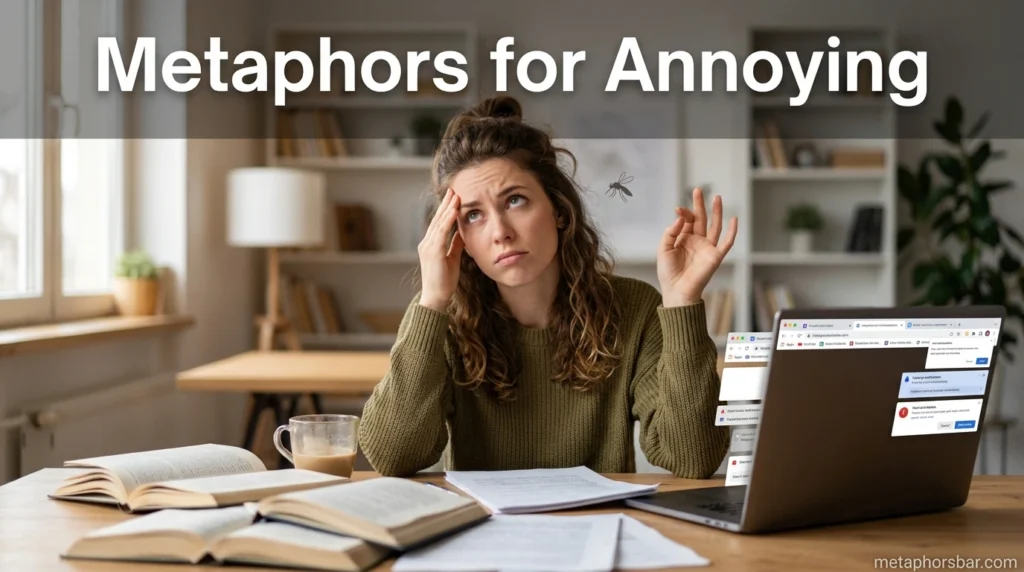
You know that feeling. The one that creeps up when someone taps your shoulder for the tenth time in five minutes, or when the neighbor’s dog won’t stop barking at 3 a.m. It’s small, gnawing, and impossible to ignore.
\ That’s annoyance. But words like “annoying” or “bothersome” feel flat compared to the colorful, living ways language can express it. This is where metaphors for annoying step in—they let us capture not just the act but the feeling, painting it in a way readers, listeners, or followers can almost touch.
In this article, we’ll explore vivid, relatable metaphors for annoying, unpack their meanings, provide examples, and offer interactive exercises to make these ideas stick. Whether you’re writing a story, tweeting a quip, or just venting, you’ll find metaphors that bring life to irritation.
What Are Metaphors for Annoying and Why They Matter
A metaphor compares one thing to another without using “like” or “as.” Instead of saying, “He’s annoying,” a metaphor might say, “He’s a mosquito buzzing in the middle of the night.” The second image sparks an immediate sensory reaction: you can almost feel the itch, hear the buzz, and sense the frustration.
Why does this matter? Because metaphors do three things:
- Paint emotion – They show how annoyance feels rather than just naming it.
- Engage the reader – People remember imagery far better than plain words.
- Boost creativity – They stretch the mind, making everyday frustrations feel story-worthy.
Buzzing Mosquitoes – Tiny But Tormenting

Imagine lying in bed, eyes half-closed, when a high-pitched buzz circles your head. You swat, you move, you groan. That’s the feeling of a mosquito metaphor for annoyance.
Meaning: Small actions or words that repeatedly disturb your peace. Example: “Her constant humming around the office was like a mosquito in a quiet bedroom.” Alternative ways to say it: nagging fly, persistent gnat, tiny irritant
Mini Story: In India, my aunt always said, “The little mosquito bites the hardest.” Every time her younger brother poked her for attention, she’d laugh, but inside, she felt the buzzing frustration.
Interactive Exercise: Write three sentences describing minor irritations in your day using insects as metaphors. E.g., “My phone’s notifications are little fleas jumping on my nerves.”
Gravel in Your Shoes – Annoyance That Slows You Down
Ever taken a step only to feel something sharp underfoot? That prickly discomfort slows you down, makes you focus on the irritation, and distracts you from the path. Gravel in your shoes captures the nagging, persistent nature of annoyance.
Meaning: Continuous, uncomfortable interruptions in daily life. Example: “Every time my coworker corrected my grammar mid-sentence, it felt like gravel in my shoes.” Alternative ways to say it: pebble underfoot, sand in the sock, thorn in the step
Tip: Use physical discomfort in metaphors to evoke empathy. Readers instantly “feel” the irritation.
Interactive Exercise: Think of one small physical sensation that annoys you. Write a metaphor comparing it to a person, habit, or sound in your life.
A Car Alarm at 2 a.m. – Loud and Unavoidable
Some annoyances are not small—they shout. Imagine a car alarm piercing the night while you’re trying to sleep. That’s a metaphor for intrusive or aggressive irritation.
Meaning: Loud, disruptive actions that demand attention. Example: “His endless complaining was a car alarm at 2 a.m., impossible to ignore.” Alternative ways to say it: fire alarm in the library, siren in the night, blaring horn
Mini Story: In New York City, street noise is part of life. But one night, a broken car alarm made the whole block restless. Everyone related to the metaphor instantly—it’s unforgettable.
Nails on a Chalkboard – The Classic Annoying Sound
Some metaphors become classics because they hit the senses perfectly. Nails on a chalkboard create shivers that make your teeth clench—a perfect image for irritation.
Meaning: An almost painful annoyance, usually auditory or social. Example: “Her high-pitched laughter during the serious meeting was like nails on a chalkboard.” Alternative ways to say it: screeching violin, grating screech, teeth-rattling noise
Bonus Tip: Use sound-based metaphors for annoyances that get under the skin or trigger stress.
A Squeaky Door That Never Stops – Persistent Annoyance
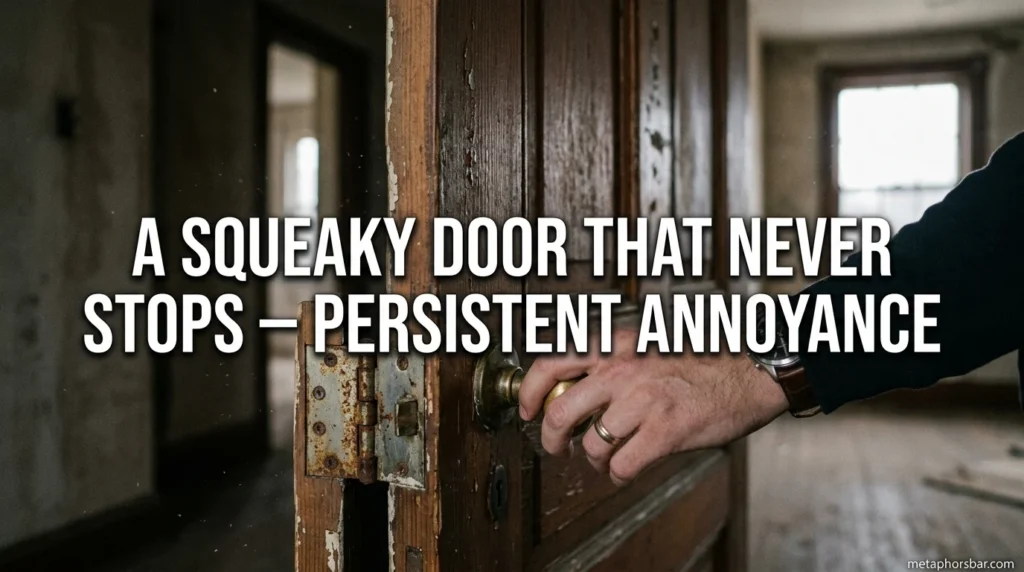
A squeaky door keeps creaking, even when you’ve oiled the hinges. It’s a metaphor for repetitive, unavoidable irritation.
Meaning: Persistent, nagging annoyances that wear down patience. Example: “The manager’s constant emails were a squeaky door that never stops.” Alternative ways to say it: whiny faucet, creaky floorboard, ticking clock
Paper Cut on a Finger – Small but Sharp
Tiny but intense, a paper cut stings more than you expect. Some annoyances are like this—they’re minor but disproportionately painful.
Meaning: Small irritations that cause sharp emotional discomfort. Example: “Her sarcastic remark was a paper cut on my patience.” Alternative ways to say it: pinprick of annoyance, splinter of irritation, tiny sting
Interactive Prompt: List five small moments in your day that feel like “paper cuts” and turn them into metaphors.
The Hum of Fluorescent Lights – Invisible but Mind-Numbing
Ever been in a room where the fluorescent lights hum all day? You barely notice at first, then suddenly it drives you crazy. This metaphor works for subtle, background annoyances.
Meaning: Low-level irritation that builds over time. Example: “Her constant phone-checking during dinner was like the hum of fluorescent lights in my head.” Alternative ways to say it: persistent buzz, background noise of irritation, constant drone
Ants in Your Pants – Restless and Irritating
This playful metaphor conjures energy, discomfort, and frustration. It works when someone’s behavior is both fidgety and bothersome.
Meaning: Someone is restless, meddlesome, or constantly moving in a way that annoys. Example: “His questions during class made me feel like I had ants in my pants.” Alternative ways to say it: jittery nerves, restless fidgets, buzzing energy
Cultural Reference: The phrase “ants in your pants” appears in old cartoons and songs, making it instantly relatable for readers.
Fog That Won’t Lift – Lingering Irritation
Some annoyances stick around, clouding your mood or mind. Fog works perfectly as a metaphor for these invisible, lingering irritations.
Meaning: Persistent mental or emotional annoyance. Example: “Her criticism hung over me like fog that won’t lift.” Alternative ways to say it: stubborn mist, gray cloud of irritation, endless haze
Tip for Writers
To make metaphors for annoying truly vivid, combine senses. Don’t just describe a sound—add touch, sight, or emotion. For example, a mosquito isn’t just buzzing; it bites, it distracts, it frustrates.
Interactive Exercise: Take one annoying event from your week. Describe it using three senses in one metaphor. Example: “His endless notifications were like tiny fireworks, bright and loud, poking at my nerves.”
Bonus Tips for Daily Use:
- In writing: Use metaphors to make everyday annoyances relatable and funny.
- On social media: Share short, witty metaphors to convey frustration creatively.
- In conversation: Spice up complaints with metaphors—it’s more memorable than saying “annoying.”
Interactive Challenge for Readers
- Pick three annoyances from your day.
- Write a metaphor for each, mixing senses (sight, sound, touch).
- Share them with friends or journal them for creative practice.
Example:
- Annoying coworker → “A ticking clock that speeds up whenever I look away.”
- Sibling teasing → “A leaf caught in a ceiling fan, spinning endlessly.”
- Phone notifications → “Tiny firecrackers in my pocket, startling and persistent.”
Metaphors let annoyance feel tangible, relatable, and sometimes even funny. Next time something bugs you, try describing it like a mosquito, a fog, or a paper cut—you’ll not only feel better, but you’ll give others a story they can almost touch.
Using these metaphors isn’t just about words—it’s about empathy, creativity, and turning the everyday grind into something vivid. Start small, experiment, and watch how your language transforms even the most irritating moments into art.
FAQs
What are metaphors for annoying?
Metaphors for annoying are creative comparisons used to describe something or someone irritating, frustrating, or bothersome. Instead of directly saying a person is annoying, metaphors compare the feeling to experiences like buzzing insects, dripping faucets, or endless noise to create stronger imagery.
Why are metaphors useful for describing annoyance?
Metaphors make descriptions more vivid, emotional, and relatable. They help readers or listeners better understand the intensity of irritation by connecting it to familiar experiences and sensations.
What are some common metaphors for annoying?
Some popular metaphors include:
- “A buzzing mosquito” for someone constantly bothering others
- “A broken record” for repetitive behavior or speech
- “Nails on a chalkboard” for something extremely irritating
- “A dripping faucet” for nonstop small frustrations
- “An itch you can’t scratch” for persistent annoyance
Are metaphors for annoying always negative?
Most metaphors for annoyance carry negative meanings, but some can also be humorous or playful depending on the context. Friends may jokingly use lighthearted metaphors without intending serious offense.
Can metaphors improve writing and conversations?
Yes. Metaphors add personality and creativity to communication. They make stories, conversations, and descriptions more engaging by helping people visualize emotions and reactions more clearly.
How can I create my own metaphor for annoying?
Think about what annoyance feels like and compare it to a familiar experience. For example:
- Constant interruption → “a buzzing alarm clock”
- Small but repeated frustration → “sand in your shoes”
- Loud irritation → “a car horn stuck in traffic”
What is the difference between a metaphor and a simile?
A metaphor directly compares two things, such as “He was a mosquito in the room.” A simile uses words like “as” or “like,” such as “He was as annoying as a buzzing mosquito.”
Where are metaphors for annoying commonly used?
They are often used in everyday conversation, storytelling, comedy, social media posts, speeches, and creative writing to express frustration in a more colorful and entertaining way.
Conclusion
Metaphors for annoying help people express irritation and frustration in vivid, imaginative ways. By comparing annoyance to experiences like buzzing insects, dripping faucets, or scratching noises, these metaphors make emotions easier to picture and understand. They turn ordinary descriptions into memorable and expressive language.
Whether used humorously among friends or seriously in writing and storytelling, annoyance metaphors add creativity and emotional depth to communication. They allow speakers and writers to describe frustration more effectively while keeping their language engaging and relatable. Learning and using these metaphors can make conversations and writing far more colorful and impactful.