
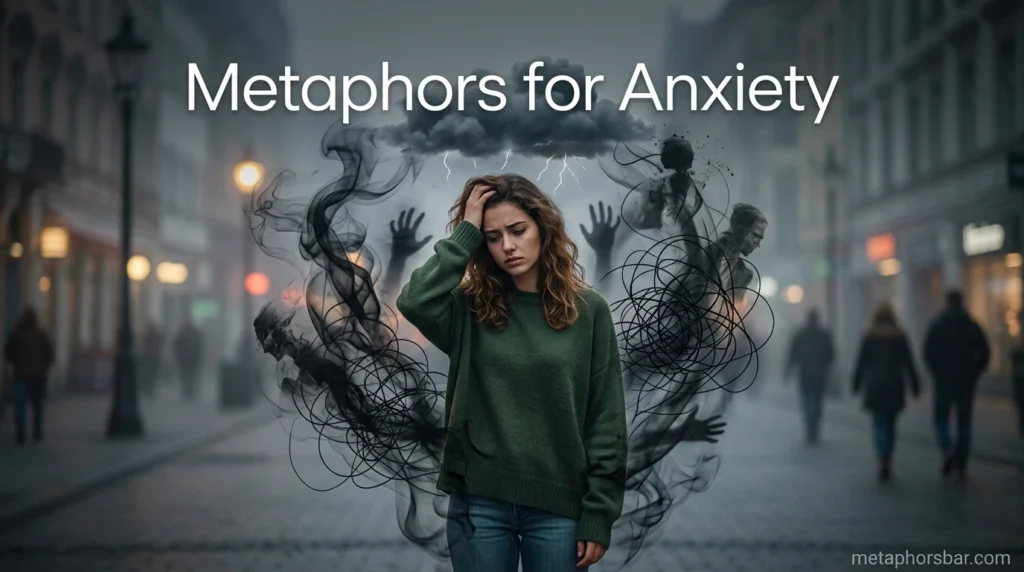
The first sign of anxiety is not always a thought. Sometimes it is a tightness in the chest before you know why. Sometimes it is a restless leg under the table, a mind that keeps checking the same worry like a hand hovering over a bruise, a feeling that something is about to happen even when the room is perfectly still. Anxiety can arrive like weather, like noise, like motion without direction. It is often difficult to describe because it lives in both the body and the mind at once.
That is why metaphors for anxiety matter. They help give shape to an experience that can feel blurry, private, and hard to name. A good metaphor can make the invisible visible. It can help writers, speakers, and readers understand anxiety not as a single emotion, but as a shifting state: pressure, alertness, confusion, anticipation, and exhaustion all tangled together.
Whether you are writing a poem, a journal entry, a story, a caption, or simply looking for a more accurate way to explain how you feel, metaphors for anxiety can make your language more vivid, compassionate, and memorable.
Why Metaphors for Anxiety Matter in Writing and Reflection
They give shape to an invisible feeling
Anxiety is often hard to explain directly because it can be both physical and emotional. A metaphor turns it into something the imagination can hold.
They help describe the kind of anxiety you mean
Not all anxiety feels the same. Sometimes it buzzes. Sometimes it clouds. Sometimes it alarms. A metaphor can show the exact shape of the experience.
They make writing more memorable
A sentence like “I felt anxious” is clear, but “my mind felt like a hallway full of blinking lights” creates an image that stays with the reader.
They can support understanding and empathy
When used thoughtfully, metaphors help others sense the texture of anxiety rather than judging it from a distance. They can make personal writing, fiction, and everyday conversation more humane.
Three Powerful Metaphors for Anxiety
1. Anxiety as a Smoke Alarm That Won’t Stop
A smoke alarm is designed to alert us to danger, which makes it a fitting metaphor for anxiety. Sometimes anxiety feels like an alarm system that has become too sensitive: it keeps going off even when there is no fire, no immediate danger, and no clear reason to keep sounding. This image is especially useful for describing hyper-awareness, panic, and the feeling of being on edge.
Meaning and explanation
When anxiety is compared to a smoke alarm, it suggests a nervous system that is working too hard to protect you. It is trying to warn you, but the warning never shuts off. The metaphor captures the exhausting reality of being unable to relax because the body keeps acting like something urgent is happening.
This image works beautifully because it is specific. It does not just say “anxiety is loud”; it shows a system that keeps interrupting peace.
Example sentence or scenario
Her anxiety was a smoke alarm that would not stop, shrieking at every small thought until even silence felt suspicious.
This metaphor works especially well in personal essays, reflective writing, and scenes where a character is trapped inside constant alertness.
Alternative ways to express it
- a warning bell in the chest
- an alarm that keeps misfiring
- a siren under the skin
- an internal emergency signal
- a blaring notice of danger
Sensory and emotional details
You can almost hear the shrill beep, feel the jolt in the body, and picture someone standing in the middle of a room trying to figure out how to make the sound stop. Emotionally, this metaphor feels frantic, exhausting, and hard to ignore. It suggests that anxiety can make peace feel unreachable because the body keeps insisting on danger.
Mini storytelling touch
A student once described exam season as “living inside a smoke alarm with bad wiring.” That line works because it captures the absurdity of anxiety: the system is trying to help, but it is helping too much. The result is not safety, but strain.
Literary or cultural reference
Alarm imagery appears often in thrillers and psychological stories because it mirrors how a person can feel trapped in a state of constant readiness. As a metaphor for anxiety, the smoke alarm is particularly strong because it makes the internal experience immediate and audible.
2. Anxiety as a Swarm of Bees
A swarm of bees is busy, buzzing, fast-moving, and impossible to ignore. As a metaphor for anxiety, it captures the sensation of thoughts darting everywhere, body tension, and the feeling that your mind is full of movement that will not settle. This image works especially well when anxiety is buzzing, restless, and slightly chaotic.
Meaning and explanation
When anxiety is described as a swarm of bees, it suggests clustered thoughts, nervous energy, and a body that cannot quite relax. The bees may not all be individually harmful, but their collective motion creates pressure and fear. This metaphor is especially useful when anxiety feels like too many thoughts happening at once.
It also captures the way anxiety can feel both small and overwhelming. A single bee may not matter much, but a swarm fills the air.
Example sentence or scenario
His anxiety came like a swarm of bees, each thought buzzing louder than the last until he could barely hear himself think.
This metaphor is useful for describing racing thoughts, social anxiety, anticipation, or the nervous energy that feels hard to contain.
Alternative ways to express it
- a hive of restless thoughts
- a buzzing cloud of worry
- a storm of small wings
- a brain full of humming motion
- a swarm under the ribs
Sensory and emotional details
You can hear the faint electric buzz, feel the itch of too much motion, and imagine the nervous instinct to step away from what might sting. Emotionally, this metaphor feels agitated, crowded, and hard to settle. It suggests that anxiety is not always one huge fear, but a hundred tiny movements all at once.
Mini storytelling touch
A woman once said that whenever she had to speak in public, it felt like “a beehive had opened in my chest.” That image is memorable because it captures the fluttering, urgent, and multiplied nature of anxiety. The swarm metaphor gives that sensation a body.
Literary or cultural reference
Bees often symbolize industry, activity, and collective motion in literature and folklore. As a metaphor for anxiety, they become something less orderly and more restless—a living cloud of energy that won’t let the mind rest.
3. Anxiety as Fog on the Road
Fog is one of the most accurate metaphors for anxiety because it blurs the path ahead. You may know where you are standing, but the road beyond that becomes uncertain. This metaphor works especially well when anxiety feels like confusion, uncertainty, or the inability to see what comes next.
Meaning and explanation
When anxiety is compared to fog, it emphasizes uncertainty and lack of clarity. Anxiety often makes the future look dim or indistinct, even when nothing has actually changed. The road is still there, but it is harder to trust what lies ahead. This image is especially powerful for describing anxious thinking, decision-making, or the fear of the unknown.
Unlike the smoke alarm or the swarm, fog is quieter. It does not shout; it obscures. That makes it ideal for more subtle, lingering anxiety.
Example sentence or scenario
Her anxiety felt like fog on the road, softening every landmark and making each step forward feel uncertain.
This metaphor works beautifully in reflective writing, memoirs, and scenes where a character is unsure of what comes next.
Alternative ways to express it
- a haze of uncertainty
- a cloud over the path
- a blurred horizon
- a road hidden by mist
- a future wrapped in gray
Sensory and emotional details
You can imagine cool damp air, the muffled sound of footsteps, and the uneasy feeling of moving through a world that has lost its edges. Emotionally, this metaphor feels quiet, disorienting, and unresolved. It suggests that anxiety can make life feel less like a clear journey and more like walking carefully through weather you cannot control.
Mini storytelling touch
A man once described his post-graduation anxiety as “standing at the edge of my future and only seeing fog.” That image stays because it is so human. Anxiety often does not remove the road; it simply hides it from view long enough to make every choice feel heavier.
Literary or cultural reference
Fog has long appeared in literature as a symbol of uncertainty, mystery, and hidden truth. As a metaphor for anxiety, it works because it captures the way worry can cloud perception without fully stopping movement.
How to Choose the Right Metaphor for Anxiety
Use smoke alarm when anxiety feels urgent and hyper-alert
Choose this metaphor when the feeling is a constant warning, a nervous startle, or a sense that something is wrong even when nothing is visibly wrong.
Use a swarm of bees when anxiety feels busy and restless
This is the best choice when your thoughts are darting, buzzing, and difficult to quiet.
Use fog on the road when anxiety feels uncertain and unclear
Choose this image when the problem is not noise but obscurity—when the future or next step feels hard to see.
The best metaphor depends on the kind of anxiety you want to describe. Anxiety can beep, buzz, and blur—and sometimes it does all three.
Interactive Exercises for Practicing Metaphors for Anxiety
Exercise 1: Complete the sentence
Finish this prompt in three different ways:
“My anxiety felt like ______ because ______.”
Try one answer that focuses on sound, one on movement, and one on visibility.
Example: My anxiety felt like a smoke alarm because it kept warning me about danger even when the room was quiet.
Exercise 2: Sensory mapping
Think of a time you felt anxious. Write down:
- one sound
- one texture
- one color
- one body sensation
- one emotion
Then turn those details into a metaphor.
For example: It sounded like buzzing in the walls, felt like tight wire around my chest, looked like fog at dawn, moved like restless wings, and carried the emotion of uncertainty.
Exercise 3: Story starter
Begin a short paragraph with:
“Anxiety was like…”
Let the image guide the tone. It can be poetic, honest, soft, or intense.
Exercise 4: Journal or caption prompt
Try writing a one-line reflection:
- “Today my anxiety was a smoke alarm with no silence button.”
- “My thoughts felt like bees in a jar.”
- “Anxiety turned the road ahead into fog.”
Bonus tips for using metaphors for anxiety in writing, social media, and daily life
In writing
Use these metaphors in fiction, essays, poetry, and memoirs to make the experience of anxiety vivid and emotionally accurate. They help readers feel the tension rather than just identify it.
On social media
A short metaphor can make a post feel more human and expressive. “My brain is a smoke alarm today” says more than “I’m anxious.”
In everyday conversation
Metaphors can help you explain how anxiety feels without needing to overstate or oversimplify it. Saying “It feels like fog on the road” can communicate uncertainty clearly and gently.
In journaling
If you are trying to understand your own anxiety, metaphor can help you notice whether it feels loud, crowded, or obscuring. That clarity can make self-reflection easier.
Keep the image honest
The strongest anxiety metaphor is the one that truly fits the feeling. Some anxiety is noisy, some is busy, and some is simply hard to see through. Let the image reflect the truth of the moment.
FAQs
1. What is a metaphor for anxiety?
A metaphor for anxiety is a figurative comparison that describes anxiety using another image, such as a smoke alarm, a swarm of bees, or fog on the road.
2. Why are metaphors for anxiety useful?
They help make a difficult feeling easier to understand, visualize, and express in writing or speech.
3. What is a simple metaphor for anxiety?
A simple example is: Anxiety is a smoke alarm that won’t stop. It suggests constant warning and nervous tension.
4. Can these metaphors be used in fiction or poetry?
Yes. They are especially effective in fiction and poetry because they help capture the texture of inner experience.
5. How do I create my own metaphor for anxiety?
Think about what anxiety feels like—loud, buzzing, blurry, pressurized—and compare it to something with similar qualities.
6. Are these metaphors only for serious writing?
No. They can also be used in journaling, captions, and reflective conversation when the tone is appropriate.
7. What makes a strong metaphor for anxiety?
A strong metaphor is vivid, emotionally fitting, and easy to picture. It should help the reader feel the anxiety, not just name it.
Conclusion
Anxiety can be hard to explain because it moves through the body and mind in ways that are often invisible from the outside. That is why metaphors matter—they help us turn internal pressure into language that can be seen, heard, and understood.
A smoke alarm captures the feeling of constant alert. A swarm of bees captures mental and physical restlessness. Fog on the road captures uncertainty and the difficulty of seeing what comes next. Together, these images remind us that anxiety is not just one thing—it can warn, buzz, and blur all at once.
So when you write about anxiety, do not settle for the obvious. Let it ring, buzz, or mist through your language. A good metaphor can make the feeling feel less isolated—and sometimes, that is the first small relief.