
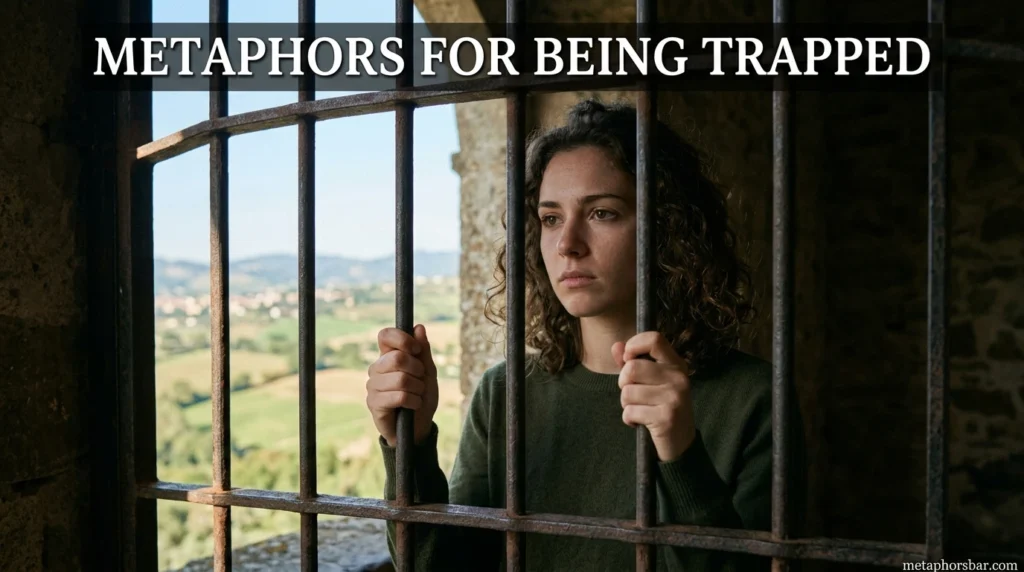
A trapped feeling has a way of changing the whole temperature of a moment. The air seems thinner. The walls seem closer. Even the smallest noise—a latch clicking, a door shutting, footsteps in the hall—can sound louder than it should. Being trapped is not always dramatic at first. Sometimes it arrives quietly, like a thought you cannot shake, a routine you cannot leave, a choice you no longer know how to make.
That is why metaphors for being trapped are so useful. They give shape to a feeling that can be physical, emotional, mental, or even social. A good metaphor can help us describe not just confinement itself, but the pressure, fear, frustration, and longing for release that come with it. Metaphors make invisible states visible, and that can be deeply valuable in writing, reflection, and everyday conversation.
Whether you are writing fiction, poetry, a journal entry, a social media caption, or a personal essay, metaphors for being trapped can make your language more vivid, expressive, and memorable.
Why Metaphors for Being Trapped Matter in Writing and Reflection
They help explain a hard-to-describe feeling
Being trapped can feel like panic, resignation, confusion, or slow-burning frustration. A metaphor can gather those emotions into one image readers can instantly feel.
They show the kind of trapped feeling you mean
Sometimes trapped feels like being locked in. Sometimes it feels like being tangled, pinned, buried, or watched. The metaphor helps reveal the exact shape of the experience.
They make writing more memorable
A sentence like “I felt trapped” is clear, but “I felt like a moth in a sealed jar” gives the reader a picture they can carry with them.
Three Powerful Metaphors for Being Trapped
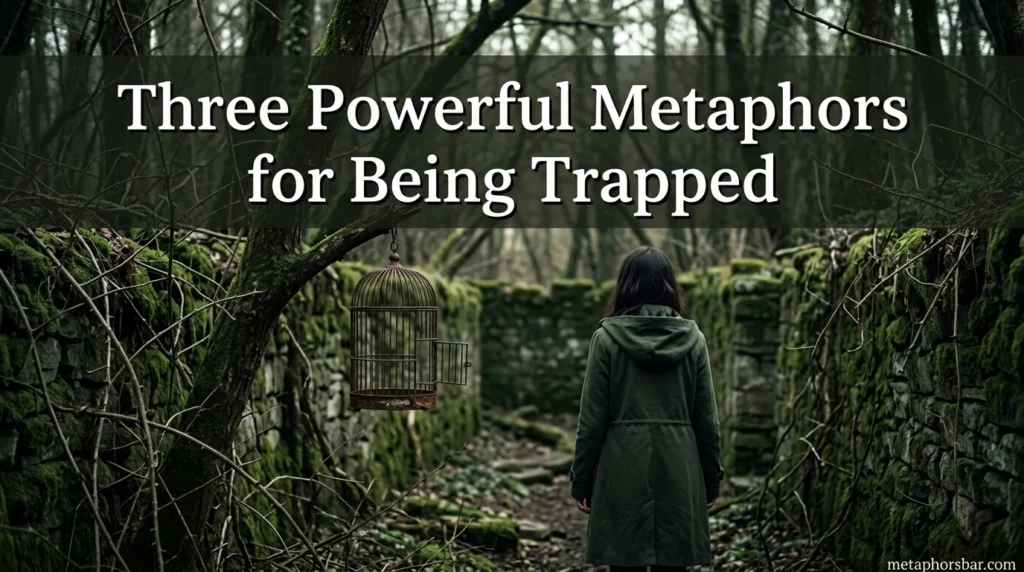
1. Being Trapped as a Locked Room
A locked room is one of the most immediate metaphors for trapped feelings because it suggests enclosure, silence, and the absence of obvious exits. It works especially well when a person feels boxed in by circumstances, obligations, thoughts, or emotions.
Meaning and explanation
A locked room suggests boundaries that cannot be crossed. It conveys the feeling of being inside something that is closed off from the outside world. This metaphor is especially effective when the trapped feeling is mental or emotional—like being stuck in a job, a relationship, a memory, or a pattern of thinking with no clear door out.
The locked room image is powerful because it implies both confinement and tension. It is not merely a space; it is a space that resists escape.
Example sentence or scenario
After months of the same arguments and unanswered questions, her life felt like a locked room—silent, narrow, and impossible to open from the inside.
This metaphor works beautifully in personal essays, fiction, and reflective writing about anxiety, burnout, or feeling boxed in.
Alternative ways to express it
- a sealed chamber
- a room with no exit
- a closed door with no key
Sensory and emotional details
You can imagine the click of a lock, the hush of a closed space, and the stillness that makes the air feel heavy. Emotionally, this metaphor feels tense, private, and claustrophobic. It suggests that being trapped can be as much about pressure as it is about walls.
Mini storytelling touch
A young man once described staying in the same small apartment during a long recovery as “living in a room my own life had locked behind me.” That image stays because it captures not just the space, but the emotional state of being unable to move freely through one’s own days.
2. Being Trapped as a Spider Web
A spider web is delicate, beautiful, and sticky all at once. As a metaphor for being trapped, it suggests that confinement can come from something subtle rather than forceful. A web can hold fast even when it seems almost invisible, which makes it a perfect image for social pressure, obligation, fear, or complicated circumstances that pull a person in from many directions.
Meaning and explanation
This metaphor suggests entanglement. Unlike the locked room, which is about hard boundaries, the spider web is about threads that catch, cling, and wrap around movement. It works especially well when the trapped feeling comes from relationships, responsibilities, or habits that are not easy to see at first.
A spider web can also suggest that the trap is made up of many small things rather than one big one.
Example sentence or scenario
He felt trapped in a spider web of deadlines, expectations, and promises he had made too quickly to too many people.
This metaphor is especially effective in writing about overwhelm, emotional entanglement, or situations where the pressure feels both delicate and inescapable.
Alternative ways to express it
- a tangle of threads
- a web of obligation
- a net of pressure
Sensory and emotional details
You can picture fine threads catching on skin, glimmering in the light, and tightening the more you struggle. Emotionally, this metaphor feels intricate, anxious, and slightly unsettling. It suggests that what traps us is not always obvious or strong-looking—it can be fragile and still impossible to break.
Mini storytelling touch
A woman once described her overbooked life as “one long sticky web made of small yeses.” That line is memorable because it reveals how many traps are created not by one huge mistake, but by tiny agreements that quietly connect and tighten around a person’s time and energy.
3. Being Trapped as Sinking in Quicksand
Quicksand is one of the most dramatic metaphors for trapped feelings because it suggests slow, silent danger. The more you struggle, the deeper you seem to sink. This makes it a powerful image for situations that worsen with resistance—stress, despair, debt, fear, or emotional overwhelm.
Meaning and explanation
Quicksand is not just about being unable to move; it is about the terrifying feeling that motion itself is part of the problem. That makes it a particularly strong metaphor for being trapped in a situation that feels like it punishes every attempt to escape. It captures panic, helplessness, and the fear of losing ground.
This image works well when the trapped feeling is intense and urgent, especially if the situation feels like it is gradually swallowing stability.
Example sentence or scenario
The more she tried to fix everything at once, the more it felt like sinking in quicksand—each effort pulling her deeper into exhaustion.
This metaphor works beautifully in writing about burnout, overwhelming responsibilities, or emotional struggles that feed on themselves.
Alternative ways to express it
- sinking deeper with every move
- swallowed by shifting ground
- a slow slide downward
- a downward spiral of effort
Sensory and emotional details
You can imagine the grainy pull under your feet, the drag of wet earth, and the rising panic of realizing that panic itself is part of the trap. Emotionally, this metaphor feels desperate, heavy, and frightening. It suggests that being trapped can feel like losing balance before you even understand why.
Mini storytelling touch
A student once said that finals week felt like “trying to stand in soup while more homework kept falling from the sky.” The quicksand metaphor captures that same helpless feeling: the harder you fight, the more the situation seems to hold you in place.
How to Choose the Right Metaphor for Being Trapped
Use a locked room when the trapped feeling is about enclosure
Choose this metaphor when the sense of no escape comes from walls, boundaries, or the absence of a way out.
Use a spider web when the trapped feeling is about entanglement
This is the best choice when the situation feels sticky, layered, or made of many small pressures.
Use sinking in quicksand when the trapped feeling is about worsening struggle
Choose this image when effort itself seems to deepen the problem and the feeling is one of slow, urgent loss of control.
The best metaphor depends on what kind of trapped feeling you want to describe. Trapped can lock, tangle, or sink—and each image gives the experience a different emotional shape.
Interactive Exercises for Practicing Metaphors for Being Trapped
Exercise 1: Complete the sentence
Finish this prompt in three different ways:
“I felt trapped like ______ because ______.”
Try one answer that feels physical, one that feels emotional, and one that feels symbolic.
Example: I felt trapped like a moth in a sealed jar because I could see light, but I could not reach it.
Exercise 2: Sensory mapping
Think of a time when you felt trapped. Write down:
- one sound
- one texture
- one color
- one shape
- one emotion
Then turn those details into a metaphor.
For example: It sounded like a lock clicking shut, felt like threads sticking to my skin, looked like a room with no windows, had the shape of a narrowing tunnel, and carried the emotion of rising panic.
Exercise 3: Story starter
Begin a short paragraph with:
“Being trapped felt like…”
Let the image guide the tone. You can make it poetic, blunt, reflective, or tense.
Exercise 4: Journal or caption prompt
Try writing a one-line reflection:
- “I was in a room with no windows.”
- “My life felt like a spider web of obligations.”
- “Every step felt like sinking in quicksand.”
Bonus tips for using metaphors for being trapped in writing, social media, and daily life
In writing
Use these metaphors in fiction, memoir, poetry, and essays to make confinement and pressure feel visible and emotionally accurate.
On social media
A metaphor can make a post about overwhelm or burnout feel relatable and expressive. “Feeling like I’m in a locked room today” says more than “I feel trapped.”
In everyday conversation
Metaphors can help you explain hard feelings without needing a long explanation. Saying “I’m in a spider web of deadlines” gives shape to stress quickly.
In journaling
If you are trying to understand a period of stuckness or pressure, metaphor can help you see whether your trapped feeling is about walls, entanglement, or sinking.
Keep the image honest
The strongest trapped metaphor is the one that truly matches the feeling. Some situations confine, some entangle, and some drag you under. Let the image fit the truth.
FAQs
1. What is a metaphor for being trapped?
A metaphor for being trapped is a figurative comparison that describes confinement or pressure using another image, such as a locked room, spider web, or quicksand.
2. Why are metaphors for being trapped useful?
They help make a hard-to-name feeling easier to understand, visualize, and express in writing or speech.
3. What is a simple metaphor for being trapped?
A simple example is: I felt trapped like a moth in a sealed jar. It suggests enclosure and the inability to escape.
4. Can these metaphors be used in fiction or essays?
Yes. They are especially effective in fiction, memoir, essays, and poetry because they reveal internal struggle in vivid ways.
5. How do I create my own metaphor for being trapped?
Think about what the feeling resembles—being enclosed, tangled, or sinking—and compare it to something with similar qualities.
6. Are these metaphors only for serious writing?
No. They can also be used in reflective captions, conversations, and journal entries when the tone is appropriate.
7. What makes a strong metaphor for being trapped?
A strong metaphor is vivid, emotionally true, and easy to picture. It should help the reader feel the confinement, not just label it.
Conclusion
Being trapped can feel different depending on the situation. Sometimes it is a closed door. Sometimes it is a sticky web, Sometimes it is the terrifying pull of sinking lower with every effort to rise. That is why metaphors matter—they help us turn the private experience of confinement into language that can be seen, felt, and understood.
A locked room captures enclosure. A spider web captures entanglement. Quicksand captures the fear of sinking deeper as you struggle. Together, these images remind us that being trapped is not one feeling, but many.
So when you write about being trapped, do not settle for the plain word alone. Let it close, cling, or pull through your language. A good metaphor can make even the heaviest feeling feel more defined—and sometimes, that clarity is the first step toward finding a way out.