
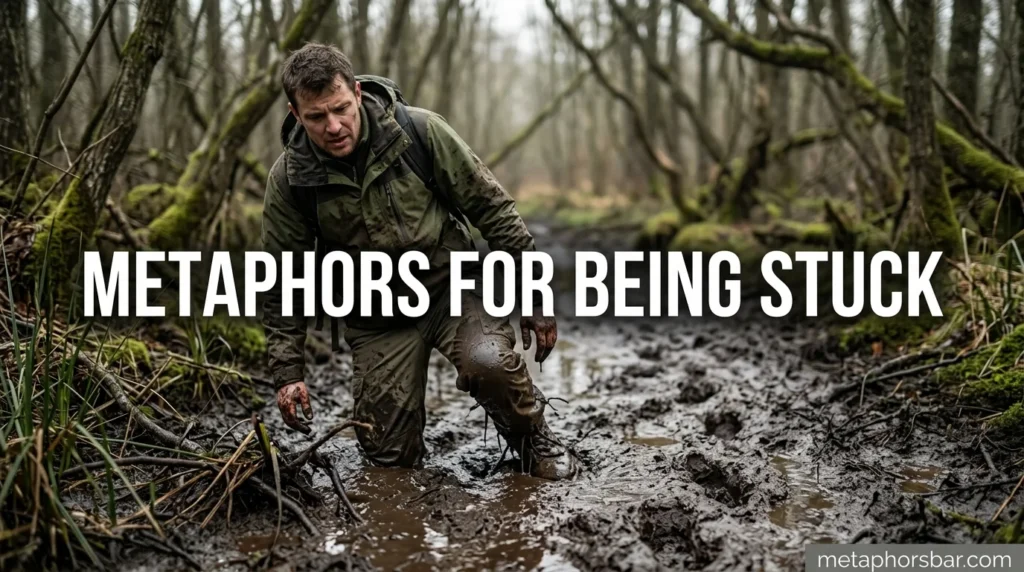
The feeling of being stuck rarely announces itself all at once. More often, it sneaks in quietly: the same thoughts looping in the same order, the same unfinished task waiting on the desk, the same question returning when you thought you had already answered it. It can feel like standing in a room where every door is closed, or like trying to walk through mud that keeps holding your feet in place. Being stuck is not always dramatic, but it can be heavy, frustrating, and strangely exhausting.
That is why metaphors for being stuck are so useful. They give shape to a feeling that is often difficult to explain. Stuckness can be emotional, mental, creative, relational, or practical. A good metaphor helps us see what kind of stuck we mean: trapped, tangled, frozen, stalled, or spinning in circles. It makes the invisible visible, and that can be the first step toward movement again.
Whether you are writing a poem, a journal entry, a short story, a social media caption, or simply trying to put a feeling into words, metaphors for being stuck can make your language more vivid, honest, and memorable.
Why Metaphors for Being Stuck Matter in Writing and Reflection
They help explain a hard-to-name feeling
Being stuck is often a mix of frustration, fatigue, confusion, and impatience. A metaphor can gather all of that into one image readers can picture.
They show the kind of stuckness you mean
Sometimes stuck feels like being trapped. Sometimes it feels like inertia, Sometimes it feels like being tangled up or frozen in place. The metaphor helps reveal the exact shape of the experience.
They make writing more memorable
A sentence like “I feel stuck” is clear, but a sentence like “I feel like a wheel spinning in mud” creates an image the reader can feel.
Three Powerful Metaphors for Being Stuck
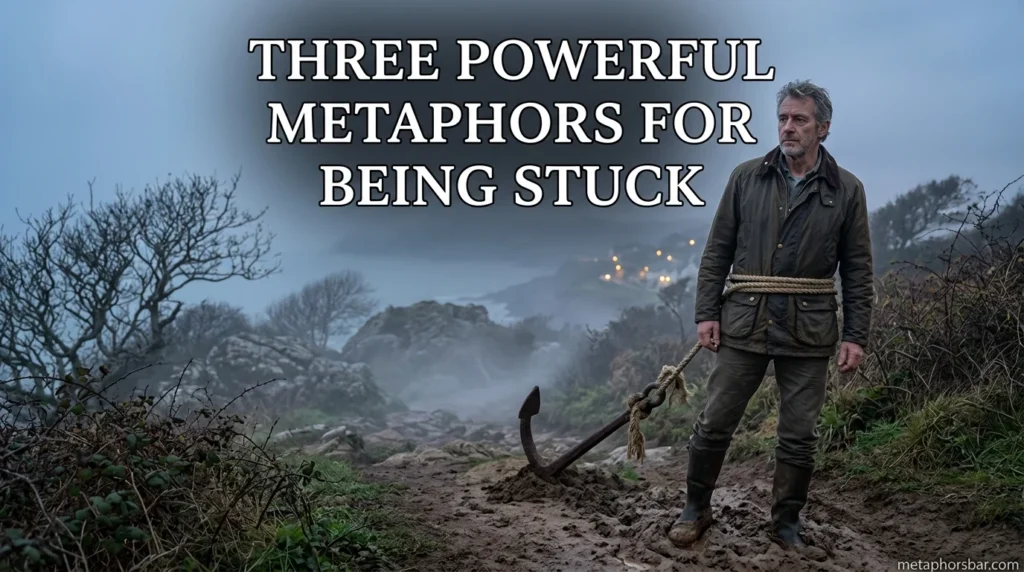
1. Being Stuck as a Wheel Spinning in Mud
A wheel spinning in mud is one of the clearest images for stuckness because it shows motion without progress. The wheel is trying. It is moving. But the mud keeps it from going anywhere. This metaphor is especially useful when you want to describe effort that is real but not effective yet.
Meaning and explanation
This metaphor suggests frustration, repetition, and the exhaustion of trying hard without seeing results. It works well for situations where someone is working, thinking, or hoping—but nothing is changing. The mud represents resistance, and the spinning wheel represents effort that cannot find traction.
It is a powerful image because it shows that being stuck is not always laziness. Sometimes it is effort trapped in the wrong conditions.
Example sentence or scenario
For weeks, her job search felt like a wheel spinning in mud—every application, interview, and revision of her résumé seemed to go nowhere.
This metaphor is especially effective in writing about career frustration, creative blocks, or any situation where progress feels blocked by unseen resistance.
Alternative ways to express it
- tires sinking in soft ground
- effort caught in the muck
- spinning without traction
Sensory and emotional details
You can imagine wet earth, a slick tire slipping, the low churn of effort, and the frustrating sight of no distance covered. Emotionally, this metaphor feels tiring, muddy, and discouraging. It suggests being stuck in a way that is both active and helpless.
Mini storytelling touch
A writer once described her blocked novel as “my brain had the engine on, but the wheels were sunk halfway into the ground.” That image works because it shows that being stuck can happen even when there is still energy present. The problem is not always the will to move—it is the inability to gain traction.
2. Being Stuck as a Room with No Windows
A room with no windows feels sealed, stale, and cut off from the outside world. As a metaphor for being stuck, it suggests mental or emotional confinement, especially when a person cannot see a way forward or feel any fresh air of possibility. This image works beautifully when stuckness feels internal, quiet, and isolating.
Meaning and explanation
This metaphor emphasizes enclosure and lack of perspective. A window usually offers light, air, and a view. Without one, a room can feel closed, repetitive, and difficult to breathe in. As a metaphor, it captures the experience of being inside a problem with no clear opening.
It is especially useful when someone feels trapped in thoughts, routines, or emotions that do not seem to lead anywhere.
Example sentence or scenario
After months of the same routines and unanswered questions, his life felt like a room with no windows—silent, sealed, and hard to breathe in.
This metaphor works well in reflective writing, poetry, and descriptions of depression, burnout, or creative confinement.
Alternative ways to express it
- a sealed chamber
- a wall with no opening
- a box without a door
- a room of stale air
- a space with no horizon
Sensory and emotional details
You can picture dim light, stale air, stillness, and the faint ache of wanting fresh wind. Emotionally, this metaphor feels closed, lonely, and quiet in a heavy way. It suggests being stuck not only in place, but in perspective.
Mini storytelling touch
A student once said her anxiety felt like “thinking inside a locked attic.” That image stayed with her teacher because it was so precise. A room without windows captures that same feeling: the sense that you can’t quite see beyond the walls around you.
3. Being Stuck as Roots Growing Around a Stone
Roots are meant to grow, reach, and feed life. But when roots grow around a stone, they can become tangled in something they cannot move. This metaphor is especially rich because it suggests stuckness that has developed over time. It works well for emotional patterns, habits, relationships, or fears that have become deeply embedded.
Meaning and explanation
This image suggests that being stuck is not always sudden. Sometimes it forms slowly as we grow around obstacles instead of past them. The stone represents whatever is blocking movement, while the roots represent the parts of us that keep adapting around it. This creates a powerful metaphor for long-term stuckness that feels rooted, complicated, and hard to undo.
Example sentence or scenario
Her fear of failure had become like roots growing around a stone—deep, tangled, and impossible to remove without disturbing everything else.
This metaphor works beautifully in essays, memoirs, and reflective writing about long-term emotional or psychological stuckness.
Alternative ways to express it
- roots wrapped around a rock
- growth trapped by what it surrounds
- a buried obstacle in the soil of the self
Sensory and emotional details
You can imagine damp earth, rough stone, twisting roots, and the slow pressure of growth around resistance. Emotionally, this metaphor feels patient, complicated, and a little painful. It suggests that being stuck can become part of the shape of a life.
Mini storytelling touch
An older man once described his habit of avoiding difficult conversations as “a tree that had learned to grow around a fence.” That image is striking because it shows how stuckness can become adapted into our lives. We do not always notice the obstacle until we realize we have been growing around it for years.
How to Choose the Right Metaphor for Being Stuck
Use wheel in mud when the stuckness feels active but ineffective
Choose this metaphor when there is effort, energy, or repeated trying that still goes nowhere.
Use a room with no windows when the stuckness feels emotional or mental
This is the best choice when the feeling is of enclosure, isolation, or lack of perspective.
Use roots around a stone when the stuckness is deep and long-term
Choose this image when the obstacle has become embedded over time and is difficult to separate from growth itself.
The best metaphor depends on the kind of stuckness you want to describe. Stuck can spin, seal, or root—and each image gives the feeling a different kind of truth.
Interactive Exercises for Practicing Metaphors for Being Stuck
Exercise 1: Complete the sentence
Finish this prompt in three different ways:
“I felt stuck like ______ because ______.”
Try one answer that feels physical, one that feels emotional, and one that feels symbolic.
Example: I felt stuck like a wheel spinning in mud because I was working hard but not getting any closer to where I wanted to go.
Exercise 2: Sensory mapping
Think of a time when you felt stuck. Write down:
- one sound
- one texture
- one color
- one shape
- one emotion
Then turn those details into a metaphor.
For example: It sounded like a tire slipping in wet soil, felt like a sealed room, looked like gray walls, had the shape of tangled roots, and carried the emotion of frustration mixed with fatigue.
Exercise 3: Story starter
Begin a short paragraph with:
“Being stuck felt like…”
Let the image guide the tone. You can make it poetic, honest, reflective, or blunt.
Exercise 4: Journal or caption prompt
Try writing a one-line reflection:
- “I am a wheel that needs better ground.”
- “My mind feels like a room waiting for a window.”
- “Some stuckness is just roots growing around a stone.”
Bonus tips for using metaphors for being stuck in writing, social media, and daily life
In writing
Use these metaphors in fiction, essays, memoirs, and poems to make frustration and stagnation feel more vivid and emotionally true.
On social media
A short metaphor can make a post about burnout or a difficult season feel more relatable. “I feel like a wheel in mud today” is more expressive than “I’m stuck.”
In everyday conversation
Metaphors can help explain your feeling without overexplaining it. Saying “I feel like I’m in a room with no windows” can communicate the emotional weight of stuckness clearly.
In journaling
If you are trying to understand a block in your life, metaphor can help you see whether it is about effort without traction, confinement without perspective, or deep-rooted patterns.
Keep the image honest
The strongest stuck metaphor is the one that truly matches the kind of stuckness you are experiencing. Some blocks are temporary. Some are emotional, Some are deeply rooted. Let the image fit the truth.
FAQs
1. What is a metaphor for being stuck?
A metaphor for being stuck is a figurative comparison that describes stagnation or frustration using another image, such as a wheel in mud, a windowless room, or roots around a stone.
2. Why are metaphors for being stuck useful?
They help make a hard-to-name feeling easier to understand, picture, and express in writing or speech.
3. What is a simple metaphor for being stuck?
A simple example is: Being stuck is like a wheel spinning in mud. It suggests effort without movement.
4. Can these metaphors be used in fiction or essays?
Yes. They are especially effective in fiction, memoir, essays, and poetry because they make internal struggle visible.
5. How do I create my own metaphor for being stuck?
Think about how stuckness feels—trapped, tangled, frozen, or spinning—and compare it to something with similar qualities.
6. Are these metaphors only for serious writing?
No. They can also be used in captions, journals, conversations, and creative prompts.
7. What makes a strong metaphor for being stuck?
A strong metaphor is vivid, emotionally accurate, and easy to picture. It should help the reader feel the stuckness, not just label it.
Conclusion
Being stuck can feel frustrating because it often combines effort with no progress, motion with no direction, or growth with no opening. That is why metaphors are so valuable—they help us understand the shape of the pause, the pressure, and the longing to move again.
A wheel in mud captures effort without traction. A room with no windows captures enclosure and the loss of perspective. Roots growing around a stone capture deep, long-term stuckness that has become part of the landscape. Together, these images remind us that stuckness is not one thing—it is a state with many forms.
So when you write about being stuck, do not settle for the plain word alone. Let it spin, seal, or root through your language. A good metaphor can turn frustration into clarity—and sometimes, that is the first small move toward forward motion.