
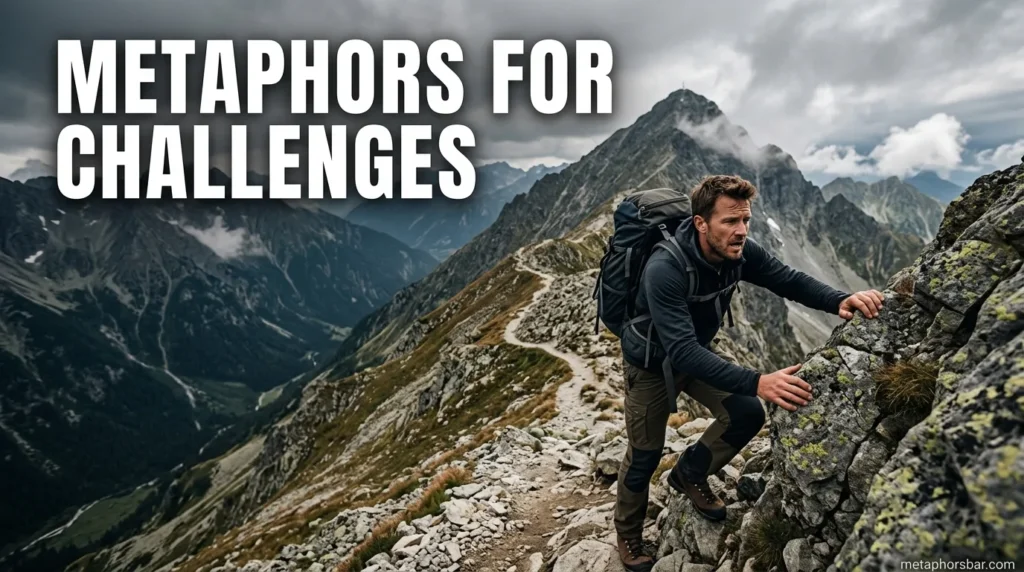
The night before a big decision can feel almost physical. Your thoughts circle like wind around a closed window. Your chest tightens. The path ahead looks dim, but you know you cannot stay still forever. Challenges often arrive this way—not as neat lessons, but as heavy, messy, human moments that ask more of us than we feel ready to give.
And yet, challenges are where growth happens. They test patience, reveal character, and often shape us more than easy days ever could. That is why metaphors for challenges are so useful. They give form to something that can otherwise feel vague, overwhelming, or impossible to explain. A challenge can become a mountain, a maze, a storm, a locked door, a climb, or a fire. With the right image, the struggle becomes easier to see, discuss, and even endure.
Whether you are writing creatively, speaking motivationally, journaling through a hard season, or trying to make sense of your own life, metaphors can turn difficulty into something vivid, memorable, and deeply human.
Why Metaphors for Challenges Matter in Writing and Daily Life
Challenges Are Easier to Understand When They Have Shape
A challenge is not just “something hard.” It can be uncertainty, delay, fear, disappointment, pressure, or the long effort of not giving up. Metaphors help organize those feelings into a picture the mind can hold.
Metaphors Can Make Struggle Feel Less Isolated
When you describe a challenge as a storm, a climb, or a maze, readers recognize the shared human experience inside it. They feel less alone in their own difficulty because the image says, in effect, “Yes, this is hard—and it is a kind of hard many people know.”
Metaphors Can Carry Hope, Not Just Burden
The best challenge metaphors do more than show hardship. They suggest movement, endurance, and the possibility of getting through it. They remind us that hard things are often temporary, and that progress can happen one step at a time.
Challenges as a Mountain: A Metaphor for Steep Effort and Determination
Meaning and Explanation
One of the most powerful metaphors for challenges is the mountain. Mountains are tall, demanding, and impossible to ignore. They represent effort, endurance, and the feeling of having to climb something that cannot be rushed.
This metaphor works especially well when a challenge takes time, discipline, and repeated effort. A mountain is not conquered in one leap. It is climbed slowly, step by step, with pauses, breath, and patience.
Example Sentence or Scenario
The project felt like a mountain rising in front of her, but she kept climbing, one careful step at a time.
This image fits many real-life situations: studying for a difficult exam, recovering from illness, building a business, or learning a new skill that takes patience and persistence.
Alternative Ways to Express It
- a steep climb
- a towering peak
- a long ascent
- a summit of effort
- a hill that keeps rising
Sensory or Emotional Details
You can feel the strain in your legs, the weight of the air, the wind at the top, the uneven ground beneath your feet. Emotionally, this metaphor carries grit, courage, and perseverance. It says: this is hard, but it is not impossible.
Mini Storytelling Touch
A student once failed her first attempt at a major exam and nearly gave up. But her teacher told her, “You are not at the top yet—you are on the mountain.” That small shift changed everything. She stopped seeing herself as defeated and started seeing herself as someone still climbing.
Literary or Cultural Reference
Mountains appear constantly in literature and culture because they symbolize trial, ambition, and transformation. In myths, heroes often climb mountains to prove their strength or discover something essential about themselves.
Challenges as a Maze: A Metaphor for Confusion and Problem-Solving
Meaning and Explanation
A maze is a strong metaphor for challenges that feel confusing, complicated, or hard to navigate. Unlike a mountain, a maze does not only test strength. It tests patience, attention, and the ability to find direction when the path keeps changing.
This metaphor works well when the challenge involves uncertainty, mixed signals, or many possible wrong turns. A maze captures the emotional frustration of not knowing which way to go, while also suggesting that progress is possible if you keep looking.
Example Sentence or Scenario
Trying to fix the broken relationship felt like walking through a maze with no map, each conversation leading to more questions than answers.
You might use this metaphor for bureaucracy, decision-making, career confusion, family conflict, or any situation where the path forward is unclear.
Alternative Ways to Express It
- a winding puzzle
- a path full of dead ends
- a twisting corridor
- a loop of uncertainty
- a room of locked doors
Sensory or Emotional Details
You can imagine echoing footsteps, dim passageways, walls close on either side, and the uneasy feeling of doubling back. Emotionally, this metaphor often feels tense, frustrating, and mentally exhausting. But it can also feel strategic and hopeful, because mazes can be solved.
Mini Storytelling Touch
A small business owner once described tax season as “a maze written in a language I do not speak.” At first, the paperwork felt endless. But after asking for help, making a checklist, and following one section at a time, the maze began to open. Not all at once—but enough to keep going.
Real-Life Example
Many people use maze imagery to describe systems that feel confusing, like job searches, hospital forms, or family decisions. It fits any challenge where the difficulty comes not from one large obstacle, but from the lack of clarity.
Challenges as a Storm: A Metaphor for Intensity, Chaos, and Survival
Meaning and Explanation
A storm is one of the most vivid metaphors for challenge because it suggests speed, force, and emotional turbulence. Storms arrive loudly. They shake things. They can feel overwhelming while they last, but they also pass.
This metaphor is especially effective for personal crises, emotional upheaval, conflict, or any season that feels wild, painful, or beyond control. It reminds us that some challenges are not about solving everything immediately. Sometimes they are about enduring until the weather changes.
Example Sentence or Scenario
The loss hit like a storm, loud and sudden, leaving her standing in the wreckage of what had been familiar.
You could use this for grief, conflict, burnout, major life transitions, or any difficult period that comes with shock and instability.
Alternative Ways to Express It
- a thunderous season
- a wave of trouble
- dark clouds overhead
- a wind that uproots everything
- a weather front of pain
Sensory or Emotional Details
You can hear thunder, feel the wind, see rain lashing against windows, and sense the world changing shape in real time. Emotionally, a storm metaphor often carries fear, urgency, and exhaustion. But it also carries the quiet promise that storms do not last forever.
Mini Storytelling Touch
A father once told his daughter after a difficult year, “This is the storm. The storm is not the whole sky.” Years later, she still remembered that line when life felt unmanageable. It helped her separate the chaos of the moment from the larger truth of her life.
Literary or Cultural Reference
Storms have long been used in literature to symbolize conflict, turmoil, and revelation. They often mark the moment when hidden truths come to light, or when a character is forced to change.
How to Choose the Right Metaphor for Challenges
Choose the Mountain for Slow, Steady Effort
Use the mountain image when the challenge demands endurance, discipline, and patience. It is ideal for long-term goals and difficult progress.
Choose the Maze for Confusing, Twisting Problems
Use the maze image when the challenge is about uncertainty, complexity, or not knowing the next step.
Choose the Storm for Intense, Emotional Hardship
Use the storm image when the challenge feels overwhelming, disruptive, or emotionally charged.
The best metaphor depends on the kind of struggle you want to describe. Some challenges are physical. Some are mental, Some are emotional. The image should match the reality.
Interactive Exercises to Practice Challenge Metaphors
Exercise 1: Name Your Challenge
Think of a challenge you have faced recently. Complete this sentence:
“This challenge feels like ______ because ______.”
Example: “This challenge feels like a mountain because every small step matters and the top still feels far away.”
Exercise 2: Sensory Mapping
Write five words connected to a challenge:
- one sound
- one texture
- one color
- one movement
- one emotion
Then turn them into a metaphor.
Example: The challenge sounded like distant thunder, felt like rough stone, looked like gray fog, moved like a storm tide, and carried the emotion of fear mixed with determination.
Exercise 3: Story Starter
Begin a short paragraph with:
“The challenge was like…”
Let the image guide the tone. You can make it hopeful, raw, reflective, or dramatic.
Exercise 4: Social Media Caption Practice
Try turning a challenge metaphor into a caption or short reflection.
Examples:
- “Still climbing.”
- “Finding the path through the maze.”
- “Weathering the storm, one day at a time.”
Bonus Tips for Using Metaphors for Challenges in Writing, Social Media, and Daily Life
In Writing
Challenge metaphors are especially useful in essays, memoirs, fiction, and speeches. They can show emotional depth without long explanations.
On Social Media
A short metaphor can make a post about difficulty or growth feel more relatable and powerful. A line like “This season feels like a climb, but I’m still moving” can resonate quickly.
In Daily Life
Metaphors can help you explain hard experiences to others without feeling overly clinical or flat. They give your emotions a shape you can point to.
For Self-Reflection
Writing challenge metaphors in a journal can help you process what you are facing. Sometimes saying “I feel like I am in a maze” makes the problem easier to understand.
Keep It Honest
The strongest metaphors are the ones that match your actual experience. Don’t force a metaphor to sound inspirational if the moment feels messy. Let the image be true.
FAQs
1. What is a metaphor for challenges?
A metaphor for challenges is a figurative comparison that describes hardship, struggle, or difficulty using another image, such as a mountain, maze, or storm.
2. Why are metaphors for challenges useful?
They make difficult experiences easier to understand, more vivid, and more emotionally resonant.
3. Can challenge metaphors be positive?
Yes. They can show strength, progress, and the hope of getting through difficult seasons.
4. What is a simple metaphor for challenges?
A simple example is: Challenges are mountains. It clearly suggests effort, endurance, and gradual progress.
5. How do I create my own challenge metaphor?
Think about what the challenge feels like—steep, confusing, intense, heavy, or slow—and compare it to something with similar qualities.
6. Are challenge metaphors only for poetry?
No. They are useful in essays, stories, motivational writing, journaling, and everyday conversations.
7. What makes a strong challenge metaphor?
A strong metaphor is vivid, emotionally accurate, and easy for the reader to picture.
Conclusion
Challenges can feel endless when we are in the middle of them. They can look like mountains, twist like mazes, or roar like storms. But metaphor gives those experiences shape, and shape makes them easier to face.
A mountain reminds us to keep climbing. A maze reminds us to keep searching. A storm reminds us to wait for clearer weather. Together, these images tell the truth about struggle: it is real, it is difficult, and it does not last forever.
So when you need to write about challenges, do not settle for plain description alone. Choose an image that carries the weight of what you mean. Let your words climb, turn, or thunder with purpose. Because sometimes, the best way to move through hardship is first to find the right metaphor for it.