
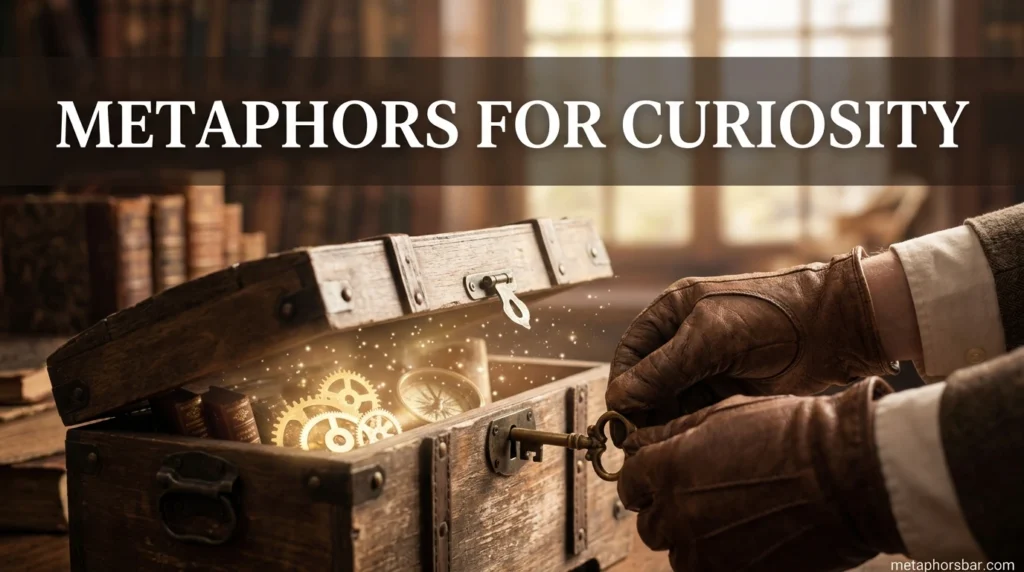
Metaphors for Curiosity – A Spark That Refuses to Stay Still
A Door Half-Open in a Quiet House
There’s a moment in life when curiosity doesn’t arrive loudly—it whispers. Like standing in an unfamiliar house where every room is silent, and one door is slightly ajar. A soft glow slips through the crack. You don’t know what’s inside, but your hand moves before your mind finishes the thought.
That is curiosity: not a decision, but a pull.
As a child, maybe you remember touching everything you weren’t supposed to touch—opening drawers that “weren’t yours,” asking “why” until adults ran out of patience. Or perhaps as an adult, you’ve felt it while scrolling an article you didn’t plan to read, suddenly ten tabs deep into something you didn’t even know you needed to know.
Curiosity is the mind leaning forward before permission is granted.
Why These Metaphors Matter
Metaphors for curiosity help us understand something invisible but deeply powerful. Curiosity drives learning, creativity, innovation, and even survival. Without it, questions fade. With it, entire worlds open.
In writing, speaking, teaching, or content creation, vivid metaphors turn curiosity from an abstract idea into something you can see, feel, and follow.
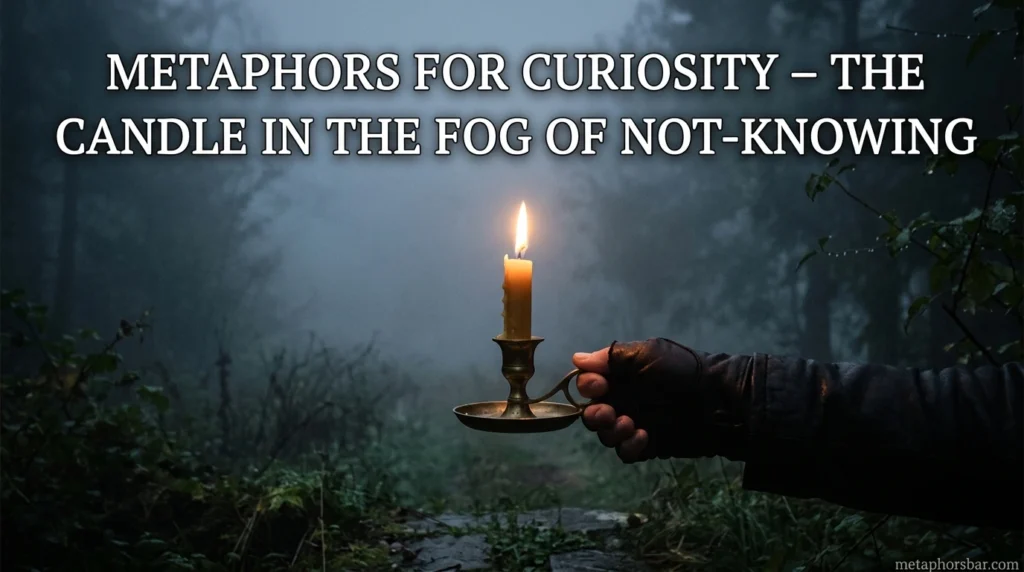
Metaphors for Curiosity – The Candle in the Fog of Not-Knowing
Meaning: A Light That Grows as You Walk
Curiosity is often described as a candle moving through fog. The more you step forward, the more light reveals itself—but only just enough to keep you moving.
It doesn’t show the entire path. It rewards movement, not hesitation.
This metaphor reflects how curiosity works in real life: you don’t discover answers by staying still—you discover them by following the faint glow of “what if?”
Example Sentence / Scenario
She started reading one article about ancient ships, and soon her curiosity became a candle in fog, lighting up forgotten histories she never planned to explore.
Alternative Expressions
- A lantern in the unknown
- A flicker guiding uncertain steps
- A match struck in darkness
- A compass made of light
Sensory & Emotional Detail
Imagine damp air on your skin, silence pressing in, and a small flame trembling in your hand. You feel both vulnerable and alive—because the unknown is no longer empty, just unlit.
Mini Storytelling Moment
Think of early explorers sailing into uncharted oceans. No maps. Just stars, instincts, and burning curiosity. Every wave was a question; every horizon, an answer waiting to be written.
Metaphors for Curiosity – A Lock Picking Itself Open
Meaning: Questions That Unlock More Questions
Curiosity can be imagined as a lock that doesn’t need a key—it teaches you how to open it as you approach. Every answer shifts the mechanism slightly, revealing a deeper chamber behind it.
Unlike satisfaction, curiosity refuses closure. It multiplies doors instead of closing them.
Example Sentence / Scenario
His curiosity was like a lock picking itself open; every explanation he found only revealed three new mysteries waiting behind it.
Alternative Expressions
- A puzzle that reshapes itself
- A maze that grows as you walk
- A key that teaches you new locks
- A question that breeds more questions
Cultural Reference
This mirrors the spirit of ancient philosophical inquiry—like Socrates, who didn’t offer final answers but instead opened intellectual doors that led others deeper into thought.
Sensory & Emotional Detail
There’s a clicking sound in your mind—small realizations unlocking bigger unknowns. It’s both frustrating and thrilling, like standing in a hallway where every door whispers your name.
Interactive Writing Prompt
Try this:
- Write a scene where a character finds an answer
- Then force that answer to create three new questions
- Keep going for five layers
Notice how curiosity expands instead of resolves.
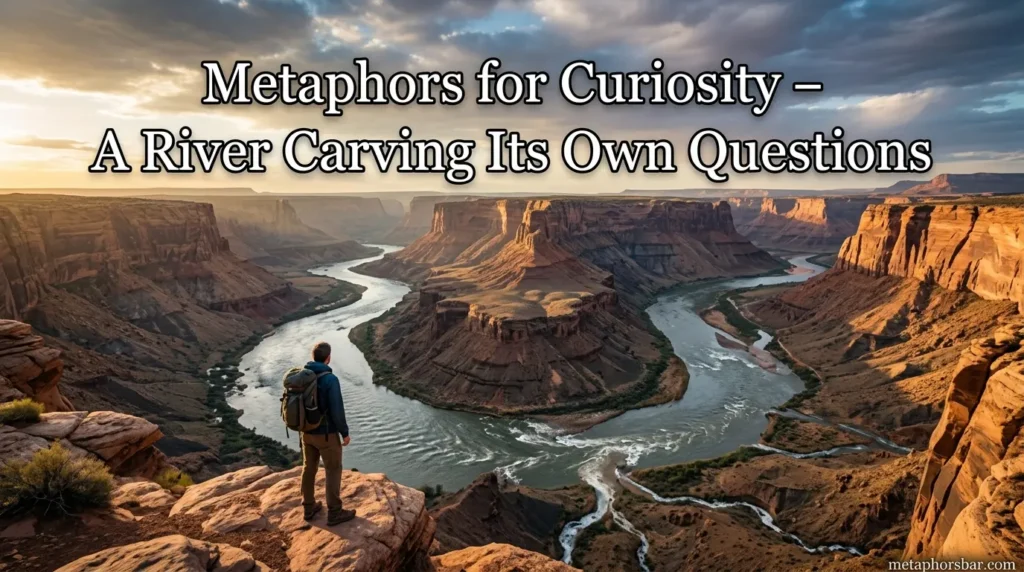
Metaphors for Curiosity – A River Carving Its Own Questions
Meaning: Flow That Shapes the Landscape of Thought
Curiosity is like a river that doesn’t just travel through land—it reshapes it. It carves valleys, bends paths, and slowly rewrites geography.
It doesn’t rush to the ocean of “knowing,” It enjoys the journey of erosion and discovery.
Example Sentence / Scenario
Her curiosity flowed like a river carving stone, slowly reshaping her understanding of people she once thought she knew completely.
Alternative Expressions
- A stream cutting through silence
- Water shaping stone with patience
- A current of endless inquiry
- A wandering river of thought
Real-Life Example
A scientist studying a simple plant may begin with curiosity about leaves—but over time, that curiosity flows into genetics, ecosystems, climate systems, and even philosophy. One stream becomes an entire watershed of knowledge.
Sensory & Emotional Detail
Imagine cool water brushing against stone, persistent yet gentle. There’s no violence in its movement—only inevitability.
Mini Storytelling Moment
A child follows a stream near their home, dropping leaves and watching them drift. Years later, that same child becomes a hydrologist—not because of a decision, but because curiosity never stopped flowing.
Metaphors for Curiosity – Creative Practice and Everyday Application
Interactive Curiosity Exercises
Try these to strengthen imaginative thinking:
- Look at any object near you (a pen, phone, cup) → Ask “What is the hidden story of this object?”
- Take a simple word like “light” or “door” → Create 5 metaphors for curiosity using it
- Scroll social media for 2 minutes → Pick one random post and write “what led here?” backstory
Bonus Tips for Writing and Social Media
- Use curiosity metaphors in hooks: “Curiosity is a candle in fog—this is what it revealed…”
- Turn explanations into imagery instead of definitions
- Use metaphors to create emotional momentum in blogs or captions
- Pair curiosity with mystery to increase engagement
- In storytelling, let curiosity be the “character” that drives action
Metaphors for Curiosity – FAQs
1. What are metaphors for curiosity used for?
They help describe curiosity in vivid, emotional ways, making abstract thinking easier to understand and more engaging in writing or speech.
2. Why is curiosity often compared to light or fire?
Because both represent guidance, energy, and discovery in darkness or uncertainty.
3. How can metaphors improve writing about curiosity?
They transform plain explanations into imagery that readers can feel, making content more memorable and impactful.
4. Can curiosity be described as negative in metaphors?
Yes. It can be a storm, itch, or maze—showing its restless or overwhelming side.
5. What is the best metaphor for curiosity?
There’s no single best one, but “a candle in fog” and “a river carving stone” are among the most versatile.
6. How do I create my own curiosity metaphors?
Start by pairing curiosity with movement, light, or tension—then imagine how it behaves like a physical object or force.
7. Where can I use these metaphors?
In essays, storytelling, social media captions, speeches, teaching, or even journaling to enrich expression.
Conclusion
Curiosity is not a single moment—it is a motion. It is the quiet lean toward the unknown, the hand reaching for a half-open door, the river that refuses to stop reshaping its path.
Through metaphors, curiosity becomes something we can see and feel: a candle in fog, a lock that teaches itself, a river carving stone. Each image reminds us that curiosity is not about arriving—it is about continuing.
And perhaps the most important truth is this: curiosity never really ends. It only changes shape.