
A room full of identical voices can feel orderly, but a room full of different ones can feel alive. One person speaks softly, another with laughter in their words, another with careful pauses, and somehow the mix does not create confusion—it creates texture. Difference is often what gives the world its color, movement, and surprise. A good metaphor can help us see that.
That is why metaphors for different matter. The idea of being different can be beautiful, complicated, lonely, exciting, or all of those at once. A strong metaphor helps turn the abstract idea of difference into something readers can picture, feel, and remember. It can show contrast, individuality, diversity, and the quiet strength of not being the same.
Whether you are writing a poem, an essay, a speech, a caption, or a personal reflection, metaphors for different can make your language more vivid, more thoughtful, and more human.
Why Metaphors for Different Matter in Writing and Communication
They make an abstract idea easier to picture
“Different” is a simple word, but the experience behind it can be layered. A metaphor gives difference a visible shape.
They help show the kind of different you mean
Different can mean unusual, unique, contrasting, independent, or even misunderstood. The right metaphor helps clarify that shade of meaning.
They make writing more memorable
A sentence like “she was different” tells the reader the fact. A sentence like “she was a prism, splitting ordinary light into color” leaves a lasting image.
They can make difference feel meaningful
Metaphors help readers see that being different is not only about standing apart; it can also mean adding something new, rich, or necessary.
Three Powerful Metaphors for Different
1. Different as a Patchwork Quilt
A patchwork quilt is made from many pieces that do not match perfectly, and that is exactly why it is beautiful. Each patch has its own color, texture, and history, but together they form something warm, useful, and whole. This is one of the most powerful metaphors for difference because it shows that variety can become unity without losing individuality.
Meaning and explanation
When difference is compared to a patchwork quilt, the focus is on many distinct parts coming together in a meaningful way. No piece needs to look like the others. In fact, the contrast between them is what makes the whole more interesting. This metaphor works especially well when you want to describe people, communities, families, or ideas that are diverse yet connected.
It also suggests care. Quilts are sewn with patience and attention, often by hand. That makes this image especially warm and tender when you want difference to feel not only acceptable, but cherished.
Example sentence or scenario
Their friendship was a patchwork quilt of different habits, accents, and dreams, stitched together by loyalty and time.
This metaphor works beautifully in essays, community writing, and reflections on identity or belonging.
Alternative ways to express it
- a stitched pattern of contrasts
- a woven mix of colors
- a blanket of many pieces
- a handmade mix of differences
- a fabric of distinct threads
Sensory and emotional details
You can imagine soft fabric, mismatched patterns, the quiet rhythm of stitching, and the comfort of something warm and handmade. Emotionally, this metaphor feels cozy, inclusive, and deeply human. It suggests that difference can be something to wrap ourselves in.
Mini storytelling touch
A grandmother once saved fabric scraps from every family milestone—a baby blanket, a school uniform, a wedding handkerchief. Years later, she turned them into a quilt. “It looks mismatched,” she said, “but so did our family, and that’s why it works.” That story captures the heart of this metaphor: difference is not a flaw in the pattern; it is often the pattern itself.
Literary or cultural reference
Quilts appear often in literature and folk tradition as symbols of memory, home, and shared life. As a metaphor for different, the quilt suggests that contrast can be both practical and beautiful.
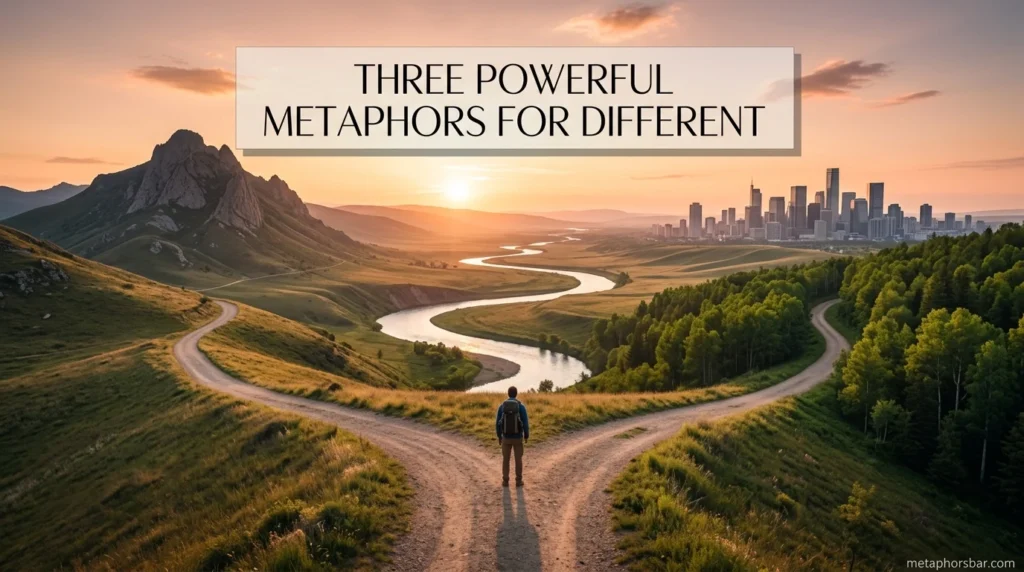
2. Different as a Fork in the Road
A fork in the road suggests choice, separation, and the moment when one path becomes two. As a metaphor for different, it works especially well when something or someone does not follow the expected route. It captures divergence, independence, and the idea that being different can lead to a new direction.
Meaning and explanation
When difference is compared to a fork in the road, the image emphasizes separation without loss of value. Two paths may split, but neither is necessarily wrong. They are simply not the same. This metaphor is useful when you want to describe people, decisions, or life experiences that branch away from the familiar.
It also suggests possibility. A fork in the road is not just a departure; it is an opening. That makes this image especially useful when difference feels like a turning point rather than a problem.
Example sentence or scenario
Her idea was a fork in the road, different from the rest but exactly what the team needed to move forward.
This metaphor works well in career writing, personal essays, and stories about individuality or change.
Alternative ways to express it
- a path that bends away
- a road that splits in two
- a turning point of difference
- a separate way forward
- a branch off the familiar
Sensory and emotional details
You can imagine standing at a dusty crossroads, the wind moving across open land, and the quiet tension of choosing one direction over another. Emotionally, this metaphor feels uncertain, bold, and full of possibility. It suggests that difference can be a decision, a direction, or a way of becoming.
Mini storytelling touch
A young artist once left a safe job to pursue painting. People said she had taken the hard road. She replied, “It just wasn’t the same road.” That line is powerful because it shows how difference can be about direction rather than value. The fork in the road metaphor reminds us that not every path has to look alike to matter.
Literary or cultural reference
Road imagery has long symbolized life choices and personal identity in literature and folklore. A fork in the road is one of the clearest symbols of divergence, making it a natural metaphor for difference.
3. Different as a Prism
A prism takes in one beam of light and separates it into many colors. As a metaphor for different, it is especially elegant because it shows that difference can come from a single source and still create something beautifully varied. It works well when you want to describe diversity, perspective, or the way one thing can reveal many sides of itself.
Meaning and explanation
When difference is compared to a prism, the image suggests transformation through variation. The light does not disappear when it splits; it becomes visible in more forms. That makes this metaphor perfect for describing people, ideas, or cultures that contain many shades, layers, or interpretations.
This image is especially useful when you want to show that being different does not mean being divided. It can mean revealing more of what was already there.
Example sentence or scenario
The classroom was a prism of different voices, each one catching the same lesson and turning it into something new.
This metaphor works especially well in writing about diversity, creativity, and perspective.
Alternative ways to express it
- a lens of many colors
- a beam turned into spectrum
- a crystal that reveals variety
- a light split into shades
- a spectrum of one source
Sensory and emotional details
You can imagine sunlight passing through glass and breaking into red, blue, gold, and violet. Emotionally, this metaphor feels bright, intelligent, and expansive. It suggests that difference is not a loss of unity but a reveal of hidden richness.
Mini storytelling touch
A teacher once held a small prism to the classroom window and let the colored light spread across the desk. The children gasped. “It’s the same light,” one of them said, “but it’s not the same anymore.” That is exactly what makes the prism such a powerful metaphor for difference. It shows that variation can be a form of revelation.
Literary or cultural reference
Prisms often appear in science and art as symbols of transformation, perception, and hidden beauty. As a metaphor for different, the prism is especially rich because it suggests that one source can hold many forms.
How to Choose the Right Metaphor for Different
Use patchwork quilt when you want to show difference as belonging
Choose this metaphor when many distinct pieces still form one warm, connected whole.
Use fork in the road when you want to show difference as a separate path
This is the best choice when difference means a turn, a choice, or a direction away from the familiar.
Use prism when you want to show difference as hidden richness
Choose this image when the emphasis is on how one source can reveal many colors or perspectives.
The best metaphor depends on the kind of difference you want to express. Different can stitch, split, and shine—and each image tells a different truth.
Interactive Exercises for Practicing Metaphors for Different
Exercise 1: Complete the sentence
Finish this prompt in three different ways:
“Being different felt like ______ because ______.”
Try one answer that feels warm, one that feels bold, and one that feels bright.
Example: Being different felt like a prism because one small change in perspective revealed many parts of me I had not seen before.
Exercise 2: Sensory mapping
Think of a time when you felt different from others. Write down:
- one color
- one sound
- one texture
- one place
- one emotion
Then turn those details into a metaphor.
For example: It sounded like footsteps on a separate road, looked like a patch sewn into a quilt, felt like a beam of light through glass, and carried the emotion of both loneliness and pride.
Exercise 3: Story starter
Begin a paragraph with:
“Different was like…”
Let the image guide the tone. You can make it reflective, poetic, hopeful, or direct.
Exercise 4: Journal or caption prompt
Try writing a one-line reflection:
- “Different is a quilt of many threads.”
- “I stood at a fork in the road and chose my own path.”
- “Being different is like light through a prism—one source, many colors.”
Bonus Tips for Using Metaphors for Different in Writing, Social Media, and Daily Life
In writing
Use these metaphors in essays, poems, fiction, and reflections to express individuality, contrast, or diversity in a vivid way.
On social media
A short metaphor can make a caption feel thoughtful and original. “Different is a prism” or “I’m a patchwork quilt” can sound memorable and personal.
In everyday conversation
Metaphors can help you talk about being different in a way that feels more expressive and less flat. Instead of saying “I’m not like the others,” you might say, “I’m a different road.”
In teaching or discussion
These images can help people explore identity, diversity, and belonging without reducing difference to a single label.
Keep the image truthful
The strongest metaphor is the one that genuinely fits the feeling of difference you want to describe. Sometimes difference feels warm and connected, sometimes bold and separate, and sometimes full of hidden light.
FAQs
1. What is a metaphor for different?
A metaphor for different is a figurative comparison that describes difference using another image, such as a patchwork quilt, a fork in the road, or a prism.
2. Why are metaphors for different useful?
They help make the idea of difference easier to understand, picture, and remember in writing or speech.
3. What is a simple metaphor for different?
A simple example is: Different is a prism. It suggests variety, transformation, and hidden richness.
4. Can these metaphors be used in essays or speeches?
Yes. They are especially effective in essays, speeches, poems, and reflections about identity or belonging.
5. How do I create my own metaphor for different?
Think about what difference feels like—connected, separate, bright, unusual, or branching—and compare it to something with similar qualities.
6. Are these metaphors only for positive difference?
No. They can also be used to describe difference that feels uncertain, lonely, or challenging, as long as the tone is respectful and honest.
7. What makes a strong metaphor for different?
A strong metaphor is vivid, emotionally fitting, and easy to imagine. It should help the reader feel the nature of difference, not just label it.
Conclusion
Difference is not one thing. It can be a patch, a path, or a prism. It can connect, separate, or reveal. That is why metaphors matter—they help us describe not just being different, but the beauty and complexity that difference can hold.
A patchwork quilt gives difference warmth and belonging. A fork in the road gives it choice and direction. A prism gives it color and revelation. Together, these images remind us that difference is not something to flatten away—it is something to notice, understand, and often celebrate.
So when you write about difference, do not settle for the obvious. Let it stitch, split, and shine through your words. A good metaphor can make difference feel unforgettable.