
A room full of different voices has its own music. One person speaks gently, another laughs with their whole chest, another pauses before choosing each word, and somehow the mix does not create noise—it creates texture. Diversity often feels like that: a living arrangement of contrasts, histories, and perspectives that can seem separate at first and yet belong to the same moment, the same place, the same human story.
That is why metaphors for diversity matter. Diversity is a broad, meaningful idea, but broad ideas can be difficult to picture unless language gives them shape. A strong metaphor can turn diversity into something readers can see, hear, and feel. It can show not just that people are different, but how those differences can coexist, strengthen one another, and create something richer than sameness ever could.
Whether you are writing an essay, a speech, a classroom lesson, a social media caption, or a reflective piece, metaphors for diversity can make your words more vivid, thoughtful, and memorable.
Why Metaphors for Diversity Matter in Writing and Everyday Language
They make an abstract idea easier to picture
Diversity is not just a statistic or a policy term. It is a lived reality made of culture, language, identity, belief, and experience. Metaphors help transform that complexity into an image the mind can hold.
They encourage nuance instead of simplification
A good metaphor avoids reducing diversity to a slogan. It can show contrast, connection, and the work of belonging all at once.
They make language more memorable
A sentence like “diversity is important” is true, but a sentence like “diversity is a garden of many seasons growing in one soil” leaves a deeper impression.
They help build empathy
When people can imagine diversity as something beautiful, interdependent, and alive, they may be more willing to value it in real life.
Three Powerful Metaphors for Diversity
1. Diversity as a Mosaic
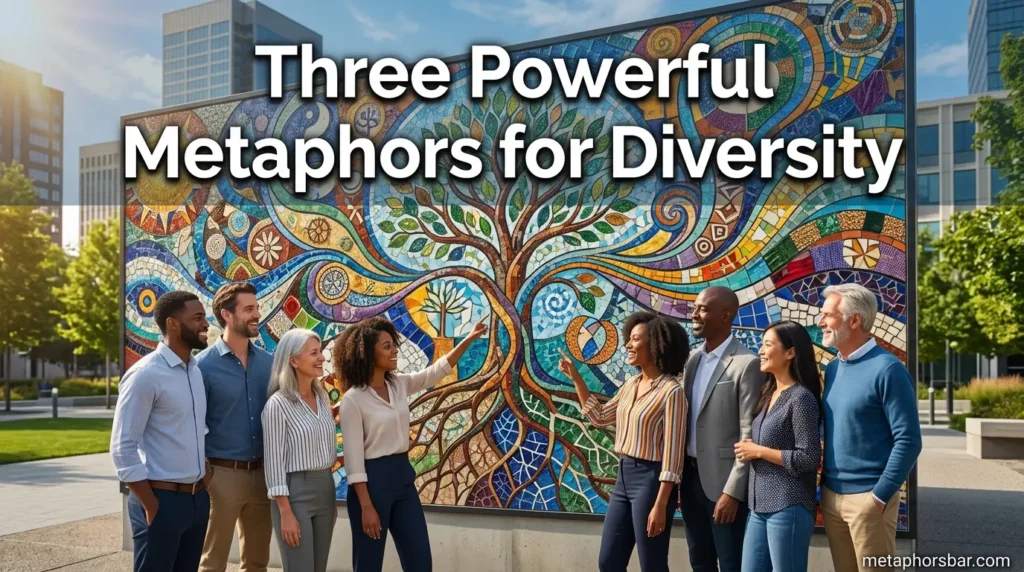
A mosaic is made from many small pieces of different colors, shapes, and textures arranged into one larger picture. This is one of the most effective metaphors for diversity because it shows how difference can form beauty, coherence, and meaning without becoming uniform. Each piece keeps its identity, yet the whole becomes something greater.
Meaning and explanation
When diversity is compared to a mosaic, the emphasis is on distinct parts creating a unified design. No single tile needs to look like the others. In fact, the beauty comes from their differences: some pieces are bright, some muted, some smooth, some jagged, some large, some tiny. Together, they create a pattern that could not exist without variety.
This metaphor is especially useful when you want to show that diversity is not a problem to be solved, but a composition to be honored. It suggests that every person or group contributes something necessary, even if their role is small or different from the rest.
Example sentence or scenario
The city was a mosaic of languages, traditions, and stories, each piece distinct yet part of one shared human picture.
This metaphor works beautifully in essays, cultural writing, and speeches about community, identity, or inclusion.
Alternative ways to express it
- a patchwork of identities
- a living tapestry of difference
- a design made of distinct pieces
- a colorful human pattern
- a composition of many voices
Sensory and emotional details
You can imagine the cool feel of tile, the gleam of glass catching light, and the satisfaction of seeing many fragments become one design. Emotionally, this metaphor feels balanced, inclusive, and quietly radiant. It suggests that diversity is strongest when difference is not hidden but placed where it can be seen.
Mini storytelling touch
A teacher once asked her students to bring one object that represented their home life. One brought a prayer bead bracelet, another a spice tin, another a soccer scarf, another a family recipe card. Spread across the desk, the objects looked mismatched at first. But the teacher smiled and said, “That is our class mosaic.” The children remembered the phrase because it made difference feel like part of a larger picture rather than a collection of exceptions.
Literary or cultural reference
Mosaics appear in ancient architecture, sacred spaces, and public art because they embody unity through variety. As a metaphor for diversity, the mosaic carries both beauty and structure, making it timeless and effective.
2. Diversity as an Orchestra
An orchestra is made of many instruments, each with its own sound, pitch, and role. A violin is not a trumpet, and a flute is not a drum. Yet when they play together with skill and attention, they create harmony. As a metaphor for diversity, the orchestra is powerful because it emphasizes coordination without sameness.
Meaning and explanation
When diversity is compared to an orchestra, the focus is on how distinct voices can contribute to a shared outcome. Not everyone plays the same note, and not everyone should. The beauty lies in listening, timing, and the willingness to let many sounds occupy the same space. This metaphor works especially well for communities, organizations, classrooms, and societies that rely on collaboration.
It also reminds us that harmony does not mean silence or uniformity. In music, harmony is what happens when differences are shaped into something meaningful. That makes the orchestra a rich metaphor for diversity done well.
Example sentence or scenario
The workplace functioned like an orchestra, with each person bringing a different instrument of thought, skill, and experience to the same creative score.
This metaphor is ideal for discussions of teamwork, leadership, community, and shared purpose.
Alternative ways to express it
- a symphony of differences
- a concert of many voices
- harmony in many keys
- a living score of identities
- a composition of distinct sounds
Sensory and emotional details
You can imagine the hum before a performance, the tuning of strings, the deep thrum of percussion, and the way sound fills a hall from many directions. Emotionally, this metaphor feels coordinated, expansive, and hopeful. It suggests that diversity becomes powerful not when differences disappear, but when they are heard clearly and in relation to one another.
Mini storytelling touch
At a school concert, the conductor asked the children to listen not just to their own parts but to the people around them. One child later said it felt like “everyone had a different voice, but the same heartbeat.” That is the essence of the orchestra metaphor. Diversity becomes music when difference is allowed to contribute rather than compete.
Literary or cultural reference
The orchestra has long symbolized collective achievement and disciplined collaboration. As a metaphor for diversity, it shows how many different sources can create one resonant experience without losing individuality.
3. Diversity as a Garden
A garden is one of the most graceful metaphors for diversity because it shows that many kinds of life can grow in one place. Different flowers, herbs, trees, colors, and seasons can share the same soil. Some grow tall, some spread low, some bloom early, some later. The garden metaphor is especially beautiful when diversity is understood as living, changing, and nourished over time.
Meaning and explanation
When diversity is compared to a garden, the emphasis is on growth, care, and coexistence. A garden does not become beautiful because every plant is identical. It becomes beautiful because different plants thrive together in the same environment, each with its own need, scent, color, and rhythm. That makes this metaphor especially useful for describing communities where diversity is not static but cultivated.
It also suggests responsibility. Gardens need tending. Diversity, too, needs attention, protection, and patience. This image works especially well when you want to show that diversity is something living, not merely decorative.
Example sentence or scenario
Their neighborhood was a garden of cultures, where every family added a different bloom to the same shared street.
This metaphor works well in essays, community writing, educational pieces, and speeches about inclusion.
Alternative ways to express it
- a field of many blooms
- a living landscape of difference
- a shared bed of growth
- a garden of voices
- a place where many roots flourish
Sensory and emotional details
You can imagine the smell of soil after rain, the sight of wildflowers beside vegetables, and the hum of bees moving from one blossom to another. Emotionally, this metaphor feels warm, hopeful, and alive. It suggests that diversity is not a finished product but an ongoing act of nurturing.
Mini storytelling touch
A woman who had moved between three countries by the age of eighteen once said, “I thought I belonged nowhere until I realized I was a garden bed, not a single flower.” That image is memorable because it reframes difference as abundance. The garden metaphor is powerful because it makes space for growth in many forms.
Literary or cultural reference
Gardens often symbolize care, renewal, and coexistence in literature and history. As a metaphor for diversity, the garden highlights the beauty of many forms of life sharing one environment.
How to Choose the Right Metaphor for Diversity
Use mosaic when you want to emphasize many parts forming a whole
Choose this metaphor when you want to show that diversity is beautiful, structured, and made meaningful by distinct pieces.
Use orchestra when you want to emphasize collaboration and harmony
This is the best choice when the focus is on how different voices, skills, or cultures can work together in a shared rhythm.
Use garden when you want to emphasize growth and care
Choose this image when diversity feels alive, nurtured, and dependent on patience and support.
The best metaphor depends on what you want to communicate. Diversity can be built, performed, and cultivated—and each image tells a different truth.
Interactive Exercises for Practicing Metaphors for Diversity
Exercise 1: Complete the sentence
Finish this prompt in three different ways:
“Diversity is like ______ because ______.”
Try one answer that feels visual, one that feels musical, and one that feels alive.
Example: Diversity is like a mosaic because many different pieces can create one beautiful picture without losing their individual shapes.
Exercise 2: Sensory mapping
Think of a place, group, or memory that makes you think of diversity. Write down:
- one color
- one sound
- one texture
- one smell
- one feeling
Then turn those details into a metaphor.
For example: It sounded like many languages at once, looked like a garden after spring rain, felt like woven fabric under the hand, smelled like spices and fresh earth, and carried the feeling of belonging.
Exercise 3: Story starter
Begin a paragraph with:
“Diversity felt like…”
Let the image guide the tone. You can make it poetic, celebratory, thoughtful, or grounded.
Exercise 4: Social media or journal prompt
Try writing a one-line reflection:
- “Diversity is a mosaic I am still learning to read.”
- “Our team feels like an orchestra when every voice is heard.”
- “The neighborhood is a garden, and every family is a different bloom.”
Bonus Tips for Using Metaphors for Diversity in Writing, Social Media, and Daily Life
In writing
Use these metaphors in essays, speeches, poetry, and reflections to create depth and emotional resonance. They are especially effective when you want to show that diversity is dynamic rather than abstract.
On social media
A short metaphor can make a caption or post feel thoughtful and memorable. “Diversity is a garden” or “We are an orchestra of voices” can communicate a hopeful message in just a few words.
In everyday conversation
Metaphors can help you talk about diversity in a more vivid, respectful, and engaging way. Instead of saying “Different people work well together,” you might say, “We’re a mosaic.”
In classrooms and workshops
These images can make discussions about identity, inclusion, and community easier to understand and remember. They can also help people think beyond simple slogans.
Keep the image truthful
The strongest metaphor is the one that genuinely fits the diversity you want to describe. Some groups are more like mosaics, others like orchestras, and others like gardens. Let the image match the reality.
FAQs
1. What is a metaphor for diversity?
A metaphor for diversity is a figurative comparison that describes difference and inclusion using another image, such as a mosaic, orchestra, or garden.
2. Why are metaphors for diversity useful?
They help make the idea of diversity easier to picture, understand, and remember in writing or speech.
3. What is a simple metaphor for diversity?
A simple example is: Diversity is a mosaic. It suggests many distinct parts forming one meaningful whole.
4. Can these metaphors be used in educational or professional settings?
Yes. They are especially useful in classrooms, speeches, team-building, and diversity and inclusion writing.
5. How do I create my own metaphor for diversity?
Think about what diversity feels like—many voices, many colors, many roots, many sounds—and compare it to something with similar qualities.
6. Are these metaphors only for formal writing?
No. They can also be used in captions, conversations, reflections, and creative projects.
7. What makes a strong metaphor for diversity?
A strong metaphor is vivid, respectful, and easy to imagine. It should help the reader feel the richness of diversity, not just label it.
Conclusion
Diversity is not a single color, note, or shape. It is a living pattern of many voices, many stories, and many ways of being human. That is why metaphors matter—they help us describe not just difference, but the beauty and strength that difference can create.
A mosaic gives diversity its pattern and visual richness. An orchestra gives it rhythm and harmony. A garden gives it growth and life. Together, these images remind us that diversity is not something fragile to be flattened—it is something living to be understood, tended, and celebrated.
So when you write about diversity, do not settle for the obvious. Let it arrange, sing, and bloom through your words. A good metaphor can make diversity feel unforgettable.