
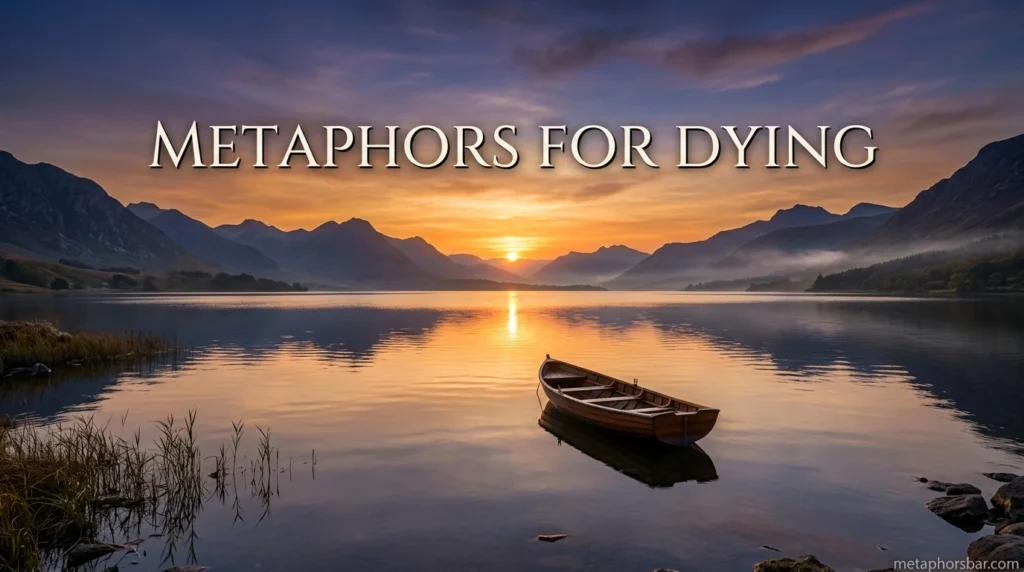
The room is still. A soft hum from an old ceiling fan stirs the curtains just enough to let the evening light slip through. On the bedside table, a glass of water sits untouched, catching the last glow of the day. Someone breathes slowly, each inhale a little shallower than the last, like waves retreating from a shore they will not return to.
Moments like these often leave us speechless. Words feel too rigid, too blunt for something so vast, so mysterious. And so, we reach for metaphors.
We say someone “passed away,” “went to sleep,” or “crossed over.” These aren’t just poetic phrases—they are bridges. They help us approach a subject that is otherwise difficult to name, soften its edges, and make it bearable to speak about.
This article explores metaphors for dying—not to avoid reality, but to understand it more gently. Whether you’re a writer, a thinker, or simply someone navigating loss, these metaphors can offer language that comforts, connects, and clarifies.
Understanding Metaphors for Dying: Why They Matter
Metaphors for dying are symbolic expressions that help describe death in ways that feel less abrupt or clinical. Instead of saying “he died,” we might say “he drifted away” or “his light went out.”
Why does this matter?
Because language shapes experience. The way we talk about death influences how we feel about it. Harsh words can create distance or fear, while softer metaphors can invite acceptance, reflection, and even peace.
Metaphors also:
- Help children understand death in gentler terms
- Allow writers to express grief creatively
- Provide emotional distance when needed
- Reflect cultural, spiritual, and philosophical beliefs
In short, metaphors give us permission to feel—without overwhelming us.
The River Meets the Sea: A Metaphor of Continuation
Meaning & Explanation
This metaphor frames death not as an ending, but as a merging. Just as a river flows into the ocean, a life flows into something larger and unknown.
Example Scenario
At a funeral, someone says, “She has become part of the great ocean now—her journey continues in a different form.”
Alternative Expressions
- “He returned to the source”
- “She joined the infinite tide”
- “His journey reached the open sea”
Sensory & Emotional Details
You can almost hear the river’s gentle current, feel its steady pull toward something vast and inevitable. There is no abrupt stop—only transition.
Mini Storytelling
In many spiritual traditions, life is seen as a temporary form, like water in a river. When it reaches the ocean, it doesn’t disappear—it becomes everything.
The Candle Flickers Out: A Metaphor of Fragility
Meaning & Explanation
This metaphor highlights the delicate nature of life. A flame burns brightly, but can be extinguished in an instant.
Example Sentence
“After years of glowing warmly, her candle finally flickered and went out.”
Alternative Ways to Express It
- “His flame dimmed”
- “Her light faded into darkness”
- “The spark quietly disappeared”
Emotional Layer
There’s a quiet sadness here—but also reverence. A candle’s glow is small, yet meaningful. Its loss is deeply felt.
Cultural Note
Candles are often used in memorials across cultures, symbolizing both life and remembrance.
Crossing the Bridge: A Metaphor of Transition
Meaning & Explanation
Death is seen as a crossing—from one state of being to another.
Example Scenario
“She crossed the bridge peacefully, surrounded by those who loved her.”
Alternative Expressions
- “He stepped into the next world”
- “She walked beyond the veil”
- “He crossed over”
Emotional Texture
There is movement, purpose, even courage in this metaphor. It suggests that death is not passive—but an act of passage.
Literary Touch
Bridges often symbolize transformation in literature—moving from the known to the unknown.
The Final Chapter: A Story Comes to an End
Meaning & Explanation
Life is compared to a book, with death marking its final page.
Example Sentence
“His final chapter was written with grace and dignity.”
Alternative Expressions
- “Her story came to a close”
- “The book of his life ended beautifully”
- “She reached the last page”
Emotional Detail
This metaphor invites reflection. What kind of story was it? What lessons did it leave behind?
Mini Reflection
Every story has an ending—but what matters is how it was lived, not how long it lasted.
Returning Home: A Metaphor of Peace
Meaning & Explanation
Death is seen as a return—to a place of origin, comfort, or belonging.
Example Scenario
“After a long journey, he finally went home.”
Alternative Expressions
- “She found her way back”
- “He returned to where he belongs”
- “She came home at last”
Emotional Tone
This metaphor is deeply comforting. It suggests rest, reunion, and peace.
Cultural Insight
Many religions describe death as a return to a divine home or source.
Like Autumn Leaves: A Natural Cycle
Meaning & Explanation
Death is part of nature’s rhythm—like leaves falling in autumn.
Example Sentence
“Like autumn leaves, we all fall in our time.”
Alternative Expressions
- “He drifted down like a leaf”
- “Her season came to an end”
- “Life completed its cycle”
Sensory Detail
Golden leaves falling quietly, carried by wind—there is beauty, not just loss.
Philosophical Angle
This metaphor emphasizes acceptance. Death is not an interruption—it’s part of the design.
A Train Leaving the Station: A Journey Forward
Meaning & Explanation
Death is framed as departure—a journey to another destination.
Example Scenario
“She boarded the final train, leaving behind everything she knew.”
Alternative Expressions
- “He took the last journey”
- “She departed for another place”
- “The train has left the station”
Emotional Layer
There is sadness in goodbye—but also curiosity. Where is the train going?
A Door Closing, Another Opening
Meaning & Explanation
This metaphor suggests that death is not final—it leads to something new.
Example Sentence
“When one door closes, another quietly opens.”
Alternatives
- “He stepped through a new doorway”
- “She entered another realm”
- “A new path began”
Emotional Tone
Hopeful and forward-looking, this metaphor softens fear with possibility.
3 Powerful Metaphors for Dying (Deep Dive Examples)
1. “Drifting Into Sleep”
Meaning: Death as peaceful rest Example: “He drifted into sleep, never to wake again.” Alternatives: “Eternal rest,” “final sleep” Emotion: Calm, quiet, gentle
Mini Story: A grandmother, after a long illness, closes her eyes as her family hums her favorite lullaby. She simply… sleeps.
2. “The Sun Setting”
Meaning: Life ending like a day Example: “Her life set like a beautiful sun.” Alternatives: “Twilight of life,” “day’s end” Emotion: Bittersweet, serene
3. “The Music Fading”
Meaning: Life as a song coming to an end Example: “His melody faded into silence.” Alternatives: “Final note,” “last chord” Emotion: Poetic, reflective
1 Practical Tip: Choosing the Right Metaphor
Not every metaphor fits every situation.
Tip: Match the metaphor to the emotional tone you want to convey.
- For comfort → “Returning home”
- For peace → “Drifting into sleep”
- For reflection → “Final chapter”
- For spirituality → “Crossing over”
Strategy: Ask yourself: What feeling should this convey? Let that guide your choice.
Interactive Exercises: Practice Using Metaphors for Dying
Exercise 1: Rewrite the Sentence
Replace “He died” with three different metaphors.
Example:
- He passed into the quiet night
- He crossed the final bridge
- His light gently faded
Exercise 2: Create Your Own Metaphor
Think of nature, travel, or art. Create a metaphor for dying.
Prompt: “Death is like ______ because ______.”
Exercise 3: Memory Writing
Write a short paragraph about someone you lost using one metaphor. Focus on emotion, not facts.
Bonus Tips: Using These Metaphors in Writing & Daily Life
- In storytelling: Use metaphors to show emotion rather than state it
- In social media: Gentle phrases resonate more than blunt ones
- In conversations: Choose metaphors that comfort the listener
- In poetry: Combine metaphors with imagery for deeper impact
Avoid overusing clichés—fresh metaphors feel more authentic.
Cultural and Literary Perspectives on Death Metaphors
Different cultures use different metaphors:
- Western traditions: “Passing away,” “resting in peace”
- Eastern traditions: “Rebirth,” “cycle of life”
- Literature: Death as sleep, journey, or transformation
Writers throughout history have leaned on metaphor to approach death without stripping it of mystery.
Common Mistakes to Avoid When Using Death Metaphors
- Using overly vague metaphors that confuse meaning
- Choosing metaphors that clash with the emotional tone
- Overloading a sentence with too many metaphors
- Ignoring cultural sensitivity
Clarity and empathy should always come first.
Why Metaphors Help Us Cope with Death
Metaphors don’t erase grief—but they reshape it.
They allow us to:
- Speak when words fail
- Feel without being overwhelmed
- Connect with others through shared imagery
In a way, metaphors are emotional tools—quiet companions in difficult moments.
Conclusion
Death is inevitable, but how we speak about it is not fixed. Metaphors offer us choices—ways to approach the subject with softness, depth, and even beauty.
Whether it’s a candle flickering out, a river meeting the sea, or a story reaching its final page, each metaphor carries a piece of understanding.
And perhaps that’s the point—not to fully explain death, but to make it feel a little less distant, a little more human.
FAQs
1. Why do people use metaphors for dying instead of direct language?
Because direct language can feel harsh or emotionally overwhelming. Metaphors soften the impact and provide comfort.
2. Are metaphors for dying culturally specific?
Yes, different cultures use different metaphors based on beliefs, traditions, and spirituality.
3. Can metaphors for death be misleading?
Sometimes, especially for children. It’s important to balance metaphor with clarity when needed.
4. What is the most common metaphor for dying?
“Passing away” and “going to sleep” are among the most widely used.
5. How can I create my own metaphor for death?
Draw from nature, journeys, or personal experiences. Think about what death feels like emotionally, and translate that into imagery.
If you’d like, I can also turn this into a shorter SEO blog version, add meta description + keywords, or tailor it for a specific audience (students, writers, grief support, etc.).