
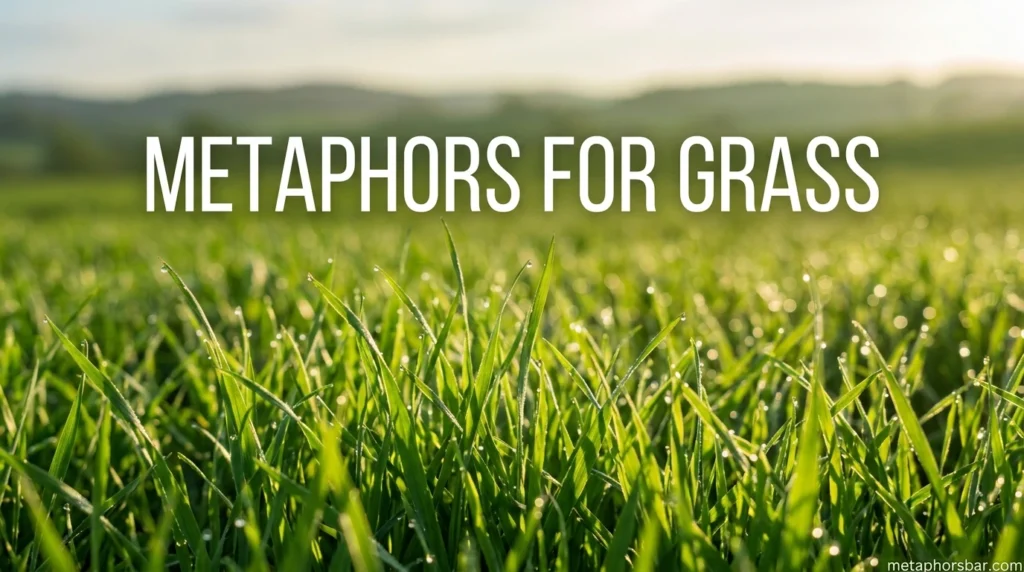
The morning field was still wet when the sun arrived.
Tiny drops clung to every blade like glass beads, trembling before falling back into the earth. A breeze passed through, and the grass responded—not loudly, not dramatically—but in a soft wave, as if the ground itself had learned how to breathe.
Grass is easy to overlook.
It does not shout like mountains or roar like oceans. Yet it covers the world in quiet persistence. That is exactly why metaphors for grass matter so much in writing. Grass becomes a symbol of resilience, renewal, humility, and constant quiet growth.
Through metaphor, grass is never just green blades underfoot. It becomes a living carpet of memory, a whispering crowd, a patient witness to time.
Whether you are writing poetry, nature descriptions, reflective essays, or storytelling scenes, metaphors for grass help transform ordinary landscapes into emotional experiences.
Metaphors for Grass: Why Grass Imagery Feels So Alive in Writing
The emotional depth hidden in something simple
Grass represents:
- growth
- renewal
- survival
- softness
- abundance
- grounding
Because it exists almost everywhere, it becomes a universal symbol of life continuing quietly.
Why readers respond to grass metaphors
Grass is familiar. People have:
- walked barefoot on it
- sat on it
- watched it sway in wind
- seen it grow after rain
That familiarity makes metaphors instantly relatable.
Compare:
- “The field had grass.”
- “The field breathed like a green ocean under the sky.”
The second sentence turns a simple image into a living world.
Powerful Metaphors for Grass With Meanings and Examples
1. Grass is a green ocean swaying on land
Meaning and explanation
This metaphor highlights movement, vastness, and rhythm. Like ocean waves, grass moves in response to wind, creating flowing patterns across fields.
It is especially powerful for describing large landscapes.
Example sentence or scenario
“The wind passed through the meadow, and the grass became a green ocean rolling gently beneath the sky.”
Alternative ways to express it
- grass is a sea of green waves
- grass is a landlocked ocean
- grass is a living tide on earth
- fields of grass move like water
Optional sensory and emotional details
Imagine:
- soft rustling sound like distant waves
- sunlight rippling across blades
- wind creating visible patterns
- a feeling of endless space and calm
Mini storytelling touch
A traveler once stood on a hill overlooking endless fields and said it felt like “the earth had turned into water but forgot how to stop growing.” That image captures how grass transforms still land into something fluid and alive.
2. Grass is a thousand hands reaching toward the sun
Meaning and explanation
This metaphor emphasizes growth, energy, and collective life. Each blade of grass becomes a living gesture—small individually, powerful together.
It works well for describing vitality, nature, or renewal after rain or hardship.
Example sentence or scenario
“After the storm, the grass rose like a thousand hands reaching toward the returning sun.”
Alternative ways to express it
- grass is a field of reaching fingers
- grass is earth’s quiet reaching gesture
- grass is green life stretching upward
- grass is a crowd of tiny seekers of light
Optional sensory and emotional details
This image carries:
- upward movement
- hope after darkness
- freshness after rain
- gentle determination
Literary or real-life reference
In many cultures, grass regrowth after fire or drought is seen as a symbol of resilience—life returning collectively, not individually. That makes this metaphor especially powerful for themes of recovery.
3. Grass is a soft memory written across the earth
Meaning and explanation
This metaphor focuses on time, history, and emotional presence. Grass becomes something that records moments—footsteps, seasons, silence, and change.
It is ideal for reflective or nostalgic writing.
Example sentence or scenario
“The abandoned field was not empty—it was a soft memory written in grass, holding every step that had ever passed through it.”
Alternative ways to express it
- grass is earth’s living journal
- grass is memory growing in silence
- grass is a green archive of time
- grass is a whisper of forgotten footsteps
Optional sensory and emotional details
This metaphor evokes:
- quiet nostalgia
- softness underfoot
- fading traces of time
- emotional stillness
Mini storytelling touch
An old playground overgrown with grass still holds invisible echoes of laughter. Though the children are gone, the grass remains—growing over their stories but never fully erasing them. That is how memory works in nature: it does not disappear, it transforms.
Creative Ways to Use Grass Metaphors in Writing
In nature descriptions and storytelling
Grass metaphors bring landscapes to life.
Examples:
- “The field breathed in waves of green.”
- “Grass covered the hills like soft moving silk.”
- “The meadow whispered in blades instead of words.”
These lines create atmosphere and immersion.
In poetry and reflective writing
Grass becomes symbolic of emotion and time.
Examples:
- “Hope grew where grass refused to stop rising.”
- “Silence lay gently across the green memory of land.”
- “Time walked barefoot through fields of grass.”
Poetry often uses grass to express quiet emotion.
In mindfulness and everyday reflection
Grass metaphors can ground abstract thoughts.
Examples:
- “Growth is often as quiet as grass after rain.”
- “Healing does not always roar—it grows slowly like grass.”
- “Even small changes spread like fields of green.”
These are ideal for captions, journaling, and reflection.
Interactive Exercises for Practicing Grass Metaphors
Exercise 1: Turn a simple sentence into metaphor
Start with:
- “The grass is green.”
Now rewrite it:
- “The grass spread like a living carpet under the sky.”
- “Green life covered the earth in quiet waves.”
- “The ground wore a coat of breathing green.”
Try at least three versions.
Exercise 2: Choose a mood and describe grass through it
Pick one:
- calm
- sadness
- joy
- nostalgia
- renewal
Now describe grass using metaphor.
Example (calm): “The grass moved like slow breathing across the earth, steady and unhurried.”
Exercise 3: Expand a metaphor into a scene
Choose one:
- ocean
- memory
- hands
- blanket
- language
Now write a short paragraph using it.
Example (ocean): “The field stretched endlessly, and the grass moved like waves finding their rhythm. Each gust of wind reshaped the surface, turning land into a breathing sea.”
Bonus Tips for Using Grass Metaphors Effectively
Focus on movement, not just color
Grass is most powerful when described in motion:
- swaying
- bending
- growing
- spreading
Use contrast to enhance imagery
Example: “The field was silent, but the grass was not still.”
Contrast brings life to description.
Add sensory detail
Include:
- sound of rustling
- feeling underfoot
- smell after rain
- visual waves of green
Avoid over-description
One strong metaphor is more effective than multiple competing images.
More Metaphors for Grass You Can Use
Grass is a green language spoken by the earth
Perfect for poetic expression.
Grass is a blanket stitched by seasons
Great for cyclical imagery.
Grass is a patient heartbeat of the land
Ideal for slow, steady life imagery.
Grass is a crowd that never leaves the ground
Useful for density and presence.
Grass is time growing quietly under sunlight
Strong for reflective writing.
FAQs About Metaphors for Grass
1. What is a metaphor for grass?
A metaphor for grass is a creative comparison that describes grass in symbolic or emotional terms rather than literal ones.
2. Why are grass metaphors used in writing?
They help turn simple nature imagery into deeper emotional or symbolic meaning.
3. What are common grass metaphors?
Examples include:
- grass as ocean
- grass as memory
- grass as hands reaching upward
- grass as blanket
4. Can grass metaphors be used in poetry?
Yes. Grass is frequently used in poetry to symbolize life, time, and nature.
5. How do I create original grass metaphors?
Focus on how grass moves, feels, or interacts with time, then compare it to emotional or physical experiences.
6. Are grass metaphors always positive?
Not always. Grass can symbolize abandonment, fading memory, or silence as well as growth and life.
7. Can grass metaphors be used in storytelling?
Absolutely. They help set tone, atmosphere, and emotional depth in scenes.
Conclusion
Grass does not demand attention, yet it covers the world with quiet persistence. It grows where nothing else will, softens the harshness of stone, and turns empty ground into living color.
That is why metaphors for grass are so powerful. They turn something simple into something meaningful: a green ocean moving under wind, a thousand hands reaching for light, a memory written softly into the earth.
In writing, grass becomes more than nature—it becomes language itself: patient, quiet, and always growing.