
The train rattled softly along the tracks as the landscape changed outside the window. Green fields gave way to busy cities, then quiet hills, and finally a sunset painted the horizon in shades of gold and crimson. Some passengers boarded, others stepped off, and the journey continued. In many ways, that train ride felt a lot like life itself—full of movement, surprises, companions, and destinations we never fully expect.
That is the beauty of metaphors for life. Life is too vast, complex, and emotional to be captured by simple definitions. It contains joy and sorrow, beginnings and endings, victories and setbacks. Metaphors help us make sense of these experiences by comparing life to something familiar and vivid.
Whether you’re writing poetry, crafting a speech, journaling, creating social media content, or simply reflecting on your own experiences, metaphors for life can add depth, emotion, and meaning to your words.
Why Metaphors for Life Matter in Writing and Reflection
They Simplify Complex Ideas
Life contains countless emotions, experiences, and lessons. Metaphors turn those abstract concepts into images readers can easily understand.
They Create Emotional Connection
People may have different experiences, but they often relate to the same symbolic images—roads, rivers, gardens, and journeys.
They Make Writing More Memorable
A powerful metaphor can stay with readers long after they’ve finished reading.
Three Powerful Metaphors for Life
Life Is a Journey
Meaning and Explanation
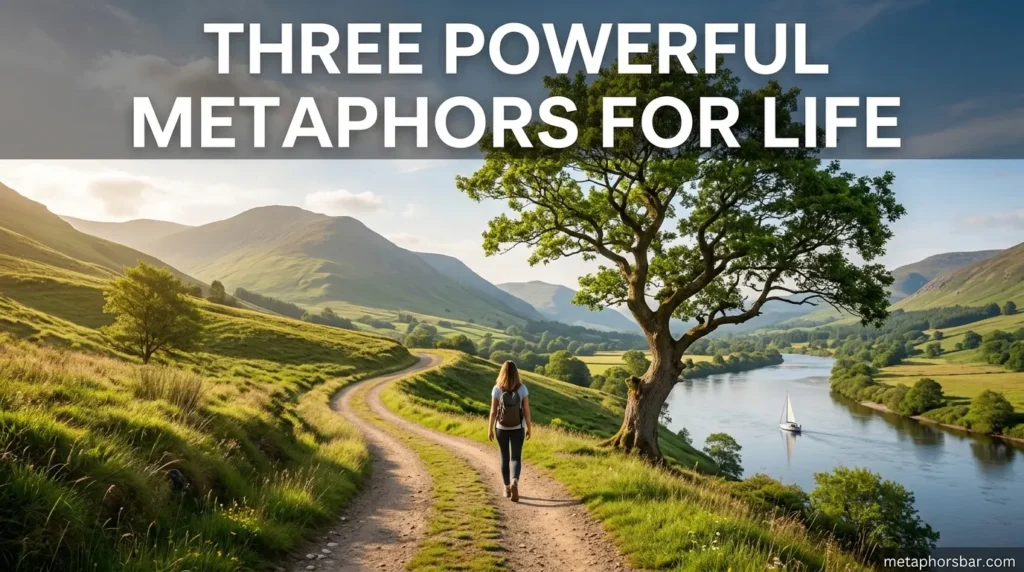
One of the most popular metaphors for life compares it to a journey. Just as travelers encounter roads, detours, companions, and destinations, people experience growth, challenges, relationships, and milestones throughout their lives.
This metaphor emphasizes progress, discovery, and personal development rather than a fixed endpoint.
Example Sentence or Scenario
Life is a journey filled with unexpected turns, each one teaching lessons that no map could predict.
This metaphor works well when discussing growth, change, and self-discovery.
Alternative Ways to Express It
- a winding road
- an unfolding adventure
- a path through unknown lands
- a voyage across the sea
- a trail toward the horizon
Sensory and Emotional Details
Imagine the crunch of gravel beneath your shoes, distant mountains ahead, and countless paths branching in different directions. Emotionally, the image evokes curiosity, hope, and resilience.
Mini Storytelling Example
A young graduate carefully mapped out every step of her future. Yet life had other plans. Unexpected opportunities and challenges took her in directions she never anticipated. Years later, she realized those detours had become the most meaningful parts of her journey.
Literary and Cultural Reference
Many classic stories, from ancient myths to modern novels, use journeys as symbols of personal transformation and growth.
Life Is a River
Meaning and Explanation
A river flows continuously, adapting to rocks, curves, and changing landscapes. Like life, it moves forward regardless of obstacles.
This metaphor highlights change, adaptability, and the natural progression of time.
Example Sentence or Scenario
Life is a river that keeps flowing, carrying us through calm waters and rushing rapids alike.
The metaphor reminds us that change is inevitable and movement is constant.
Alternative Ways to Express It
- a flowing current
- an endless stream
- a winding waterway
- a tide moving toward the sea
- a current shaped by its surroundings
Sensory and Emotional Details
Picture cool water gliding over smooth stones, reflecting sunlight while continuing its journey downstream. Emotionally, this metaphor feels peaceful, reflective, and accepting.
Mini Storytelling Example
After losing his job unexpectedly, a man spent months worrying about the future. Eventually, a new opportunity emerged that led him to a more fulfilling career. Looking back, he described the experience as a bend in the river rather than the end of the stream.
Real-Life Example
Career changes, personal growth, and unexpected life events often demonstrate the river-like nature of human experience.
Life Is a Garden
Meaning and Explanation
A garden requires patience, effort, care, and time. Seeds must be planted, nurtured, and protected before they bloom.
This metaphor emphasizes growth, responsibility, and the idea that meaningful results often develop gradually.
Example Sentence or Scenario
Life is a garden where the seeds of today’s actions become tomorrow’s harvest.
This comparison encourages intentional living and long-term thinking.
Alternative Ways to Express It
- a field waiting to bloom
- a collection of growing seasons
- fertile soil for dreams
- a landscape shaped by care
- a harvest of choices
Sensory and Emotional Details
Imagine rich soil, fresh rain, colorful blossoms, and the scent of flowers carried by a gentle breeze. Emotionally, the image evokes hope, patience, and fulfillment.
Mini Storytelling Example
An aspiring writer spent years practicing before publishing her first book. At times, progress felt invisible. Yet every page written was a seed planted. Eventually, those seeds blossomed into a successful career.
Literary and Cultural Reference
Gardens often symbolize personal growth, renewal, and the cycle of life in literature, religion, and folklore.
How to Choose the Best Metaphor for Life
Use the Journey Metaphor for Growth and Adventure
Choose this metaphor when discussing personal development, goals, and life transitions.
Use the River Metaphor for Change and Adaptability
This image works best when emphasizing movement, acceptance, and the flow of time.
Use the Garden Metaphor for Growth and Effort
Select this metaphor when focusing on patience, nurturing, and long-term success.
The right metaphor depends on which aspect of life you want to highlight.
Interactive Exercises for Practicing Metaphors for Life

Exercise 1: Finish the Sentence
Complete this prompt:
“Life is…”
Try writing three different metaphors.
Examples:
- Life is a bridge between dreams and reality.
- Life is a puzzle with pieces revealed over time.
- Life is a canvas waiting for color.
Exercise 2: Reflect on Your Current Stage
Ask yourself:
- Does life feel like a journey?
- A river?
- A garden?
- Something else entirely?
Write a paragraph explaining your answer.
Exercise 3: Create a Personal Metaphor
Think about your hobbies, interests, or favorite places.
Can you compare life to one of them?
Examples:
- Life is a library.
- Life is a mountain climb.
- Life is a symphony.
Exercise 4: Story Starter
Begin with:
“If life were a…”
Then write a short story using that metaphor as your central theme.
Bonus Tips for Using Metaphors for Life in Writing, Social Media, and Daily Reflection
In Creative Writing
Use metaphors consistently throughout a story to strengthen themes and emotional impact.
In Poetry
Life metaphors work beautifully when exploring identity, growth, loss, and hope.
In Social Media Captions
Short metaphorical statements can be powerful:
- “Still walking the road.”
- “Trusting the river.”
- “Growing through every season.”
In Journaling
Metaphors can help you understand emotions and experiences from a fresh perspective.
Mix Familiar and Original Images
Classic metaphors are effective, but creating your own unique comparisons can make your writing stand out.
FAQs About Metaphors for Life
1. What is a metaphor for life?
A metaphor for life is a figurative comparison that uses imagery such as journeys, rivers, gardens, or other symbols to describe human experiences.
2. Why are life metaphors so popular?
Because life is complex and abstract, metaphors make it easier to understand and communicate.
3. What is the most common metaphor for life?
The journey metaphor is one of the most widely used because it reflects growth, movement, and discovery.
4. Can life have multiple metaphors?
Absolutely. Different metaphors highlight different aspects of life, such as change, learning, relationships, or perseverance.
5. Are life metaphors useful in everyday communication?
Yes. They can enhance conversations, speeches, journal entries, and social media posts.
6. How can I create my own metaphor for life?
Think about activities, objects, or natural elements that reflect your experiences, then compare life to them.
7. Which metaphor is best for personal growth?
The garden metaphor is especially effective because it emphasizes patience, effort, and gradual development.
Conclusion
Life is far too rich and complicated to be described by a single definition. That is why metaphors remain such powerful tools. They help us see familiar experiences through new lenses and uncover deeper meanings within everyday moments.
The journey reminds us that growth often happens along the road rather than at the destination. The river teaches us to adapt and keep moving forward through changing circumstances. The garden encourages patience, care, and faith in the growth that comes from consistent effort.
Whether you’re writing stories, poems, speeches, journal entries, or social media content, metaphors for life can bring greater beauty, clarity, and emotional depth to your words. More importantly, they can help you better understand your own path—one step, one current, and one season at a time.