
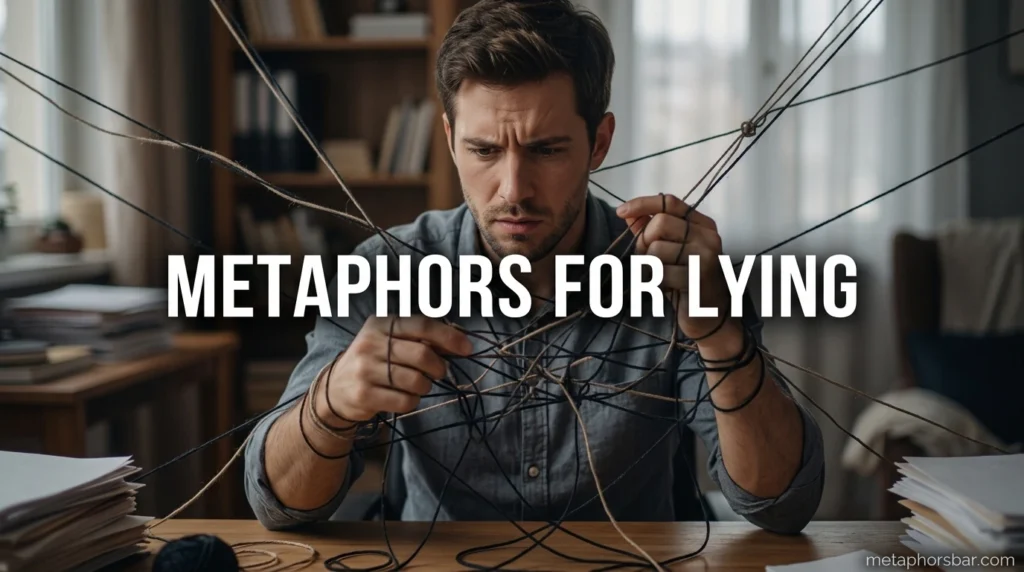
The truth often arrives quietly. A small detail doesn’t match. A story shifts slightly from one telling to the next. A promise sounds polished but somehow hollow. Then comes the realization—a feeling like discovering a crack beneath fresh paint. What seemed solid suddenly feels uncertain.
Lying is one of the oldest human behaviors, appearing in myths, literature, history, and everyday life. Yet describing deception can be difficult. Simply calling something a lie may not capture its complexity, intention, or emotional impact. That’s where metaphors for lying become valuable. They transform abstract ideas about dishonesty into vivid images readers can see and feel.
Whether you’re writing fiction, crafting poetry, creating social media content, teaching figurative language, or exploring human behavior, metaphors for lying can add depth, emotion, and clarity to your words.
Why Metaphors for Lying Matter in Writing and Communication
They Turn Abstract Ideas Into Visual Images
Lying is invisible. You cannot physically see a lie floating through the air. Metaphors make deception tangible by comparing it to masks, shadows, smoke, webs, and other familiar images.
They Add Emotional Impact
Saying “he lied” communicates information. Saying “he built a house of cards” communicates fragility, risk, and inevitable collapse. The metaphor creates a stronger emotional response.
They Reveal Different Types of Deception
Not all lies are the same. Some are small and harmless. Others are elaborate and damaging. Metaphors help distinguish between subtle dishonesty, deliberate manipulation, and self-deception.
Three Powerful Metaphors for Lying
Lying as a House of Cards
Meaning and Explanation
A house of cards looks impressive at first glance. Each card appears carefully balanced, creating the illusion of stability. Yet the entire structure depends on fragile support. One small disturbance can bring everything crashing down.
This metaphor perfectly captures many lies because deception often requires additional lies to maintain itself. The larger the structure grows, the more vulnerable it becomes.
Example Sentence or Scenario
His story was a house of cards, standing tall until one simple question caused the entire thing to collapse.
This metaphor works especially well when describing elaborate lies, false identities, or long-running deception.
Alternative Ways to Express It
- a fragile tower of falsehoods
- a collapsing illusion
- a shaky structure built on deception
- a castle made of paper
- a foundation of dishonesty
Sensory or Emotional Details
Imagine delicate cards trembling under the slightest breeze. There is tension in the air, a feeling that everything could fall apart at any moment. Emotionally, this metaphor creates suspense and uncertainty.
Mini Storytelling Touch
A businessman spent years exaggerating his achievements. Each exaggeration required another. Awards became larger, successes became grander, and stories became more complicated. Eventually, a routine background check exposed the truth. Years of carefully arranged deception collapsed in a single afternoon—just like a house of cards.
Literary and Cultural Connection
Throughout literature, fragile structures often symbolize false appearances. The house of cards remains one of the clearest symbols of something impressive yet fundamentally unstable.
Lying as a Mask
Meaning and Explanation
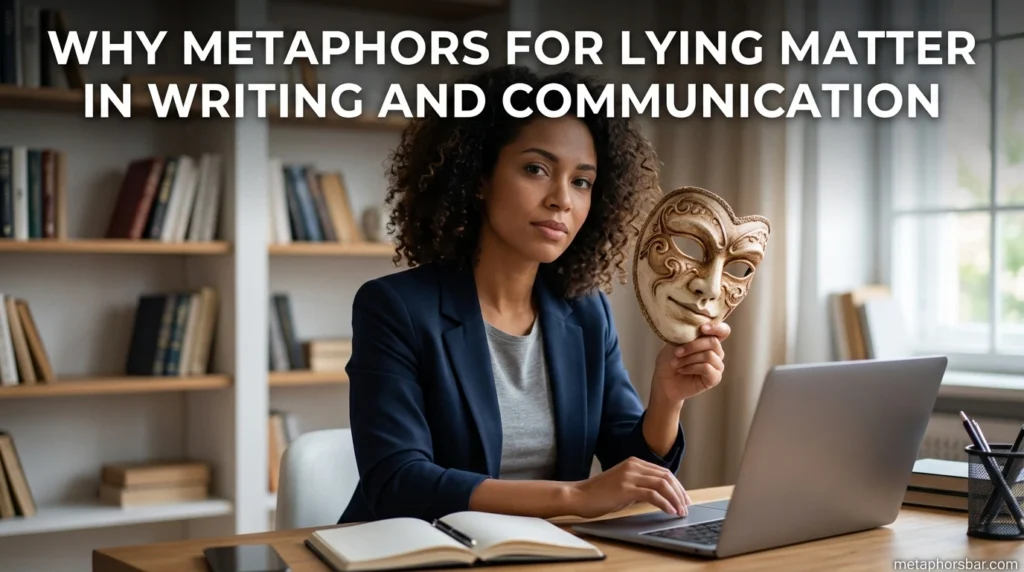
A mask hides a person’s true face while presenting a different appearance to the world. Similarly, lies often conceal reality behind a carefully crafted version of events.
This metaphor emphasizes disguise, performance, and concealment rather than outright fabrication. It suggests that dishonesty is often about hiding truth rather than inventing something entirely new.
Example Sentence or Scenario
She wore a mask of confidence, hiding her mistakes behind practiced smiles and carefully chosen words.
This metaphor works particularly well for social deception, secret struggles, hidden intentions, or situations where appearances differ from reality.
Alternative Ways to Express It
- hiding behind a disguise
- wearing a false face
- covering the truth
- concealing reality behind a curtain
- presenting a polished mask
Sensory or Emotional Details
Picture a smooth mask covering a face, hiding every genuine expression underneath. The image can feel mysterious, unsettling, or even tragic depending on the context.
Mini Storytelling Touch
In many cultures, theatrical masks represent different emotions and identities. A performer may switch masks to become a different character. Similarly, a liar sometimes adopts a false version of themselves, hoping others will believe the performance.
Real-Life Example
People occasionally exaggerate success on social media, creating a carefully curated image that doesn’t reflect reality. The mask metaphor helps describe this difference between appearance and truth.
Lying as a Spider’s Web
Meaning and Explanation
A spider’s web is intricate, delicate, and designed to trap. This metaphor portrays lies as interconnected strands that become increasingly difficult to escape. One false statement often connects to another until the liar becomes caught within their own creation.
Unlike the house-of-cards metaphor, which emphasizes collapse, the web metaphor highlights entanglement and complexity.
Example Sentence or Scenario
He spun a web of lies so complicated that even he struggled to remember which threads were real.
This metaphor is particularly effective for describing manipulation, ongoing deception, and situations where lies multiply over time.
Alternative Ways to Express It
- tangled in deception
- weaving false stories
- caught in a net of lies
- spinning threads of dishonesty
- trapped in one’s own fabrications
Sensory or Emotional Details
Imagine silver strands stretching in every direction, nearly invisible until sunlight reveals them. Emotionally, the metaphor suggests tension, confusion, and entrapment.
Mini Storytelling Touch
A student once lied about missing an assignment. To support that lie, he invented computer problems. Then he needed another explanation for why he had no evidence of the issue. Soon he was juggling multiple stories. What began as a single thread became a tangled web that was far harder to manage than telling the truth would have been.
Literary Reference
Spiders and webs frequently appear in folklore and literature as symbols of cunning, traps, and hidden dangers. This makes the metaphor especially powerful for stories involving deception.
How to Choose the Right Metaphor for Lying
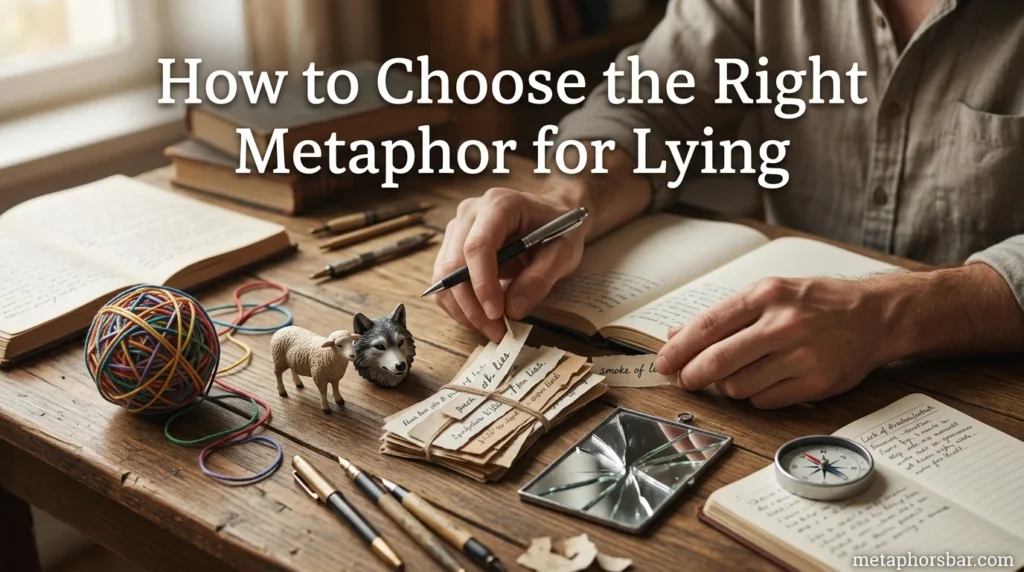
Use the House of Cards for Fragile Deception
Choose this metaphor when you want to emphasize instability, vulnerability, and eventual collapse.
Use the Mask for Hidden Truths
This metaphor works best when the focus is concealment, appearance, or pretending to be something one is not.
Use the Spider’s Web for Complex Lies
Use this image when discussing layered deception, manipulation, or situations where lies become increasingly complicated.
The best metaphor depends on the type of dishonesty you want to describe and the emotional tone you want readers to experience.
Interactive Exercises for Practicing Metaphors for Lying
Exercise 1: Complete the Comparison
Finish this sentence:
“A lie is like ______ because ______.”
Try creating three completely different comparisons.
Example:
“A lie is like fog because it makes it difficult to see what’s really there.”
Exercise 2: Character Creation Challenge
Imagine a fictional character who frequently lies.
Describe their dishonesty using a metaphor:
- Is it a mask?
- A maze?
- A shadow?
- A web?
- A house of cards?
Write a short paragraph explaining your choice.
Exercise 3: Story Starter
Begin a story with:
“The lie grew like…”
Allow the metaphor to guide the direction of the narrative.
Exercise 4: Rewrite a Plain Sentence
Take this sentence:
“He was dishonest.”
Now rewrite it using a metaphor.
Examples:
- He hid behind a mask of honesty.
- He built castles from fragile cards.
- He spun webs wherever he went.
Bonus Tips for Using Metaphors for Lying in Writing, Social Media, and Daily Life
In Fiction Writing
Metaphors help show deception instead of merely stating it. Readers often connect more deeply with images than direct explanations.
In Poetry
Images like masks, shadows, smoke, mirrors, and webs create rich emotional layers and symbolic meaning.
In Social Media Content
Short metaphorical phrases can be memorable and shareable:
- “Every lie builds another card in the tower.”
- “Truth walks openly; lies wear masks.”
- “A web may catch others, but it can also trap the spider.”
In Public Speaking
Metaphors make discussions about honesty more engaging and easier to remember.
Avoid Overusing One Image
If your writing contains multiple references to webs, masks, and cards in every paragraph, the imagery may feel repetitive. Vary your comparisons to keep them fresh.
FAQs
1. What is a metaphor for lying?
A metaphor for lying is a figurative comparison that describes deception through another image, such as a mask, a web, or a house of cards.
2. Why are metaphors for lying useful?
They make abstract concepts like dishonesty more vivid, memorable, and emotionally impactful.
3. What is a simple metaphor for lying?
One simple example is: “A lie is a mask.” This suggests hiding reality behind a false appearance.
4. Can metaphors for lying be used in fiction?
Yes. They are commonly used in novels, short stories, poetry, and screenwriting to create symbolism and emotional depth.
5. What metaphor best describes complicated lies?
The spider’s web metaphor is often ideal because it highlights interconnected deception and entanglement.
6. Are metaphors for lying always negative?
Most are negative because lying is generally associated with dishonesty. However, some metaphors may explore complexity, fear, or self-protection rather than simple wrongdoing.
7. How can I create my own metaphor for lying?
Think about what deception does. Does it hide, trap, distort, confuse, or collapse? Then compare it to something that behaves in a similar way.
Conclusion
Lying is more than a false statement. It can be a disguise, a fragile structure, or a tangled trap. That complexity is why metaphors are so effective. They transform an invisible act into something readers can visualize and understand.
The house of cards reveals how fragile deception can be. The mask highlights concealment and false appearances. The spider’s web illustrates how lies can spread and entangle everyone involved—including the person who created them.
Whether you’re writing fiction, teaching figurative language, crafting social media content, or exploring human behavior, metaphors for lying offer powerful tools for expression. They remind us that words can do more than explain reality—they can paint it. And when it comes to understanding deception, sometimes a vivid image reveals more truth than a simple definition ever could.