
The first time a difficult math problem finally clicks, it can feel almost physical. The scattered numbers stop feeling scattered. The symbols line up. A shape appears where there was once confusion, like a path emerging from fog. What seemed cold a moment ago suddenly feels alive with pattern and purpose.
That is the quiet beauty of math. It is precise, but it is also elegant. It is logical, but it can feel surprisingly poetic. And because math can sometimes seem abstract or intimidating, metaphors for math help make it more human, vivid, and easier to understand. They turn equations into stories, problem-solving into journeys, and patterns into something we can see, feel, and remember.
Whether you are writing for students, teaching a lesson, creating a caption, or trying to explain why math matters, the right metaphor can change everything. It can make math feel less like a wall and more like a door.
Why Metaphors for Math Matter in Learning and Writing
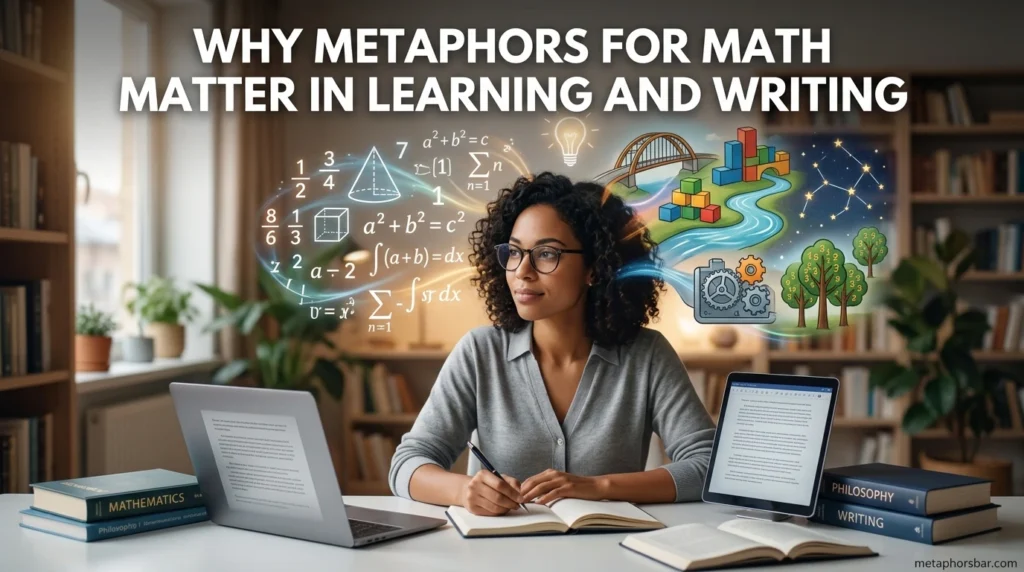
They Make Abstract Ideas Easier to Picture
Math often deals with invisible relationships: quantities, patterns, formulas, and structures. A metaphor gives those invisible things shape. Instead of saying, “Algebra helps organize relationships between numbers,” you might say, “Algebra is a map that shows how numbers move together.” That image stays with people.
They Reduce Fear and Build Confidence
Many people approach math with anxiety. A warm metaphor can soften that feeling. If math is described as a puzzle, a staircase, or a language, it becomes less like an enemy and more like something you can learn to work with.
They Make Math Feel Human
At its best, math is not just calculation. It is discovery. It is logic with rhythm, It is pattern in motion. Metaphors help us feel the beauty of that structure instead of only the pressure of getting the answer right.
Three Creative Metaphors for Math
1. Math as a Language
Meaning and Explanation
One of the most powerful metaphors for math is that it is a language. Like language, math has symbols, grammar, rules, and meaning. It communicates ideas across cultures and disciplines. It helps people express relationships, patterns, and structures that words alone may not capture.
This metaphor works especially well because it reminds us that math is not random. It speaks. It tells us something, It connects people through a system that can be understood anywhere in the world.
Example Sentence or Scenario
Math is a language written in symbols, where every equation tells a story about how things connect.
This metaphor is useful in classrooms, essays, and explanations for students who feel math is disconnected from real life. It shows that math is not just about memorizing procedures. It is about reading and writing patterns.
Alternative Ways to Express It
- math is the grammar of the universe
- equations are sentences made of numbers
- numbers speak in a universal voice
- math is a code that describes reality
- formulas are another way of telling the truth
Sensory or Emotional Details
This metaphor feels clean and structured, like a page filled with symbols that suddenly begin to make sense. It can carry a sense of discovery, like learning to read a new alphabet. Emotionally, it feels empowering, because language suggests the possibility of understanding.
Mini Storytelling Touch
A student once struggled with fractions until her teacher said, “Think of math as another language. You do not have to love every word yet, but you can learn to read it.” That changed the way she approached the subject. The page stopped looking like a wall of confusion and started looking like a conversation.
Literary or Cultural Reference
People often call math a universal language because it can be understood across countries and cultures. That idea has appeared in science, philosophy, and education for centuries.
2. Math as a Puzzle
Meaning and Explanation
Another effective metaphor is math as a puzzle. Puzzles require patience, pattern recognition, and the satisfaction of fitting pieces together. Math often works the same way. A problem may look impossible at first, but with careful thought, the pieces begin to click.
This metaphor is especially helpful for problem-solving, because it shifts the focus from fear to curiosity. A puzzle invites exploration. It says: look closely, keep trying, and the shape will emerge.
Example Sentence or Scenario
Solving the math problem felt like working on a puzzle, each step revealing one more piece of the picture.
This metaphor is useful for describing word problems, logic exercises, geometry, and any situation where a solution must be assembled rather than simply remembered.
Alternative Ways to Express It
- math is a mystery to solve
- numbers fit together like puzzle pieces
- each answer unlocks the next piece
- equations are fragments waiting to click into place
- problem-solving is assembling a hidden picture
Sensory or Emotional Details
You can imagine the soft click of a puzzle piece snapping into place, the small thrill of recognition, the relief when a complicated picture starts to come together. Emotionally, this metaphor feels satisfying, playful, and hopeful.
Mini Storytelling Touch
A middle school student once stared at a geometry problem for twenty minutes, feeling stuck and frustrated. Then he drew the shapes separately, cut the problem into smaller parts in his mind, and suddenly it became manageable. Later he said it felt like finding the missing puzzle piece at the bottom of the box.
Real-Life Example
Many people approach coding, engineering, and logic-based math this way. They do not see a blank wall; they see scattered pieces waiting for arrangement.
3. Math as a Bridge
Meaning and Explanation
A bridge connects one side to another. In the same way, math can connect ideas, concepts, and real-world applications. This metaphor works beautifully because it suggests movement, access, and transition. Math helps us cross from confusion to clarity, from theory to practical use, from one level of understanding to another.
This is a strong metaphor for education because it emphasizes that math is not only a destination. It is also a means of getting somewhere else.
Example Sentence or Scenario
Math is a bridge between abstract ideas and real-life solutions, carrying us from numbers on paper to the world beyond them.
This metaphor is especially useful when explaining why math matters outside the classroom. It connects learning to engineering, technology, finance, architecture, science, and everyday decision-making.
Alternative Ways to Express It
- math is a pathway to understanding
- equations are stepping stones
- numbers build a crossing over uncertainty
- math links ideas together
- formulas carry us from question to answer
Sensory or Emotional Details
You can imagine walking across a stable bridge, hearing it hold your weight, seeing the other side come closer step by step. Emotionally, this metaphor feels steady, practical, and reassuring. It suggests that math helps people move forward safely and confidently.
Mini Storytelling Touch
A young woman once wanted to become an architect but doubted whether her math skills were strong enough. Her mentor told her, “Math is the bridge between your imagination and your buildings.” That sentence stayed with her. She began to see equations not as obstacles, but as the support beams of her future.
Literary or Cultural Reference
Bridges often symbolize connection in literature and culture. In this metaphor, math becomes the thing that lets us cross into new understanding and new possibilities.
How to Choose the Right Math Metaphor
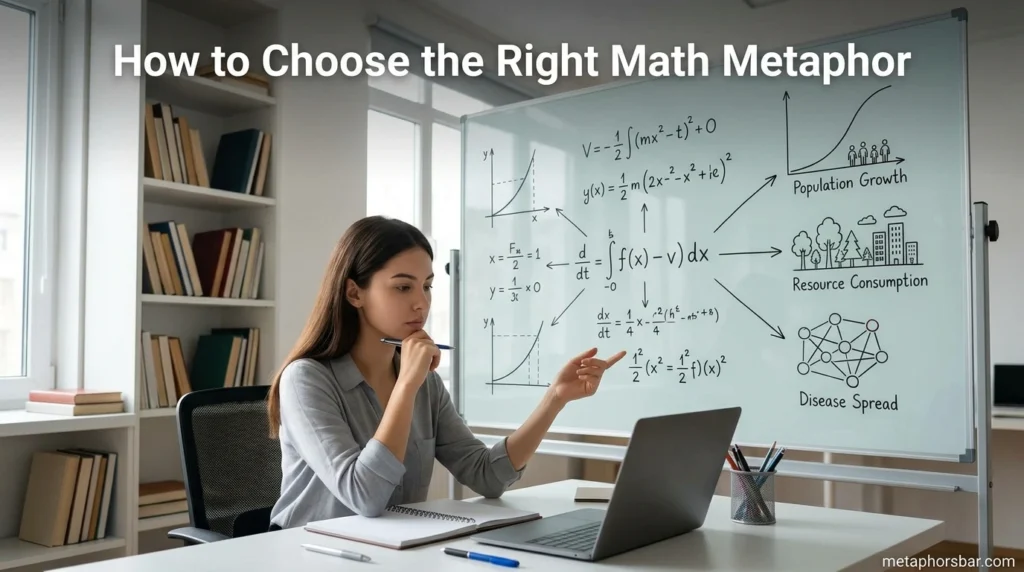
Use Math as a Language When You Want to Emphasize Communication
This is a great choice for discussing symbols, formulas, and the way math expresses ideas clearly and universally.
Use Math as a Puzzle When You Want to Emphasize Problem-Solving
Choose this metaphor when you want to highlight patience, curiosity, and the satisfaction of working through a challenge.
Use Math as a Bridge When You Want to Emphasize Connection and Application
This metaphor is ideal when explaining how math links learning to real-world life, future careers, or broader thinking.
The best metaphor depends on the feeling you want to create. Sometimes math is something to read. Sometimes it is something to solve, Sometimes it is something to cross.
Interactive Exercises to Practice Math Metaphors
Exercise 1: Finish the Sentence
Complete this prompt:
“Math is like ______ because ______.”
Try writing three versions: one that feels logical, one that feels playful, and one that feels inspiring.
Example: “Math is like a language because it helps us say things that words alone cannot.”
Exercise 2: Match the Mood
Think about how you feel about math right now. Is it confusing, exciting, challenging, or calming?
Now choose a metaphor that fits:
- a language
- a puzzle
- a bridge
- a staircase
- a map
Write one or two sentences explaining why that image fits your experience.
Exercise 3: Story Starter
Begin a paragraph with:
“Math felt like…”
Let the metaphor shape the mood. You can make it hopeful, frustrated, curious, or triumphant.
Exercise 4: Caption Practice
Try turning a math metaphor into a short social media caption or classroom line.
Examples:
- “Math is the language of patterns.”
- “Every problem is a puzzle waiting to be solved.”
- “Math builds the bridge from confusion to clarity.”
Bonus Tips for Using Metaphors for Math in Writing, Social Media, and Daily Life
In Writing
Use math metaphors in essays, speeches, lesson plans, and stories. They can make technical ideas feel more approachable and memorable.
In Social Media
Short metaphors can help math content feel less intimidating and more shareable. A line like “Math is a bridge, not a barrier” can resonate quickly.
In Teaching
Metaphors are especially powerful in the classroom. They help students understand not just what math is, but how to feel their way into it.
In Everyday Conversation
Metaphors can make it easier to talk about learning, problem-solving, and even frustration. They turn a dry subject into something relatable.
Keep the Imagery Fresh
Try to avoid stale phrases unless they truly fit. A strong metaphor feels specific, clear, and emotionally true.
FAQs
1. What is a metaphor for math?
A metaphor for math is a figurative comparison that describes math using another image, such as a language, puzzle, or bridge.
2. Why are metaphors for math useful?
They help make abstract concepts easier to understand, less intimidating, and more memorable.
3. Can math metaphors help students learn?
Yes. They can improve comprehension and reduce anxiety by making math feel more familiar and visual.
4. What is a simple metaphor for math?
A simple example is: Math is a language. It suggests communication, structure, and meaning.
5. How do I create my own math metaphor?
Think about how math feels or functions, then compare it to something with similar qualities, like solving, building, or connecting.
6. Are math metaphors only for teachers or students?
No. They can be used by writers, speakers, parents, creators, and anyone trying to explain mathematical ideas.
7. What makes a strong math metaphor?
A strong metaphor is clear, vivid, and relevant to the idea being described. It should help the reader see math in a new way.
Conclusion
Math may look cold on the surface, but underneath it is alive with pattern, logic, and beauty. It speaks in symbols. It invites us to solve, connect, and cross from what we know into what we do not yet understand.
That is why metaphors matter. Math as a language reminds us that it communicates. Math as a puzzle reminds us that it can be explored, Math as a bridge reminds us that it can carry us somewhere new.
So the next time you describe math, do not settle for plain explanation alone. Choose an image that gives it shape. Let your words make numbers feel less distant and more human. Because sometimes, understanding math begins with seeing it as something more than numbers: as a story, a structure, a crossing, a way forward.