

The first day of something new has a particular kind of air to it. It might be the smell of rain on dry ground, the quiet of a room before the furniture is moved in, or the nervous brightness of a morning when everything feels possible. New beginnings rarely arrive with fanfare. More often, they arrive as a small shift: a door opening, a page turning, a seed splitting under the soil. And yet, those small shifts can change the shape of a life.
That is why metaphors for new beginnings matter so much. New beginnings are difficult to pin down with plain language because they are not just events—they are thresholds. They are part hope, part uncertainty, part courage. Metaphors help us give that experience shape. They let us describe renewal in a way that feels vivid, emotional, and memorable.
Whether you are writing a poem, a speech, a journal entry, a story, or even a social media caption, the right metaphor can make a fresh start feel alive on the page.
Why Metaphors for New Beginnings Matter in Writing and Reflection
They make change feel hopeful
A new beginning can feel fragile, exciting, or intimidating. A metaphor helps turn that feeling into something readers can picture and trust.
They help describe transition
New beginnings are often not a single moment, but a bridge between what was and what will be. Metaphors make that in-between space easier to understand.
They make writing more memorable
A simple phrase like “I’m starting over” is clear, but a metaphor like “I am a seed waiting for spring” lingers. Images stay in the mind longer than plain statements.
Three Powerful Metaphors for New Beginnings
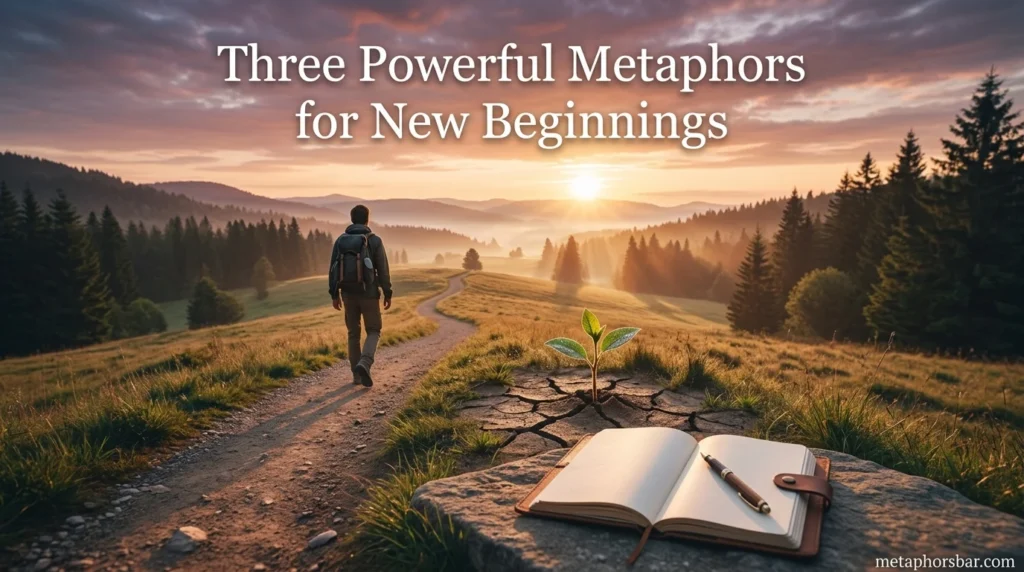
1. New Beginnings as Sunrise
Meaning and explanation
Sunrise is one of the most beloved metaphors for new beginnings because it represents light returning after darkness. It suggests hope, warmth, and the quiet certainty that a new day can begin even after a long night. This metaphor works beautifully when the fresh start feels gentle, gradual, and full of possibility.
Unlike a sudden flash, sunrise is a process. It does not rush. It spreads slowly across the sky, which makes it a wonderful image for beginnings that take time to unfold.
Example sentence or scenario
After months of uncertainty, her life felt like sunrise—soft at first, then brighter with each passing hour.
This metaphor is especially effective in writing about recovery, healing, new jobs, relationships, or any moment where hope begins to return.
Alternative ways to express it
- a new dawn
- the morning after a long night
- light breaking the horizon
- day returning
- the sky opening again
Sensory or emotional details
You can almost feel the cool air of early morning, see pale gold spreading across the sky, and hear the quiet stillness before the world fully wakes. Emotionally, this metaphor feels calming, reassuring, and full of promise. It suggests that even after darkness, light arrives on time.
Mini storytelling touch
A man once left a job that had drained him for years. On his first free morning, he watched the sunrise from his kitchen window and felt something shift. “It wasn’t instant happiness,” he said later. “It was more like the world saying, ‘You may begin again now.’” That is the power of this metaphor—it captures not just hope, but permission.
Literary or cultural reference
Sunrise appears across cultures as a symbol of renewal, awakening, and divine mercy. In literature and poetry, dawn often signals the arrival of a new chapter.
2. New Beginnings as a Seed Sprouting
Meaning and explanation
A seed looks small, quiet, and almost invisible, yet it carries the promise of a plant, a flower, or a tree. As a metaphor, a seed sprouting suggests potential, patience, and the hidden work of growth. It is a powerful image for beginnings that are not yet fully visible but are already alive beneath the surface.
This metaphor works especially well when a new beginning is still fragile—when someone has just started a new path, new habit, or new life stage.
Example sentence or scenario
Her new beginning was like a seed sprouting beneath the soil, invisible to most but already pushing toward the light.
This metaphor is ideal for writing about personal growth, healing after grief, starting a new chapter, or building something slowly and carefully.
Alternative ways to express it
- a bud of possibility
- roots beginning to form
- a green shoot of hope
- life under the soil
- a hidden beginning
Sensory or emotional details
Imagine dark earth, gentle rain, the first tender green tip breaking through the ground, and the soft smell of soil after rain. Emotionally, this metaphor feels patient, tender, and resilient. It reminds us that beginnings are not always loud—they often begin underground.
Mini storytelling touch
A woman who had spent years believing she had missed her chance to change careers finally enrolled in a night course. At first, no one around her noticed anything different. But she described the experience as “feeling a root wake up.” Months later, that small decision had grown into a new life. That is what makes the seed metaphor so powerful—it honors growth before it becomes visible.
Real-life example
Many people experience new beginnings this way: quietly, gradually, and without applause. The seed metaphor reminds us that a fresh start does not need to be dramatic to be real.
3. New Beginnings as an Open Door
Meaning and explanation
An open door suggests opportunity, invitation, and movement from one space into another. As a metaphor for new beginnings, it represents choice, transition, and the chance to step forward. Unlike sunrise, which feels natural and gradual, or the seed, which feels hidden and slow, the open door is immediate and active. It says: there is a way through, and it is ready now.
This metaphor is especially useful when a person is about to make a decision, enter a new stage of life, or leave something behind.
Example sentence or scenario
When she received the offer letter, it felt like an open door had appeared in front of her, leading to a life she had only imagined before.
This metaphor works beautifully in writing about careers, relocation, recovery, education, and life transitions.
Alternative ways to express it
- a doorway to possibility
- a threshold of change
- a path waiting to be entered
- a passage into something new
- a gate opened wide
Sensory or emotional details
You can imagine the light falling through a doorway, the feeling of standing at a threshold, and the small breath before stepping forward. Emotionally, this metaphor feels hopeful, active, and slightly brave. It suggests not only possibility but the courage to walk toward it.
Mini storytelling touch
A teenager once described moving to a new city as “standing in front of a door with my name on it.” She said she was terrified and excited at once. That image is so effective because it captures the strange mix of fear and possibility that often comes with new beginnings.
Literary or cultural reference
Doors and thresholds have long symbolized change in literature and folklore. An open door suggests that the next chapter is not just possible—it is available.
How to Choose the Right Metaphor for New Beginnings
Use sunrise when the beginning feels hopeful and gradual
Choose this metaphor when you want to emphasize light returning, emotional healing, or a gentle unfolding.
Use a sprouting seed when the beginning feels hidden and full of potential
This image is best when the fresh start is still small, vulnerable, or developing beneath the surface.
Use an open door when the beginning feels like a choice or opportunity
Choose this metaphor when the new start is active, visible, and asking for a step forward.
The best metaphor depends on the kind of beginning you want to describe. New beginnings can glow, grow, or invite—and sometimes they do all three.
Interactive Exercises for Practicing Metaphors for New Beginnings
Exercise 1: Complete the sentence
Finish this prompt in three different ways:
“My new beginning felt like ______ because ______.”
Try one answer that feels peaceful, one that feels fragile, and one that feels brave.
Example: My new beginning felt like sunrise because it started quietly and made the world feel lighter by degrees.
Exercise 2: Sensory mapping
Think of a time when something new began in your life. Write down:
- one sound
- one color
- one smell
- one texture
- one emotion
Then turn those details into a metaphor.
For example: The beginning sounded like birds waking up, looked like pale gold, smelled like rain on soil, felt like a seedling reaching upward, and carried the emotion of nervous hope.
Exercise 3: Story starter
Begin a paragraph with:
“The new beginning was like…”
Let the image guide the tone. Make it reflective, hopeful, dramatic, or simple.
Exercise 4: Caption or journal prompt
Try turning a new beginnings metaphor into a short line:
- “Every sunrise is a second chance.”
- “Some beginnings grow quietly under the soil.”
- “An open door is still an invitation.”
Bonus tips for using metaphors for new beginnings in writing, social media, and daily life
In writing
Use new beginnings metaphors in stories, poems, essays, memoirs, and speeches to create emotional depth and a sense of movement.
On social media
A short metaphor can turn a fresh-start caption into something more memorable. “Feeling like a seed in spring” or “Walking through an open door” sounds more vivid than “starting over.”
In journaling
If you are processing change, metaphor can help you understand the shape of your beginning. Is it sunrise, a sprout, or a doorway?
In everyday conversation
Metaphors can make a new chapter in life sound more human and hopeful. Instead of saying “I’m starting over,” you might say, “It feels like a dawn I’ve been waiting for.”
Keep the image true to the moment
The strongest metaphor is the one that truly fits the beginning you are describing. Some starts are slow and quiet. Some are immediate and bold. Let the image match the truth.
FAQs
1. What is a metaphor for new beginnings?
A metaphor for new beginnings is a figurative comparison that describes a fresh start using another image, such as sunrise, a seed, or an open door.
2. Why are metaphors for new beginnings useful?
They help make hope, transition, and renewal feel more vivid, emotional, and memorable.
3. What is a simple metaphor for new beginnings?
A simple example is: A new beginning is sunrise. It suggests light returning after darkness.
4. Can new beginnings metaphors be used in poetry?
Yes. They are especially effective in poetry because they naturally carry symbolism, beauty, and emotional depth.
5. How do I create my own metaphor for a new beginning?
Think about what the fresh start feels like—small, bright, hidden, brave—and compare it to something with similar qualities.
6. Are these metaphors only for personal growth writing?
No. They can also be used in fiction, speeches, captions, journaling, and reflective essays.
7. What makes a strong metaphor for new beginnings?
A strong metaphor is vivid, emotionally truthful, and easy to picture. It should help the reader feel the beginning, not just understand it.
Conclusion
New beginnings are some of the most hopeful moments in life, even when they arrive with uncertainty. They can shine like sunrise, hide like a seed, or open like a door. That is why metaphors matter—they help us describe not just the fact of starting again, but the feeling of becoming.
The sunrise reminds us that light returns. The sprouting seed reminds us that growth begins beneath the surface. The open door reminds us that opportunity often waits for our next step. Together, these images make fresh starts feel more human, more beautiful, and more real.
So when you write about new beginnings, do not settle for plain language alone. Let the beginning glow, grow, or invite through your words. A good metaphor can make a fresh start feel unforgettable.