
There are nights when the moon does not merely hang in the sky—it seems to listen. It spills silver over rooftops, brushes the sea with pale fire, and turns familiar streets into something softer, stranger, almost sacred. A child may look up and call it a lamp. A poet may call it a witness. A lonely traveler may call it a friend.
The moon has always invited metaphor because it is both close and unreachable, comforting and mysterious. It changes shape, yet remains itself. It reflects light, yet feels luminous, It watches over us without a voice. That is why metaphors for the moon are so powerful: they help us describe beauty, distance, calm, longing, romance, and change in language that feels alive.
In writing, conversation, poetry, captions, and storytelling, moon metaphors can add depth and atmosphere. They can make a scene shimmer. They can turn a simple night sky into an emotional landscape.
Why Metaphors for the Moon Matter in Writing and Expression
The moon is one of the most enduring symbols in human language. Across cultures and centuries, it has stood for guidance, femininity, cycles, memory, dreams, and quiet light in dark places. Because it holds so many meanings, it is a rich source of figurative language.
Using metaphors for the moon can help you:
- create vivid imagery in poems, stories, and essays
- express emotions like longing, peace, mystery, or change
- make your language feel more lyrical and memorable
- connect ordinary scenes with something timeless and universal
A plain sentence says, “The moon was bright.” A metaphor says, “The moon was a silver lantern hanging over the sleeping world.” One informs. The other enchants.
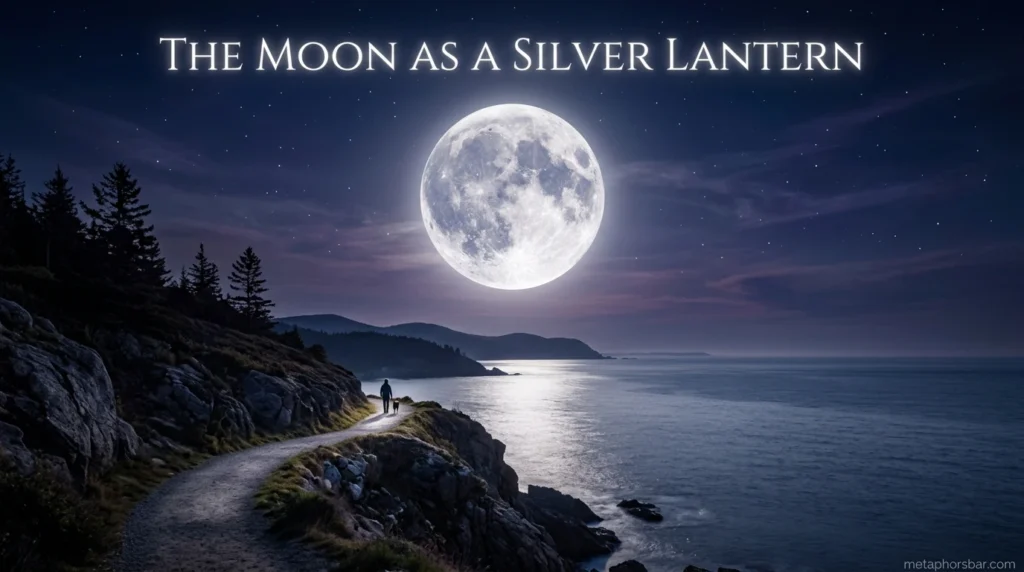
The Moon as a Silver Lantern
Meaning and Explanation
This metaphor presents the moon as a light source guiding the night. A lantern is small, steady, and comforting. It doesn’t banish the darkness completely, but it makes the dark livable, visible, and less lonely.
This is a beautiful metaphor when you want to show the moon as a quiet protector or a source of gentle light. It feels intimate rather than grand.
Example Sentence or Scenario
The moon hung above the trees like a silver lantern, lighting the path home with a calm, patient glow.
You might use this in a story where a character walks alone at night, finds comfort in the sky, or feels steadier under moonlight. It works well for scenes of safety, reflection, or peaceful solitude.
Alternative Ways to Express It
- the moon as a night lamp
- the moon as a glowing lantern in the dark
- the moon as a soft lighthouse in the sky
- the moon as a pearl of light
Sensory or Emotional Details
This metaphor brings in cool light, quiet streets, soft shadows, and the feeling of being gently guided. Emotionally, it suggests reassurance, softness, and trust. The moon does not command the darkness; it simply makes it easier to move through.
Mini Storytelling Touch
An old grandmother once told her grandson that the moon was “God’s lantern,” hung high so travelers would not lose their way. He remembered that every time he walked home late. Years later, when he lived in another city and felt adrift, he looked up at the same moon and felt, for a moment, that he was not lost after all.
Literary or Cultural Reference
Moonlight often appears in folklore as a guiding force. From village paths to ancient myths, the moon has been imagined as a companion for wanderers, lovers, and dreamers. Its lantern-like quality makes it a natural symbol of quiet guidance.
The Moon as a Floating Mirror
Meaning and Explanation
This metaphor emphasizes reflection. The moon does not create its own light; it reflects the sun’s glow. Calling it a floating mirror captures both its beauty and its symbolic meaning: reflection, memory, and borrowed brilliance.
This metaphor works especially well when describing self-awareness, emotional depth, or the idea that something can shine by reflecting another source.
Example Sentence or Scenario
The moon was a floating mirror, catching the sun’s fire and turning it into something softer for the night.
You could use this in reflective writing, romantic scenes, or philosophical passages. It suggests that beauty does not always come from self-generation; sometimes it comes from transformation.
Alternative Ways to Express It
- the moon as a mirror in the sky
- the moon as a silver reflection
- the moon as a polished shield
- the moon as a disc of borrowed light
Sensory or Emotional Details
This image feels smooth, cool, and luminous. It suggests stillness and quiet intelligence. Emotionally, it can carry themes of identity, reflection, and gentle distance. The moon mirrors, but it never repeats exactly—it changes the light into something its own.
Mini Storytelling Touch
A young artist once struggled to find her “own style.” She admired others so much that her work felt borrowed and unfinished. One evening, watching the full moon rise over her window, she realized something: the moon did not have to be the sun to shine. It had its own way of receiving and reshaping light. That thought changed the way she created forever.
Cultural Reference
The moon has long been linked to reflection in poetry and philosophy. In many traditions, it symbolizes inward looking, memory, and the soft truth that we often see ourselves most clearly in borrowed light.
The Moon as a Silent Witness
Meaning and Explanation
This metaphor gives the moon an observing role. A witness sees, remembers, and remains. The moon has watched over countless nights, stories, heartbreaks, reunions, and secrets. Calling it a silent witness gives it emotional gravity and a sense of ancient presence.
This works especially well in writing about history, memory, love, grief, or endurance. It gives the moon a feeling of timeless awareness.
Example Sentence or Scenario
The moon was a silent witness to their promises, their silences, and the years that followed.
This could describe a marriage, a friendship, a farewell, or even a place where many things happened and nothing at all was said. The moon becomes the keeper of unspoken stories.
Alternative Ways to Express It
- the moon as an old observer
- the moon as a watcher in the sky
- the moon as a keeper of nights
- the moon as a patient witness
Sensory or Emotional Details
This metaphor brings in stillness, distance, and the pale gaze of moonlight. It can feel solemn, tender, or haunting depending on the scene. Emotionally, it suggests memory, endurance, and the quiet accumulation of time.
Mini Storytelling Touch
In a village near the sea, people used to say the moon had seen everything: births, farewells, storms, weddings, wars. An old fisherman believed it. When he was a boy, he watched his mother wait for his father’s boat under the moon. When he was a man, he stood in that same place and told his own children stories under the same watchful light. The moon had become part of the family history—silent, unwavering, and kind.
Literary Reference
This image appears often in literature because the moon naturally feels like an observer. It is present in the background of human life, shining over private moments that might otherwise be forgotten.
How to Choose the Right Moon Metaphor
Different moon metaphors create different moods.
Use a silver lantern when you want the moon to feel comforting, guiding, and softly luminous. Use a floating mirror when you want to emphasize reflection, transformation, or borrowed light, Use a silent witness when you want the moon to feel ancient, watchful, and emotionally deep.
The right metaphor depends on the feeling you want to create. The moon can be tender, reflective, romantic, lonely, or wise—and your language can follow that tone.
Interactive Exercises: Practice Creating Your Own Moon Metaphors
Exercise 1: Moon Mood Match
Choose one feeling: peace, longing, mystery, hope, loneliness, romance.
Complete this sentence:
“The moon feels like ______ because ______.”
Example: “The moon feels like a secret because it appears quietly and changes everything without speaking.”
Exercise 2: Sensory Writing
Look at the moon, if it is visible, or imagine it clearly. Write down:
- one color
- one sound
- one texture
- one emotion
- one movement
Then turn those details into a metaphor.
Example: The moon was the color of old silver, the texture of cool glass, the movement of a slow breath, and the emotion of something remembered.
Exercise 3: Story Starter
Begin a short paragraph with:
“The moon was like…”
Let the metaphor guide the mood. You can make it dreamy, eerie, romantic, or peaceful.
Exercise 4: Caption Practice
Try turning a moon metaphor into a short social media caption or quote.
Examples:
- “The moon is a lantern for the sleepless.”
- “Some nights, the moon feels like a mirror for the heart.”
- “The moon has seen all my quiet endings.”
Bonus Tips for Using Moon Metaphors in Writing, Social Media, and Daily Life
In writing
Moon metaphors are especially useful in poetry, fiction, journaling, and reflective essays. They can help create atmosphere quickly and elegantly.
On social media
A moon metaphor can turn a simple night photo into a memorable caption. It works beautifully for full moon shots, silhouettes, ocean scenes, or late-night reflections.
In daily conversation
Metaphors can make your speech more vivid without sounding overly formal. Saying “I feel like the moon tonight” can suggest calm, distance, or quiet thought, depending on the context.
In journaling
If you are processing emotions, the moon can be a gentle symbol. Writing about your feelings as moonlight, phases, or reflections can make them easier to understand.
Use restraint
A single strong moon metaphor often shines more brightly than several competing images. Let it hold the scene.
FAQs
1. What is a metaphor for the moon?
A metaphor for the moon is a figurative comparison that describes the moon by relating it to something else, like a lantern, mirror, or witness.
2. Why are moon metaphors so popular?
Because the moon is rich in symbolism. It represents light, mystery, change, and emotional depth in a way that feels universal.
3. Can moon metaphors be romantic?
Yes. The moon is often used in romantic writing to suggest tenderness, longing, and quiet beauty.
4. What is a simple metaphor for the moon?
A simple example is: The moon is a silver lantern. It is easy to imagine and emotionally warm.
5. How do I make my own moon metaphor?
Think about how the moon makes you feel, then compare it to something with a similar mood, shape, or effect.
6. Are moon metaphors only for poetry?
No. They work in fiction, essays, captions, journaling, speeches, and everyday expression.
7. What makes a strong moon metaphor?
A strong metaphor is clear, evocative, and emotionally fitting. It should help the reader see the moon in a fresh and memorable way.
Conclusion
The moon has been above us for as long as stories have been told, and still it feels new every time we look up. It can guide, reflect, and witness. It can calm a restless mind or deepen a lonely night, It can be a lantern, a mirror, a guardian, a memory.
That is the gift of metaphor: it lets the moon become more than an object in the sky. It lets it become a feeling, a symbol, a voice in the dark.