
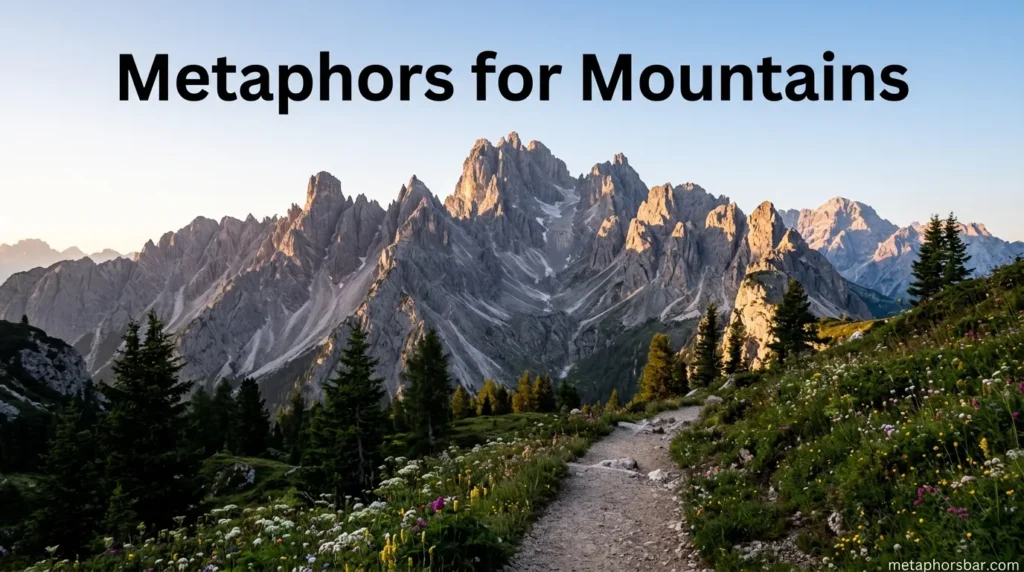
The air grew thinner long before the summit came into view.
Each step on the rocky path echoed with effort, as if the mountain itself was listening—patient, unmoved, ancient. Clouds drifted low, brushing the peaks like passing thoughts. Far below, the world felt smaller, quieter, almost irrelevant. Up here, silence wasn’t empty. It was heavy, meaningful, and alive.
Mountains do not simply exist.
They dominate landscapes, shape weather, guard horizons, and challenge anyone who dares approach them. They are symbols of endurance, resilience, isolation, and awe. Because of this emotional and visual weight, writers often turn to metaphors for mountains to capture their grandeur in language.
A mountain might become a sleeping giant. It might become a stone cathedral. It might become a wall between earth and sky. Through metaphor, mountains transform from geological formations into emotional experiences.
Whether you are writing poetry, travel essays, fiction, or reflective content, metaphors for mountains help you express strength, struggle, and beauty in vivid and unforgettable ways.
Metaphors for Mountains: Why Mountain Imagery Matters in Writing
The emotional meaning behind mountains
Mountains carry deep symbolic weight. They often represent:
- strength and resilience
- challenges and struggle
- isolation and solitude
- achievement and triumph
- permanence and stability
- spiritual elevation and perspective
Metaphors help translate these meanings into sensory experience.
Why readers connect with mountain imagery
Even people who have never climbed a mountain understand its symbolism:
- difficulty and effort
- reaching goals
- standing tall through hardship
- feeling small in nature’s presence
Compare:
- “The mountain was high.”
- “The mountain stood like an ancient guardian watching over the valley.”
The second version adds emotion, personality, and depth.
Powerful Metaphors for Mountains With Meanings and Examples
1. Mountains are sleeping giants
Meaning and explanation
This metaphor emphasizes power, stillness, and ancient presence. Mountains feel alive in their silence—immovable yet full of hidden force. Comparing them to giants suggests both strength and mystery.
It works well for landscapes that feel dominant or emotionally overwhelming.
Example sentence or scenario
“The mountain range stretched across the horizon like sleeping giants resting beneath the clouds.”
Alternative ways to express it
- giants of stone and silence
- ancient beings resting in stillness
- the earth’s sleeping guardians
- colossal shapes frozen in time
Optional sensory or emotional details
Imagine:
- deep silence
- slow-moving clouds like breath
- cold wind across stone
- a sense of awe and humility
Mini storytelling touch
Many hikers describe mountain ranges as if they are watching them. The feeling of being small beneath something so vast often creates a sense of respect, as though the earth itself is alive and aware.
2. Mountains are stone cathedrals
Meaning and explanation
This metaphor highlights majesty, spirituality, and sacredness. Cathedrals are grand, echoing, and awe-inspiring—just like towering peaks and rugged cliffs.
It is ideal for describing mountain valleys, echoing winds, or sunlit peaks.
Example sentence or scenario
“As the sun rose, the mountains became stone cathedrals filled with golden light and quiet reverence.”
Alternative ways to express it
- temples carved by time
- nature’s grand halls of stone
- sacred peaks reaching skyward
- the earth’s silent places of worship
Optional sensory or emotional details
Think of:
- sunlight pouring over ridges like stained glass
- echoes of wind in valleys
- cool stone underfoot
- deep, reverent silence
Literary or cultural reference
Many cultures see mountains as sacred spaces—places where gods reside or where humans come closer to the divine. This metaphor reflects that timeless spiritual connection.
3. Mountains are walls between earth and sky
Meaning and explanation
This metaphor emphasizes separation, height, and boundary. Mountains often feel like barriers dividing worlds—grounded human life below and infinite sky above.
It is especially effective for dramatic landscapes or emotional symbolism.
Example sentence or scenario
“The mountain rose like a wall between earth and sky, dividing the known from the unreachable.”
Alternative ways to express it
- stone barrier reaching the heavens
- earth touching the sky through stone
- a boundary carved by time
- towering divide of rock and cloud
Optional sensory or emotional details
Readers may imagine:
- steep cliffs disappearing into clouds
- cold winds at high altitude
- dizzying heights
- vast open skies above
Real-life example
Travelers often describe mountain passes as transitions between worlds. Driving or hiking through them feels like crossing a threshold between different emotional and physical realities.
Creative Ways to Use Metaphors for Mountains in Writing
In poetry and lyrical writing
Mountain metaphors create emotional depth and grandeur.
Examples:
- “The peaks held the sky like forgotten promises.”
- “Snow crowned the mountains like time’s final blessing.”
- “The valley whispered beneath stone giants.”
These lines create scale and emotion simultaneously.
In storytelling and fiction
Writers use mountain imagery to symbolize challenge and transformation.
Examples:
- “He climbed the mountain like he was climbing his own doubt.”
- “The village slept beneath a wall of ancient stone.”
- “Her journey felt as steep as the cliffs above her.”
These metaphors make emotional journeys visible.
In travel writing and reflective essays
Mountain metaphors enhance sensory experience and awe.
Examples:
- “The Himalayas felt like the spine of the earth.”
- “Mist rolled through the peaks like slow breath.”
- “Every step echoed against eternity.”
These descriptions bring landscapes to life emotionally.
Interactive Exercises for Practicing Mountain Metaphors
Exercise 1: Compare mountains to something symbolic
Choose one:
Now create a metaphor.
Example: “The mountains stood like the earth’s forgotten memory rising into the sky.”
Exercise 2: Rewrite simple descriptions
Take plain sentences:
- “The mountain was tall.”
- “The view was beautiful.”
- “The climb was difficult.”
Rewrite them:
- “The mountain reached upward like a prayer carved in stone.”
- “The view unfolded like a sacred painting.”
- “The climb pressed against every breath like a test of will.”
Exercise 3: Describe a mountain experience
Think about:
- hiking
- driving through hills
- seeing a mountain in the distance
- photographs or memories
Now describe it metaphorically.
Example: “The mountain didn’t feel like scenery—it felt like silence made solid.”
Bonus Tips for Using Mountain Metaphors Effectively
Match metaphor to emotional tone
Different mountain metaphors carry different meanings:
- giant → power and awe
- cathedral → spirituality
- wall → separation or challenge
- spine → structure or strength
- guardian → protection
Choose carefully based on mood.
Use scale and contrast
Mountains feel powerful because of contrast:
- small human vs vast peak
- silence vs echo
- earth vs sky
Highlighting contrast strengthens imagery.
Include physical sensations
Make metaphors feel real with:
- thin air
- cold wind
- echoing footsteps
- vast silence
- changing light
Avoid overloading imagery
Keep metaphors clean and focused.
Instead of: “The mountain was a giant cathedral wall guardian.”
Try: “The mountain stood like a cathedral carved from stone and silence.”
More Metaphors for Mountains You Can Use
Mountains are frozen waves of earth
Perfect for describing ridges and ranges.
Mountains are the earth’s backbone
Ideal for strength and structure.
Mountains are ancient sentinels
Great for watchful, protective imagery.
Mountains are slow-moving shadows of time
Beautiful for timelessness and history.
Mountains are stairways to the sky
Excellent for ascent and aspiration.
FAQs About Metaphors for Mountains
1. What is a metaphor for mountains?
A metaphor for mountains is a symbolic comparison used to describe their strength, size, or emotional meaning in creative language.
2. Why are mountain metaphors important?
They help express awe, challenge, and emotional depth in landscapes and human experiences.
3. What are common metaphors for mountains?
Examples include:
- mountains as giants
- mountains as cathedrals
- mountains as walls
- mountains as guardians
4. Can mountain metaphors describe emotions?
Yes. They are often used to represent strength, struggle, and resilience.
5. Are mountain metaphors used in poetry?
Very often. Mountains are powerful symbols in poetic and spiritual writing.
6. How do I create original mountain metaphors?
Think about how mountains feel emotionally—then compare them to human ideas like memory, strength, silence, or time.
7. Can mountain metaphors be used in storytelling?
Absolutely. They are widely used to symbolize journeys, challenges, and transformation.
Conclusion
Mountains are more than stone and elevation. They are silence made visible, strength made solid, and time written into the earth. They stand like sleeping giants, rise like stone cathedrals, and divide earth from sky like ancient walls of nature itself.
That is why metaphors for mountains are so powerful. They allow language to rise beyond description into experience—turning landscapes into emotion, and elevation into meaning.
Whether you are writing poetry, fiction, travel reflections, or personal narratives, mountain metaphors help you capture awe, struggle, and perspective in unforgettable ways. Because in the end, mountains are not just things we look at—they are things we feel, long before we ever reach the top.